FlowHMR: Physically Plausible Motion Capture from Video
FlowHMR is a method for recovering global human motion, including body pose, hands, and trajectory, from monocular videos by integrating physics-based feedback during training.

Original paper: FlowHMR: Physically Plausible Motion Capture from Video
Highlights and Results
FlowHMR recovers global human motion from a monocular video, jointly representing body pose, hands and trajectory. Its central contribution is a video-conditioned generator whose training incorporates feedback from a physics controller. The goal is to recover the observed performance while reducing motions that look plausible but cannot be tracked in simulation. Source
On 4,182 Wild-4K clips, the authors report 82.47% PHC+ tracking success, compared with 62.82% for GVHMR and 78.79% for FlowHMR before reinforcement learning. This is a particular simulation protocol, not a guarantee of correct motion on every video; GVHMR still has lower foot-skating error in that comparison. Source
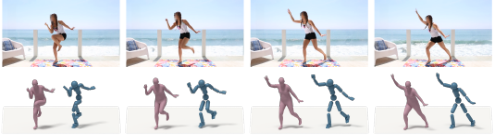 Official example: input video above, recovered motion and simulation tracking below. Source: FlowHMR authors.
How It Works
Video preprocessing detects and tracks people, estimates camera motion and extracts person-centric visual features. The current official CLI offers YOLO26m or YOLOX detection and several camera backends; defaults now differ from the original paper setup. SAM 3D Body features and camera rotations condition a 0.46B multimodal diffusion transformer. Current inference Paper
Each frame is represented by root movement, joint positions, 6D rotations, shape and foot contacts. The base configuration uses a 491-dimensional motion vector. Separate motion and visual streams feed dual-stream and then shared-stream blocks, with local temporal attention. During flow-matching pretraining, noisy motion is mapped toward clean motion; geometric forward-kinematics losses also supervise global joint configuration. Configuration Transformer Training
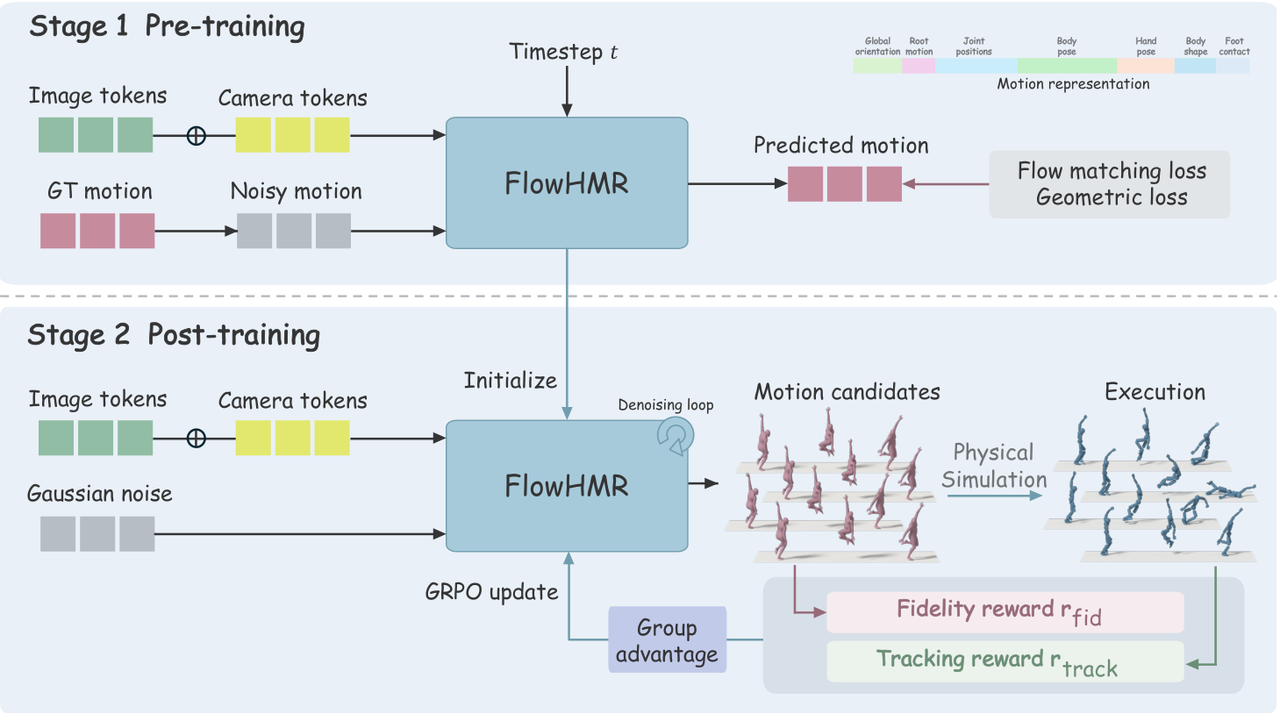 Official training architecture: flow-matching pretraining followed by reward-guided physical post-training. Source: FlowHMR authors.
Post-training samples groups of candidate motions. A frozen PHC+ controller attempts to track each candidate in simulation; a separate fidelity reward measures agreement with the reference motion. GRPO updates the generator using both signals. Tracking reward alone can encourage an easy but incorrect action, so fidelity is essential. Inference uses 20 Euler steps in the paper, without running simulation-based selection or correction. Source
The official pipeline decodes root velocity, joint rotations and sequence-level shape into SMPL-H motion, saving NPZ and optionally FBX. The independently maintained FlowHMR-Windows project adds a desktop workflow, character retargeting and several export formats. Its experimental multishot and camera features must be distinguished from the paper’s core model: camera data explicitly records that physical calibration is not guaranteed. Source Windows exports Camera representation
Applications and Author-Stated Future Work
The method is relevant to animation reference recovery and motion data for humanoid research. Its physical evaluation currently uses a ground plane, while repeated simulation rollouts make training expensive. The authors propose reconstructing interacting objects and support surfaces, modeling their contacts, and improving rollout efficiency for larger datasets and longer sequences. Source
FAQ
How does FlowHMR compare with V2Fun’s animation workflow?
FlowHMR provides a local research model and motion outputs. V2Fun’s motion API offers video-based capture, while its animation Skill assembles capture or existing BVH, rigged characters, retargeting and a viewer. The distinction is model-level research versus an application workflow. [V2Fun API](https://doc.v2fun.ai/api/core_functions/motion-detection) [V2Fun Skill](https://github.com/V2Fun-Research/v2fun-animation)
Could FlowHMR motion enter a V2Fun-based character workflow?
As a proposed file-based workflow, its motion could be converted and retargeted to a compatible BVH skeleton, then used with the Skill’s existing-motion path and an already rigged GLB or FBX character. NPZ is not a drop-in BVH replacement; frame rate, axes, scale and joint mapping require verification. [Source](https://github.com/flowhmr/flowhmr/blob/86e56eef51647adfed09bdc5e455047b48be1560/docs/inference.md) [Skill inputs](https://github.com/V2Fun-Research/v2fun-animation)
Does the Windows video prove arbitrary camera cuts are solved?
No. The fork exposes multishot and camera extensions, but their experimental status and camera-validity masks matter. Successful examples do not establish universal identity continuity or accurate camera calibration across edited footage. [Source](https://github.com/xiaoerofficial021-collab/FlowHMR-Windows) [Camera constraints](https://github.com/xiaoerofficial021-collab/FlowHMR-Windows/blob/3fdc80c9277ed30cb7334bc77d7ae25e3d6dc17f/flowhmr/multishot/camera.py)