MotionBricks: Scalable Real-Time Motions with Modular Latent Generative Model and Smart Primitives
MotionBricks is a scalable system for generating real-time character motions using modular latent generative models and smart primitives, enabling diverse actions like walking, vaulting, or sitting without retraining.

Original paper: MotionBricks: Scalable Real-Time Motions with Modular Latent Generative Model and Smart Primitives
Highlights and Results
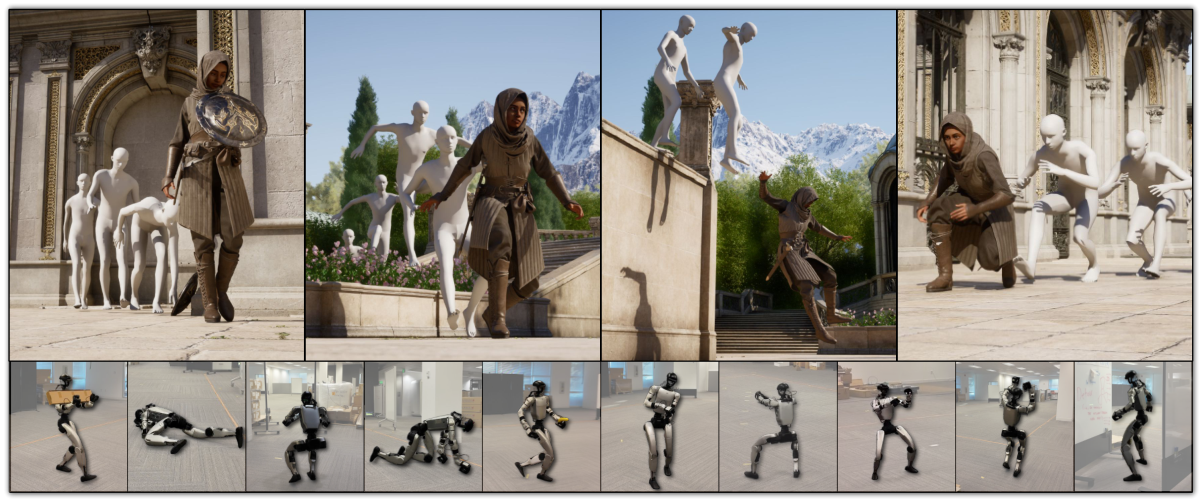
MotionBricks generates character movement between recent poses and desired future poses. Smart Primitives turn locomotion commands and object interactions into these constraints, allowing one learned backbone to support walking, vaulting or sitting without retraining for each authored interaction. The paper demonstrates both Unreal Engine characters and a Unitree G1 robot. Source
The authors report 2 ms inference latency and 15,000 generated frames per second on an RTX 5090, with 99.6% target-root reaching success on their 350k dataset evaluation. Throughput counts generated motion frames, not rendered game frames. These are reported model results, not measurements of the released application on our hardware. Source
How It Works
At runtime, a primitive produces target poses from player input or an object’s interaction setup. The root module predicts the transition duration and a preliminary root trajectory. The pose module predicts discrete motion tokens; a conditional decoder reconstructs continuous poses and refines root movement. Planning repeats as commands change or the playback buffer runs low. Source
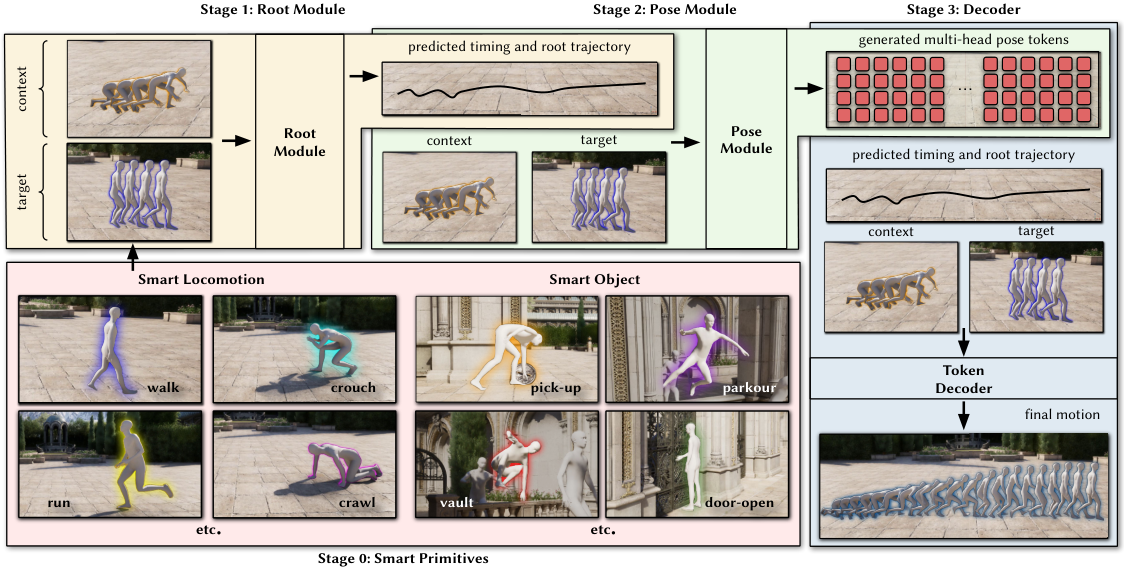
The latent representation separates pose from root motion. A temporal encoder compresses four motion frames per token position; multiple learned codebooks quantize different feature partitions rather than manually assigning a codebook to each limb. The pose transformer learns masked-token prediction. During decoding, root trajectories and sparse pose constraints enter through conditioning paths, allowing the same pose tokens to adapt to a modified trajectory. Source
The released runtime makes that contract concrete: generate_animation() requires four context poses, one to four target poses and a 30 Hz output buffer with foot-contact storage. SOMA and G1 have different pose layouts and coordinate conventions. The application records the poses actually played, then uses the latest four as the next context. This avoids chaining from an imagined endpoint that the character never reached. Buffer checks Runtime API
ONNX models are compiled into cached TensorRT plans. The engine aligns inputs, encodes conditions, runs inference, decodes output and optionally corrects endpoints; CUDA buffers and graphs are reused across calls. The repository provides inspection and scene-preview applications, while custom characters still require compatible skeleton mapping or retargeting. Engine Integration
Applications, Availability and Future Work
The framework is relevant to interactive animation and kinematic motion planning. It does not itself guarantee physical feasibility: the robot demonstrations use a tracking controller. The authors identify rare-motion coverage, visual planning from noisy observations, physical awareness and retargeting as unresolved directions. Source
Code, model files and demos are available, but their licenses differ: code is Apache-2.0, models use NVIDIA’s Open Model agreement, and bundled example motions have separate evaluation restrictions. Deployment should follow the appropriate component terms. Source
FAQ
How does MotionBricks differ from V2Fun video animation?
V2Fun’s animation Skill captures or loads motion and retargets it to an already rigged character. MotionBricks instead synthesizes transitions toward pose goals during interaction. The former helps obtain and preview a performance; the latter controls what happens next. Neither comparison establishes a quality ranking. V2Fun Skill MotionBricks API
Could V2Fun-captured motion supply style poses?
That is a plausible editorial workflow, not an existing verified integration. A captured clip would need retargeting to MotionBricks’ supported skeleton, correct units and coordinates, and 30 Hz sampling before selected poses become constraints. A textured GLB alone does not contain those motion inputs. Source V2Fun inputs
Does a Smart Object automatically understand arbitrary scene geometry?
No. The interaction needs authored poses and bindings such as pivots, triggers or sockets. The paper explicitly identifies visual planning without privileged object information as future work. Source