DSH Game Studio: From a Prompt to a Playable Mini Game
DSH Game Studio enables coding agents to create playable mini games from prompts, offering tools like templates, artwork slots, and automated playtests. It supports exporting games as offline HTML files or WeChat Mini Game projects.

Highlights and Results
DSH Game Studio gives a coding agent a small game workshop: templates, artwork slots, builds, previews and automated playtests. A prompt can become an editable Canvas 2D or Three.js 3D game, then an offline HTML file or a WeChat Mini Game project. The current rc.6 source includes the WeChat exporter; older indexed descriptions mainly cover HTML. Source
The author reports 10/10 first-attempt successes for a small collect-and-dodge test set, with a median of 14 minutes. These are author-run prototype trials, not a guarantee for arbitrary genres or commercial release. Its distinctive contribution is the edit–build–observe loop around a general coding model. Source
How It Works
A project begins from a working template. The agent edits game.js for behavior and game.json for rules, runtime dependencies and named artwork slots. Art generation produces candidate images; selected assets enter a ledger. This keeps gameplay code, asset choices and subsequent revisions inspectable. The workshop is available through DSH or a standalone MCP server. Source
The HTML builder bundles the JavaScript, required Three.js runtime and image data into a self-contained file. Build hashes and snapshots connect an artifact to its code, rules and artwork. The resulting offline page has a restrictive network policy; external services are not automatically part of the game. Source
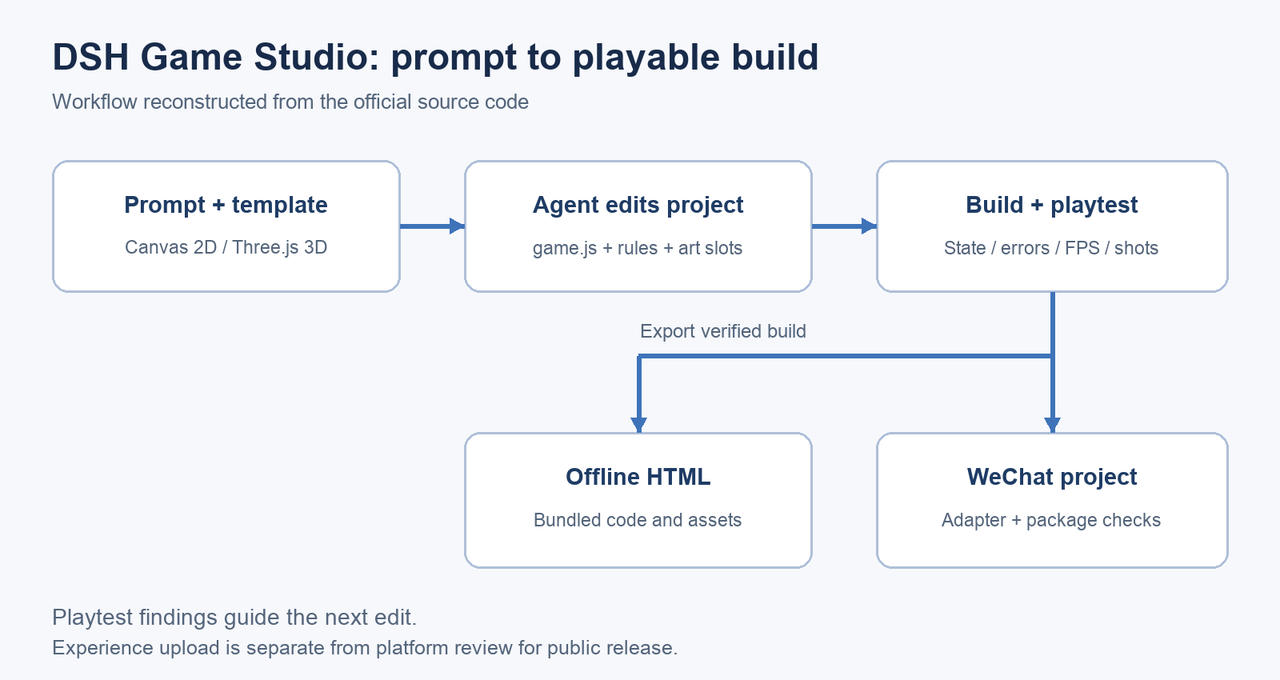
Testing happens in a real browser. The harness reads window.__gameState(), records phase changes, scores, errors, screenshots and FPS, and can call a game-defined __autoplay(state). Its fallback steers toward collectibles. The agent uses those observations to revise the project. A successful automated round therefore checks a particular behavior path, rather than proving that all mechanics are correct. Source
WeChat export repackages the project with a platform adapter and local assets, rasterizes SVG artwork when possible, and enforces a package-size budget. Three.js scenes must respect the adapter’s canvas and input constraints. Experience-version upload uses the local WeChat DevTools CLI and a real AppID; platform review remains a separate step. Source
Applications and Practical Limits
The project suits quick gameplay experiments, small interactive promotions and agent-assisted learning. It exposes source files that can be revised after the first generation. Browser tests and WeChat simulation still need device checks, especially for touch input, rendering and memory. The reviewed release does not establish a general production-success benchmark or a committed future roadmap. Source
FAQ
How could V2Fun assets complement a DSH 3D game?
V2Fun's model-generation API supplies 3D meshes, including GLB outputs; DSH supplies game code and runtime packaging. A proposed combination is to generate a prop with V2Fun, then add an appropriate loader and asset handling to the Three.js game. Mesh size, materials and WeChat packaging need validation. This is an integration suggestion, not a verified built-in connector. [V2Fun API](https://doc.v2fun.ai/api/core_functions/model-generation) [DSH exporter](https://github.com/ZSeven-W/dsh-game-studio/blob/7d7630bfe1320327befb766501559893540ca782/src/wechat.ts)
Does one prompt publish a live WeChat game?
No. The repository can export a project and assist experience-version upload. A valid AppID, developer environment, device validation and the platform’s submission process are still required. [Source](https://github.com/ZSeven-W/dsh-game-studio/blob/7d7630bfe1320327befb766501559893540ca782/src/wechat.ts)
Does the playtest understand every game genre?
No. Custom games should expose useful state and an autoplay strategy. The default movement heuristic is tailored to collecting and avoiding obstacles, so passing it alone does not validate puzzles, narrative logic or every possible interaction. [Source](https://github.com/ZSeven-W/dsh-game-studio/blob/7d7630bfe1320327befb766501559893540ca782/src/playtest.ts)
Related Articles
MotionBricks: Scalable Real-Time Motions with Modular Latent Generative Model and Smart Primitives
 v2fun · Nov 23, 2026
How to Make AI 3D Animations in 2026? Quick Start Guide with V2Fun+Blender
 Tammy · May 13, 2026

Vertex Lab Tech V2Fun: Reconstructing a New Path for Intelligent AI 3D Animation Production
Tammy · Apr 5, 2026