vork: A 3D Engine Built for AI Agents
Vork is a 3D engine built with Rust and Slang, designed to enable AI coding agents to create, render, and refine 3D scenes through an inspectable workflow. It provides tools for geometry, lighting, materials, simulation, and compositing.
Highlights and Results
vork gives coding agents a direct way to create rendered 3D shots: write a scene, render it, inspect the image and revise the code. Built by Voyager in Rust and Slang, it exposes geometry, lights, materials, cameras, simulation and compositing through scene data and programmable GPU hooks. Its practical appeal is an inspectable creative workflow for developers and technical artists. Official overview.
The flagship demonstration contains one million simulated birds. A measured 192-frame, 1080p clip took 96.942 seconds on an NVIDIA L4 using four samples and denoising, excluding setup and warmup. The advertised Blender comparison extrapolates a few frames and uses different processing boundaries; it is not an equal-quality, end-to-end speed guarantee. Nine foreground birds and the camera are authored, and the simulated million do not flap. Measurement conditions.

Bird and environment credits. Other demonstrations combine filmed footage with rendered objects, tracked cameras, shadows and relighting. Their appearance depends on prepared assets and shot direction as well as the engine; the examples are evidence of specific workflows, not a promise that every prompt produces a finished film.
How It Works
The intermediate representation is versioned scene JSON, written directly or through Python and TypeScript SDKs. It names scene nodes, geometry, materials, animation tracks and output settings. The CLI turns the scene path, render profile and overrides into a Shot request. Host-side parsing and planning prepare the scene, while GPU programs perform rendering. The architecture is a rendering engine operated by an external agent; it has no neural latent-space generation stage. CLI entry; schema.
Rendering separates scene content from quality settings. The default hybrid pipeline combines raster visibility with hardware ray-traced lighting, while std/path provides path transport. The renderer builds an effect plan from the scene's actual requirements, including reflections, denoising and compositing. An SDK Session retains the device, pipelines and installed scene across renders; reopening edited JSON reports whether resources were reused, updated, reinstalled or recompiled. This supports repeated camera and lighting adjustments without rebuilding everything. Planning; session behavior.
Slang hooks extend surface response, displacement, camera rays, light propagation, sensors, compositing and compute. Simulation declares a fixed timestep, seed, state buffers and ordered GPU passes. In the flock example, a 32³ grid retains four representatives per cell; each bird selects seven neighbors from at most 108 candidates. Separate clear, grid, advance and placement dispatches prevent neighbor reads from mixing old and new state. A fixed 60 Hz simulation schedule supports replay independently of rendering FPS. Program interface; flock algorithm.

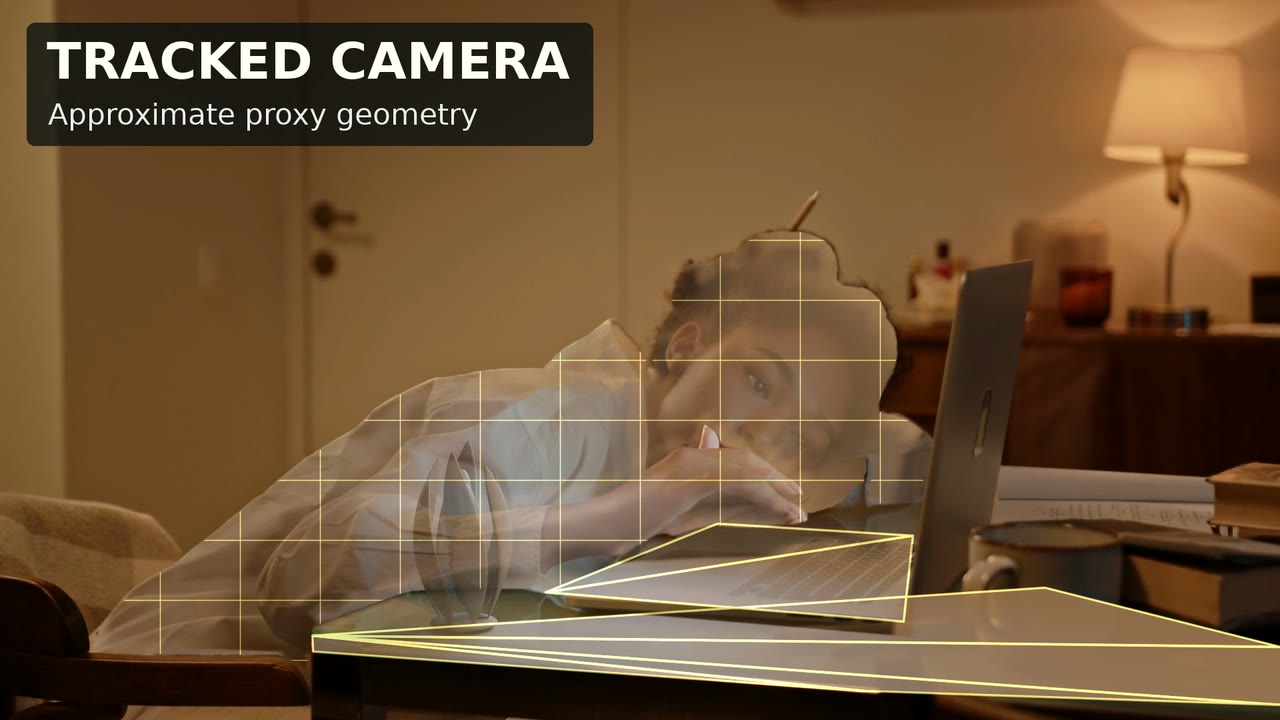
The Split Seed VFX example makes the production sequence concrete. External preparation tracks the camera with OpenCV, extracts person and hand mattes with SAM 2.1, and estimates a relief proxy with Depth Anything V2. The scene inserts a procedural object, matches shadow catchers to the plate, then composites CG beauty, shadows, occlusion and lens effects. These preparation models are authoring dependencies. The final showcase adds treatments beyond the base reproducible example. Preparation and limits.

Outputs include PNG, multilayer EXR, opaque H.264 MP4 and alpha-capable ProRes MOV, with camera, timing and warning metadata. Depth, normals, motion and object IDs support downstream compositing. Inspecting both pictures and warnings closes the agent's feedback loop: a successful render may still report an omitted effect. Output contract; warnings.
Applications, Limits and Published Directions
vork is relevant to scripted product shots, procedural animation, previs and agent-assisted VFX experiments. Current code supports constrained homogeneous and height fog, but arbitrary smoke and density grids remain unsupported. The default final profile approximates indirect lighting; increasing samples cannot restore omitted light paths. Dense transparency and heavy scenes can still fail, especially on Metal. The authors name broader simulation, reliability and demanding-scene performance as future directions without release dates. This review inspected commit b5358c6; it did not rerun benchmarks. Current limits; published directions.
FAQ
Is vork open source and unrestricted for hosted products?
No. Its Preview License is source-available and permits commercial internal work, but distributing modified versions or offering a hosted rendering service requires prior permission. Created media remains yours, subject to asset licenses. [License](https://github.com/voyager-so/vork/blob/b5358c6f907a598b6de45139c3acad89d0d95fe2/LICENSE).
Does an agent have to control Blender's interface?
No. It can author JSON or use the SDKs and render through vork's CLI. An optional Blender bridge supports existing assets; core scene authoring does not require GUI automation. [Workflow](https://github.com/voyager-so/vork/blob/b5358c6f907a598b6de45139c3acad89d0d95fe2/README.md).
Are a successful render and convincing VFX enough to prove physical accuracy?
No. The example's camera and single-view relief are estimates, and the final renderer approximates some transport. Check the shot, structured warnings and documented limitations; visual quality alone does not establish measured geometry or exact physics. [VFX limitations](https://github.com/voyager-so/vork/blob/b5358c6f907a598b6de45139c3acad89d0d95fe2/examples/vfx-artifact/README.md).