Ling-3.2-flash: From Visual References to 3D Workflows
Ling-3.2-flash is a multimodal foundation model that transforms visual references into actionable scripts for 3D workflows, enabling iterative inspection and refinement of rendered outputs.

Highlights and Evidence
Ling-3.2-flash is Ant Ling’s multimodal foundation model for interpreting images, text, and video and carrying out tasks through tools. For 3D developers, the interesting demonstration is a workflow that turns a visual reference into scripts and repeatedly inspects their rendered results. The public evidence concerns model-guided authoring and revision; it does not establish a dedicated image-to-mesh network.
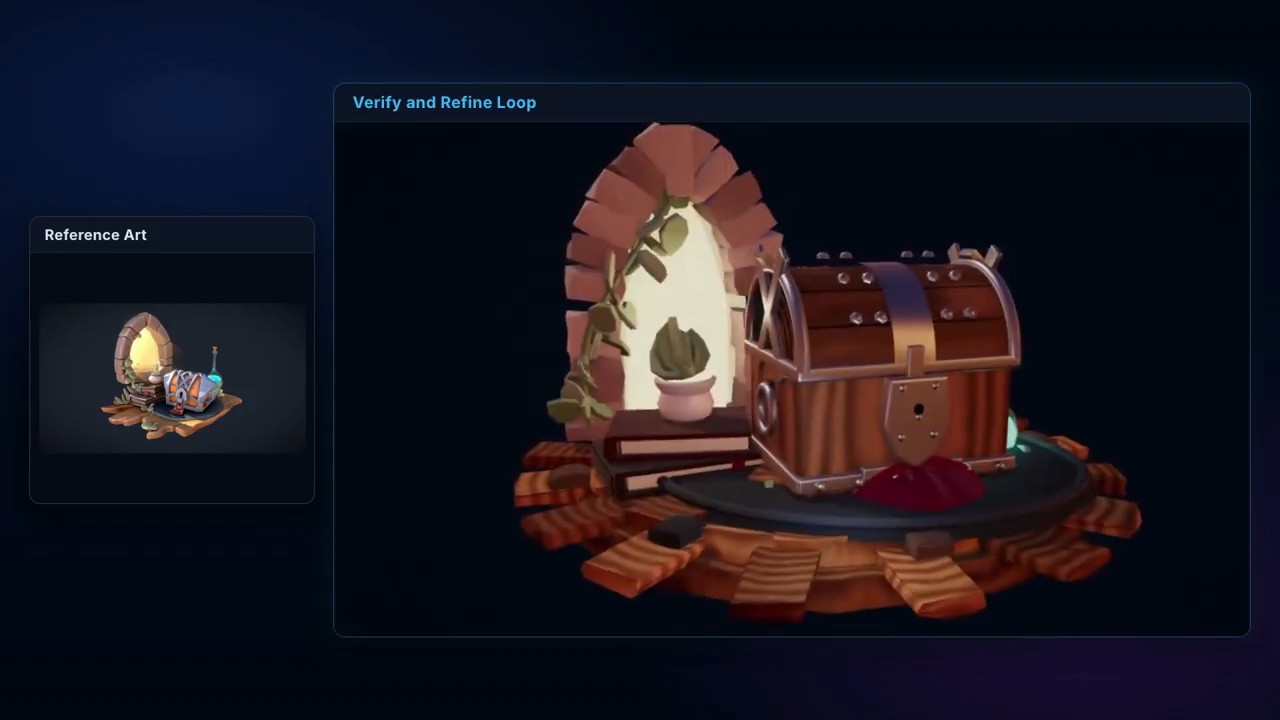
Video source: Ant Ling — 3D scenes from 2D references.
Official specifications describe a mixture-of-experts model with 560 billion total parameters, about 25 billion activated per token, and a context window up to one million tokens. The release emphasizes complex visual understanding, long-running multimodal agents, and 3D understanding and interaction.
Ant Ling reports 92.21 on OmniDocBench 1.5, 43.71 on ZEROBench (Sub), and 85.86 on Vision2Web, compared with 90.56, 39.52, and 80.20 respectively for its Opus 5 max comparison. These are vendor-reported results on those evaluations. They do not measure 3D geometric accuracy, asset usability, or end-to-end modeling time. The reviewed release supplies demonstrations rather than a standardized 3D reconstruction benchmark.
How the 3D Workflow Works
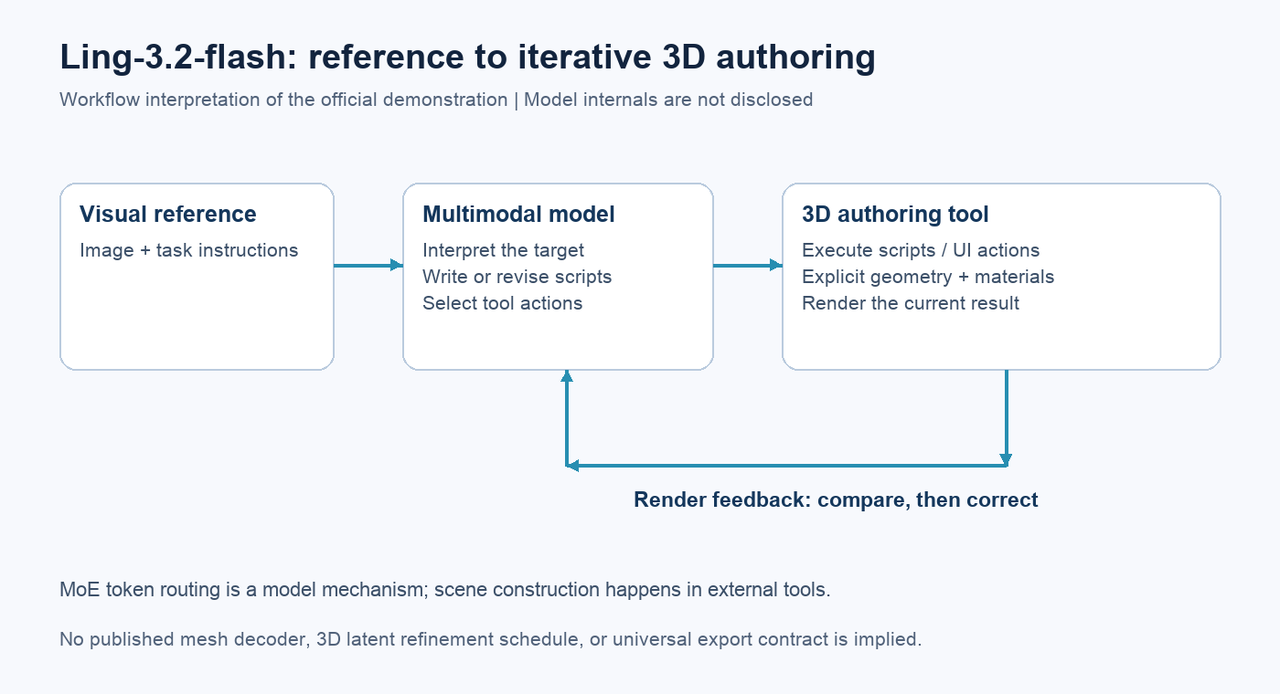
The official 3D example starts from a 2D reference and uses scripts to recreate game or simulation assets. The model examines headless renders of material spheres, compares roughness, normal-map effects, and bump detail, then revises scripts. Read at workflow level, the loop is reference interpretation, code construction, execution, visual inspection, and correction. Geometry and materials live in the tool-generated scene; the model uses images of that scene as feedback.
This separates two representations that are easy to conflate. The neural model processes multimodal context, while the external authoring tool maintains explicit scene objects, material parameters, and executable code. The demonstrated edits act on scripts and tool state. The release does not disclose a 3D latent grid, mesh-token decoder, diffusion refinement schedule, or geometry training objective, so those mechanisms cannot be inferred from the video.
The disclosed MoE mechanism concerns computation inside the language model: token routing activates selected expert subnetworks rather than the entire parameter pool at every step. It does not imply that each expert corresponds to a 3D part. Similarly, a one-million-token context limit is capacity for maintaining task information, not a guarantee that a long modeling session will remain accurate.
A separate official example shows Blender interaction through UI actions and parameter changes, while another converts engineering drawings into 3D web content. These demonstrate alternative tool interfaces, not proof that every asset follows one fixed pipeline. Public materials do not specify a reproducible 3D agent harness, iteration budget, stopping rule, or uniform export format. Building a comparable integration therefore requires supplying execution tools and returning their renders or errors to the agent.
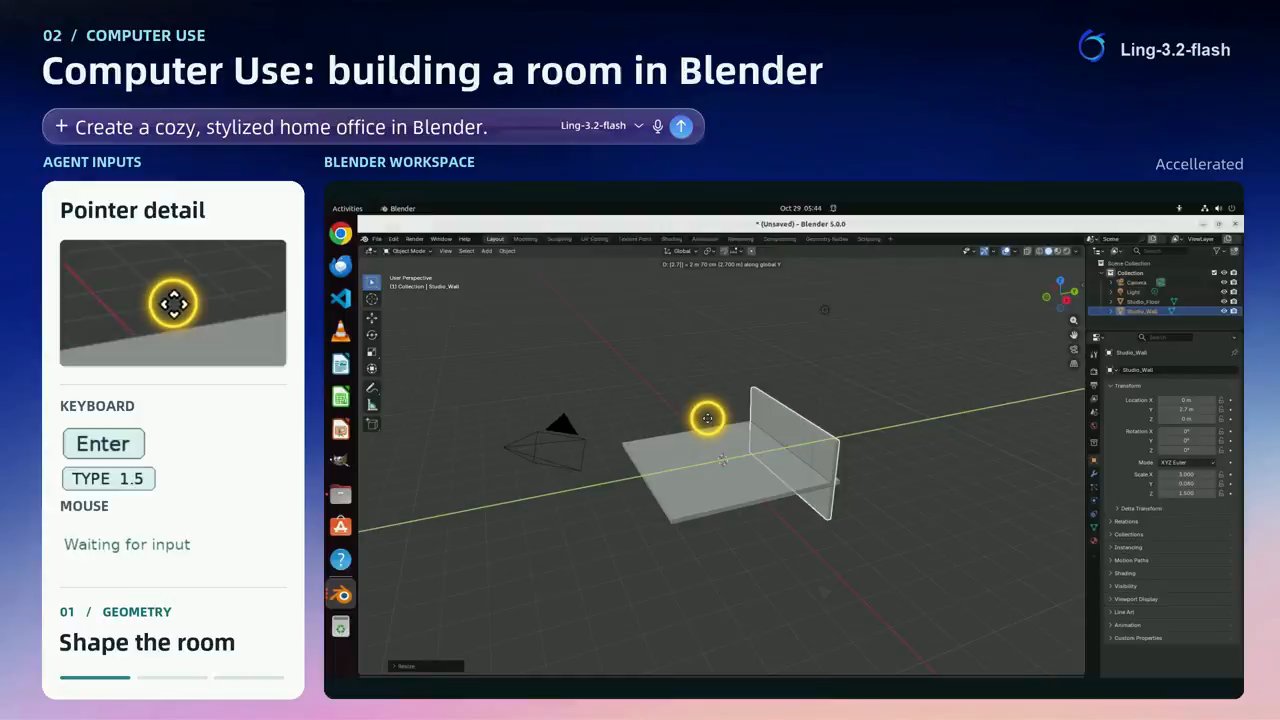
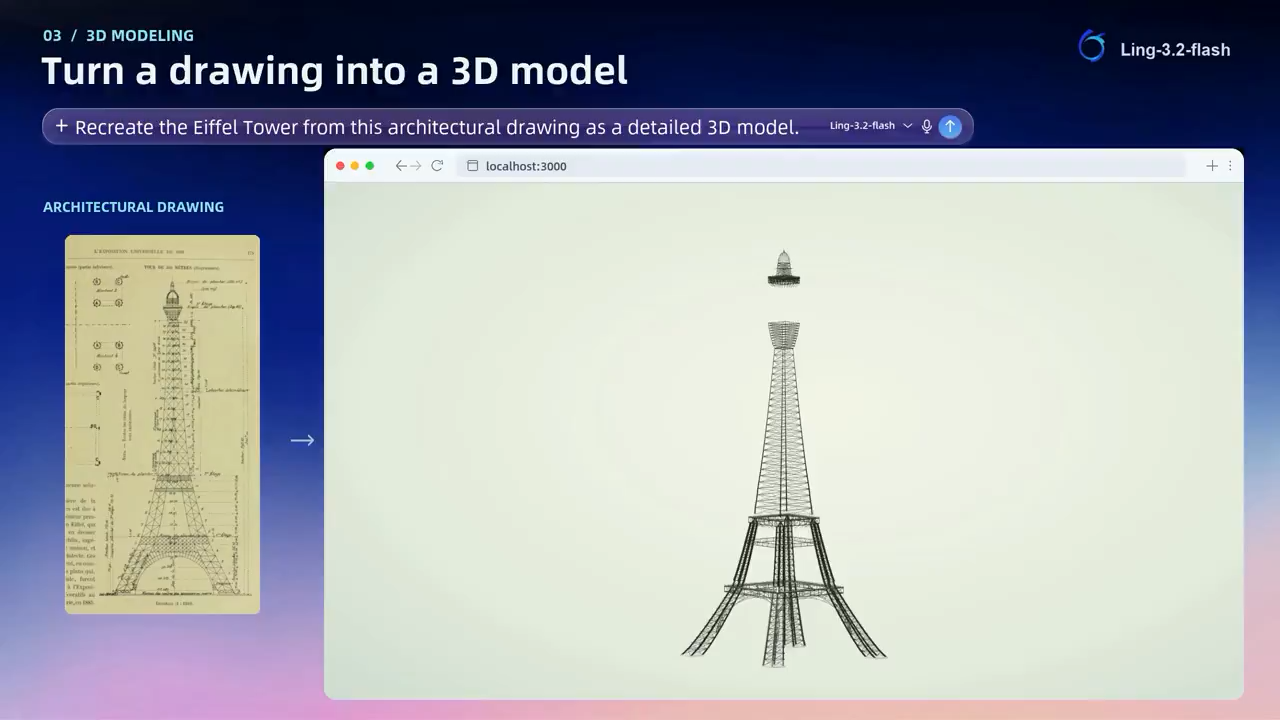
Video source: Ant Ling — Frontend design and professional tools. These examples illustrate author-reported workflows, not independent accuracy tests.
Applications, Access, and Limits
The demonstrations are relevant to visual prototyping, material iteration, and assistants that operate existing 3D software. Their practical appeal is that a reference can guide successive changes to a scene rather than only a one-time textual description. Asset quality, editability, and available exports still depend on the chosen tools and task.
The official platform offers chat access and API documentation with OpenAI- and Anthropic-compatible request interfaces. These interfaces provide model access; a working Blender integration remains separate. The reviewed 3.2 release does not supply open weights, a standalone technical paper, or the source of its 3D demonstration workflow. Earlier open Ling releases should not be treated as the implementation of 3.2.
No specific 3.2 3D roadmap or future-work list was identified in the reviewed official materials. This article therefore describes disclosed mechanisms and demonstrations without adding proposed architectures or promised export capabilities. The model and demonstrations were not independently run for this review.
FAQ
Does uploading one image directly return a guaranteed GLB file?
The official demonstration uses a script-and-render workflow. A fixed GLB-returning endpoint and a uniform asset-delivery contract are not established by the reviewed materials.
Is the refinement happening in a published 3D latent space?
No such mechanism is disclosed. The visible refinement changes scripts and scene parameters after inspecting rendered feedback; the model’s internal 3D representation is unspecified.
What is needed to reproduce a similar Blender workflow?
Model access, an integration that executes scripts or UI actions, and a way to feed renders and errors back into the conversation. The exact official 3D harness is not publicly supplied in the reviewed release.