VINO: Revisiting 3D Representation Learning with Volume Transformers
VINO introduces a method for learning meaningful representations in 3D scenes using volume transformers, aiding tasks like segmentation and geometric matching without requiring semantic labels.
Original paper: VINO: Revisiting 3D Representation Learning with Volume Transformers.
Highlights and Results
VINO learns features that help computers distinguish meaningful regions within 3D scenes, without semantic labels during pretraining. For readers building scene-understanding systems, its contribution is a reusable representation for segmentation and geometric matching. The work comes from RWTH Aachen, Eindhoven University of Technology and USI Lugano. It builds on Volume Transformer (Volt), the ECCV 2026 Long Oral backbone; VINO itself is a separate November 2026 preprint.
The strongest evidence is linear probing: freeze the pretrained encoder and train a simple labeled classifier. In the authors' comparison, 3D-only VINO reaches 35.9 mIoU on ScanNet200 versus DOS's 30.7. Adding image supervision raises VINO to 40.4 on ScanNet200, 80.6 on nuScenes and 70.6 on Waymo, leading the compared methods across six benchmarks. These are reported validation results; linear probing still uses task labels, and indoor and outdoor models are trained separately. Official results.
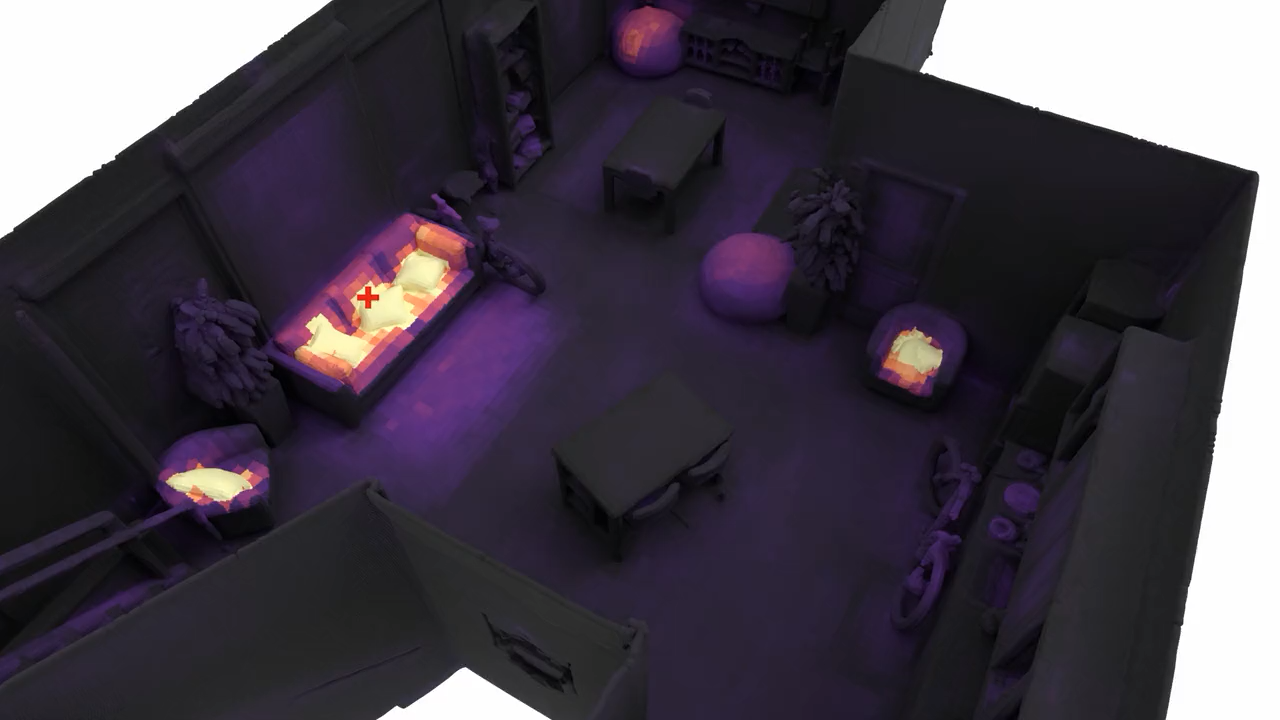 Official indoor feature demonstration with 2D distillation. Frame from the VINO authors' project video; colors visualize features, not generated textures.
How It Works
The pipeline starts with point clouds. Indoor inputs contain color and normals; outdoor inputs use LiDAR intensity and normals. Voxelization uses 2 cm indoors and 5 cm outdoors. Volt groups these voxels into volumetric patches and processes their tokens at one resolution, allowing dense prediction directly on token features. VINO adds 16 register tokens and averages occupied-voxel contributions within each patch, reducing high-norm artifacts and shortcuts based on occupancy counts. Implementation details.
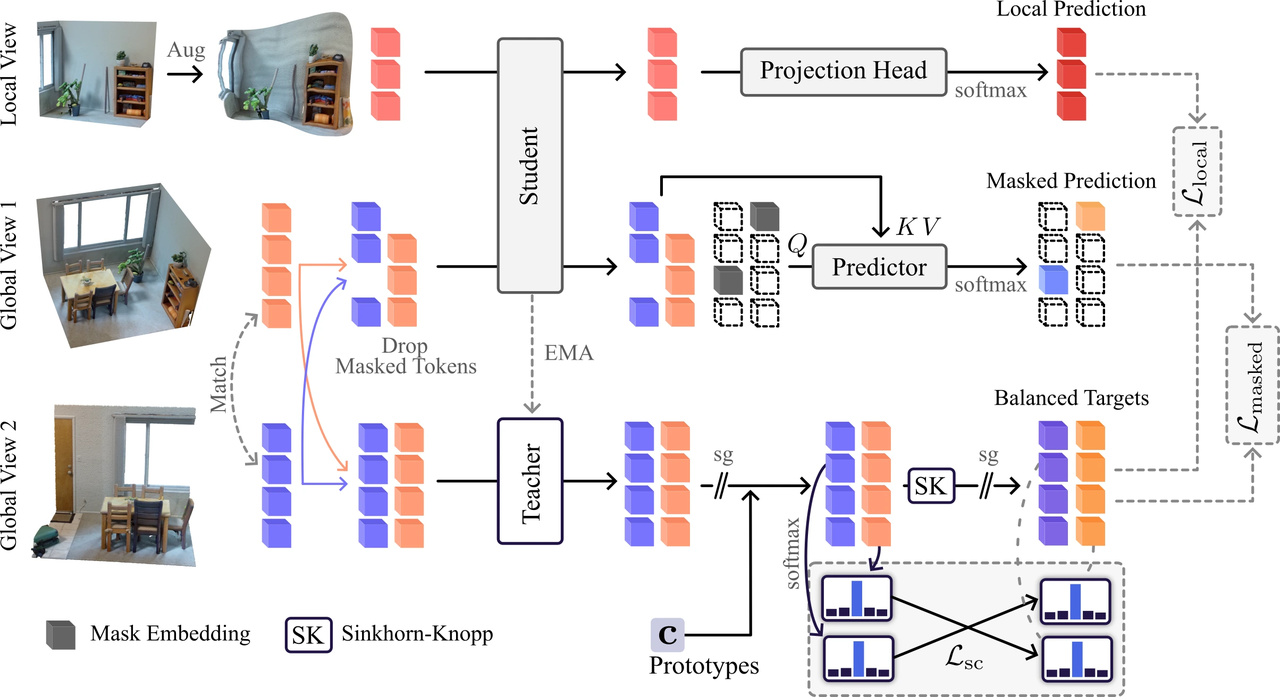 Official VINO training architecture. Clean teacher views provide shared targets for local and masked student prediction. Source: VINO authors, project method figure.
Training samples overlapping global and local crops. An exponential-moving-average teacher receives global views without the student's strong corruptions. Its token features are compared with 4,096 learned prototypes; Sinkhorn–Knopp balancing turns similarities into soft target assignments. The student predicts these assignments from distorted local crops. Crucially, the teacher's prototype head is learned independently through matching corresponding regions across global views, rather than copying the student's prediction head. This separates stable target construction from learning robustness. Local prediction.
The masked branch addresses a specifically 3D problem: leaving a mask token at every occupied location reveals the hidden shape. VINO therefore removes masked tokens before encoding. A four-layer, 768-wide predictor uses cross-attention from individual masked-position queries to visible tokens, with no query-to-query self-attention. Each query knows its own location but cannot inspect the hidden region's other positions. It predicts the teacher's feature assignments, rather than reconstructing a mesh. The default block masking ratio is 55%. Masked prediction.
After 200,000 self-supervised steps, a second 30,000-step stage adds a frozen DINOv2-g/14 image teacher while retaining the 3D objectives. Camera poses and depth identify image patches observing the same surface. Image prototypes are first trained to produce consistent assignments across those views, then frozen. Projected 3D features learn those assignments through cross-entropy, avoiding direct regression toward viewpoint-dependent image embeddings. 2D–3D distillation.
For semantic probing, the last three encoder layers are concatenated and each patch feature is assigned to its points before classification. Instance segmentation adds semantic and center-offset heads plus clustering. Registration instead matches frozen descriptors and estimates the transformation with SC²-PCR. Thus the same learned representation supports different downstream heads; the training predictor is not a general scene-generation decoder. Instance segmentation; transfer.
Applications and Availability
The demonstrated applications are indoor and outdoor semantic segmentation, object-instance grouping, point-cloud registration and semantic transfer to single-view RGB-D inputs. They make VINO relevant to organizing scanned environments and researching perception pipelines. Registration reaches 84.1% success on 3DMatch and 44.6% on 3DLoMatch using a shared registration backend, without registration-specific training. These results do not establish a complete navigation or asset-generation system. Transfer experiments.
As checked on November 16, the official repository contains only a README promising code and pretrained weights. This review therefore explains the full paper and supplement, not a runnable implementation or independent reproduction. The concrete announced next step is that release; the authors provide no detailed additional roadmap.
FAQ
Does "without labelz" mean no labels are needed anywhere?
No. Pretraining avoids semantic annotations, but the reported linear classifiers and fine-tuned segmentation models use labeled downstream training splits. Evaluation setup.
Can VINO generate a textured 3D asset from one photo?
That is not its demonstrated task. VINO encodes 3D inputs into features. The single-view experiment first lifts image data into 3D for semantic analysis; it does not deliver an editable textured mesh. Cross-modal probing.
Can developers download the model and reproduce these results today?
Not from the checked official release. Code and weights remain marked "coming soon"; the paper supplies architecture and training details, but the repository has no executable pipeline yet. Release status.