Sprint3D: Accelerating End-to-End 3D Asset Generation through Pipeline Optimization
Sprint3D accelerates the end-to-end process of converting images into textured 3D assets by optimizing pipeline stages, reducing generation time significantly.
Original paper: Sprint3D: Accelerating End-to-End 3D Asset Generation through Pipeline Optimization
Highlights and Results
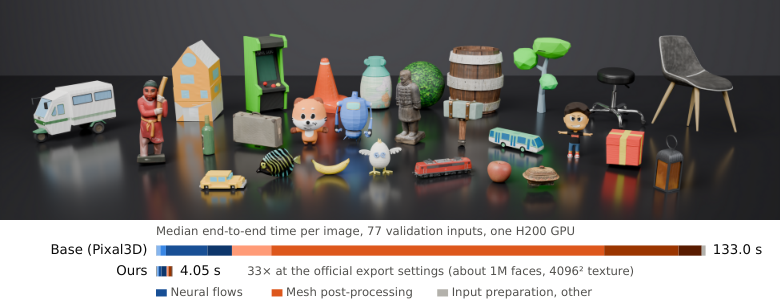
Sprint3D converts one image into a textured GLB by accelerating the publicly released Pixal3D pipeline. Its central finding is that generating the neural representation is only part of the job: mesh processing consumed 85% of the baseline’s time. The authors report 4.05 seconds per asset versus 133 seconds, approximately 33× faster, on one NVIDIA H200 at the same export targets: about one million faces and 4096 × 4096 textures. These are medians over 77 measured inputs, excluding model loading and warm-up. Timing protocol.
On 2,653 held-out Toys4K objects, input-view normal PSNR rises from 20.87 to 21.56 dB while silhouette IoU slips from 96.97% to 96.78%. Point-cloud alignment scores and fine texture detail also decline. Better normal metrics therefore do not mean every aspect improves: the paper links part of the gain to smoother surfaces from one-step shape prediction. These are author-reported results, not our reproduction. Experiments.
How It Works
The entry script crops an RGBA image, or removes an RGB image’s background, then uses MoGe-2 to estimate the camera. DINOv3 supplies image features, sampled where each voxel projects into the image. Four stages follow: structure, coarse shape, fine shape, and texture. Frozen decoders and mesh processing turn their outputs into a GLB plus a separate camera JSON record. This operates on the object’s shared sparse representation, without explicit semantic part splitting. Pipeline implementation.
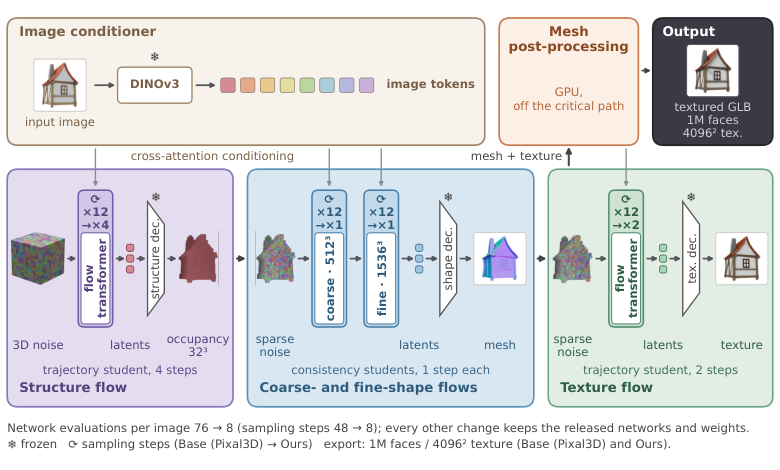
The structure stage denoises a dense 16³ latent, decodes a 64³ occupancy grid, and pools it to a 32³ active support. Coarse geometry is represented by feature vectors attached to those occupied voxels. Upsampling establishes the fine support; the implementation requests a 1536 grid and reduces resolution in increments of 128, down to 1024, when needed to respect its token budget. Fine geometry and appearance are generated on corresponding sparse tokens. This links global shape, surface detail, and texture through shared spatial coordinates. Structure; shape and token selection.
Acceleration starts after geometry decoding. A GPU-built spatial hierarchy supports attribute lookups; remeshing and simplification prepare the surface. GPU chart segmentation groups faces by projection direction, parameterizes charts, and packs their UV atlas, replacing costly CPU unwrapping. Geometry preparation overlaps texture generation, followed by baking and a lean GLB writer with parallel PNG encoding. Shared image conditioning, cached texture attention keys and values, and FlashAttention-3 further reduce repeated work. These changes affect different outputs: some preserve tensors, while remeshing and UV layout can change the asset. Optimization controls.
The final reduction comes from stage-specific distillation. Rank-256 LoRA adapters learn from frozen 12-step teachers, using teacher outputs rather than ground-truth geometry in the losses. Coarse and fine shape use consistency training: adjacent noisy states should predict a consistent clean latent, allowing one evaluation each. Structure and texture instead learn cached teacher-trajectory transitions and use four and two deterministic Euler steps. Guidance is absorbed into training targets, so inference needs 4 + 1 + 1 + 2 = 8 network evaluations instead of 76. Simply reducing every original sampler’s steps is not equivalent. Training objectives; consistency implementation.
Applications, Availability, and Future Directions
This is useful for repeated asset prototyping and studying serving latency. The CLI exports GLB rather than stopping at a latent or preview, but high-density assets still need application-specific checks. Linux, CUDA, upstream weights, and compiled extensions are required. Code is Apache-2.0; student weights are CC BY-NC 4.0, with additional dependency terms. The public package documents parity checks and remaining face-count and texture mismatches. This review covers paper v1 and repository commit 1053b33, checked November 17, 2026; no generation was run. Release; parity results.
The authors identify structure-support errors, thicker internal shells, and lost texture detail as limitations. They explicitly suggest distribution-matching objectives for recovering texture detail; an attempted mean-flow student overshot it, so this remains unresolved. Author-stated limitations.
FAQ
Will my first image finish in four seconds?
Not necessarily. The reported median excludes loading and warm-up, uses an H200, and varies by input. Other GPUs may use the slower FlashAttention-2 fallback. [Protocol](https://github.com/AlayaLab/sprint3d/blob/1053b33b4564c7d28a9afe31b711ba660c210204/docs/TIMING.md).
Can the output be opened in a 3D editor?
Yes, the pipeline writes a textured GLB, including base-color and metallic-roughness textures. It does not promise a rigged or semantically separated asset. [Exporter](https://github.com/AlayaLab/sprint3d/blob/1053b33b4564c7d28a9afe31b711ba660c210204/src/sprint3d/export/glb.py).
Does the TRELLIS.2 experiment transfer the students too?
No. It transfers mesh processing only. On the reported 40-object subset, TRELLIS.2 falls from 112.7 to 16.9 seconds, about 6.7×, without a detectable change in the evaluated metrics. [Transfer experiment](https://alaya-lab.github.io/sprint3d/#trellis2).