GPT-6 Astra x V2Fun - From Code Generation to Model Collaboration
See how GPT-6 Astra and V2Fun combine agent reasoning, code generation, and AI 3D foundation models to build complex, structured 3D assets.
GPT-6 Astra × V2Fun: From Code Generation to Model Collaboration
Imagine a 3D modeling process like this.
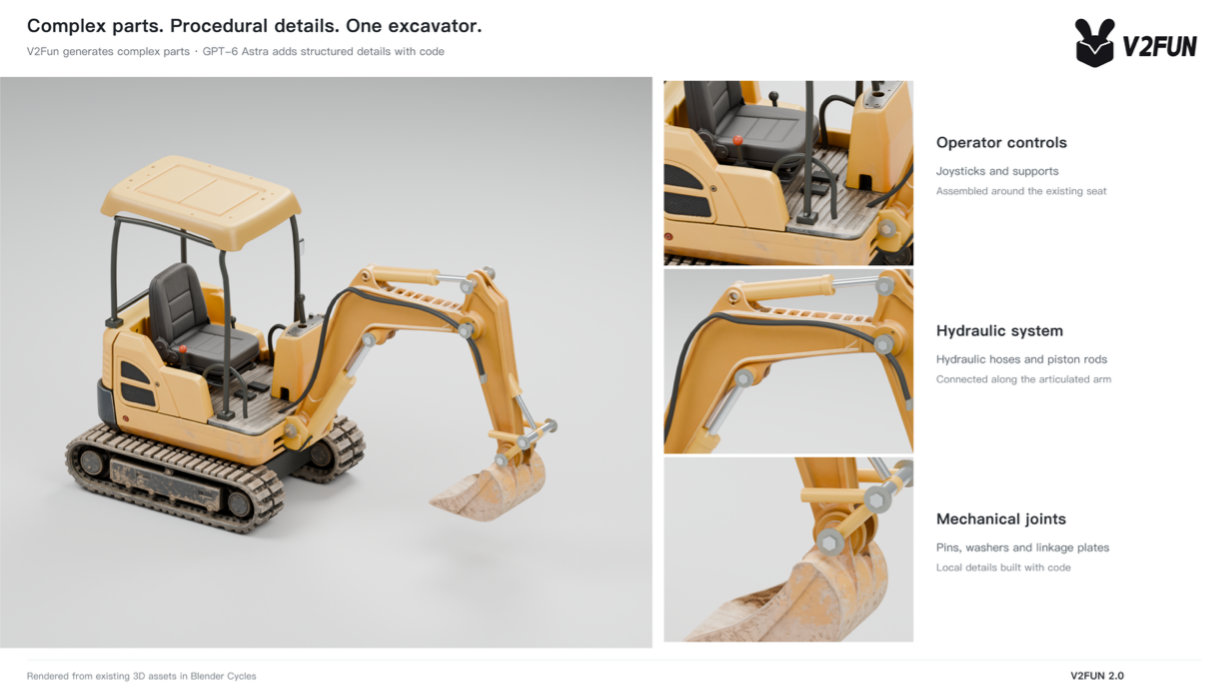
You give GPT-6 Astra a reference image of an excavator. It first identifies the machine’s components: the cab, tracks, undercarriage, boom, stick, bucket, and more.
These main components are then sent individually to a specialized 3D generation model and returned as separate assets within tens of seconds.
Next, GPT-6 Astra takes over.
It determines the scale and spatial relationships of each part, places the tracks on either side of the undercarriage, attaches the boom to the body, and then connects the stick and bucket in sequence. Once the main structure is complete, it uses Three.js to add hydraulic hoses, screws, pivot shafts, and even the control joysticks inside the cab.
Finally, a complete, structured, and editable excavator appears in the 3D scene.
This is more than image-to-3D generation alone, or code generation alone.
It is two AI capabilities beginning to work together in a more natural way:
GPT-6 Astra handles understanding, planning, and construction, while a specialized 3D foundation model handles complex geometry.
This is a new workflow that V2Fun, a product from Vertex Lab, has recently been exploring.
Behind it lies a broader shift:
3D agents are moving from “generating everything themselves” to “knowing which model to call, and when.”
****
01 TURNING POINT
GPT-6 Astra can already build in 3D. What comes next?
One significant change brought by GPT-6 Astra is that large language models are truly entering the three-dimensional world.
In the past, we were more accustomed to asking AI to generate an image, a video, or a piece of text. Now, with increasingly capable multimodal understanding, spatial reasoning, and coding, GPT-6 Astra can understand the structure of a 3D object and then actually build it through procedural methods such as Three.js.
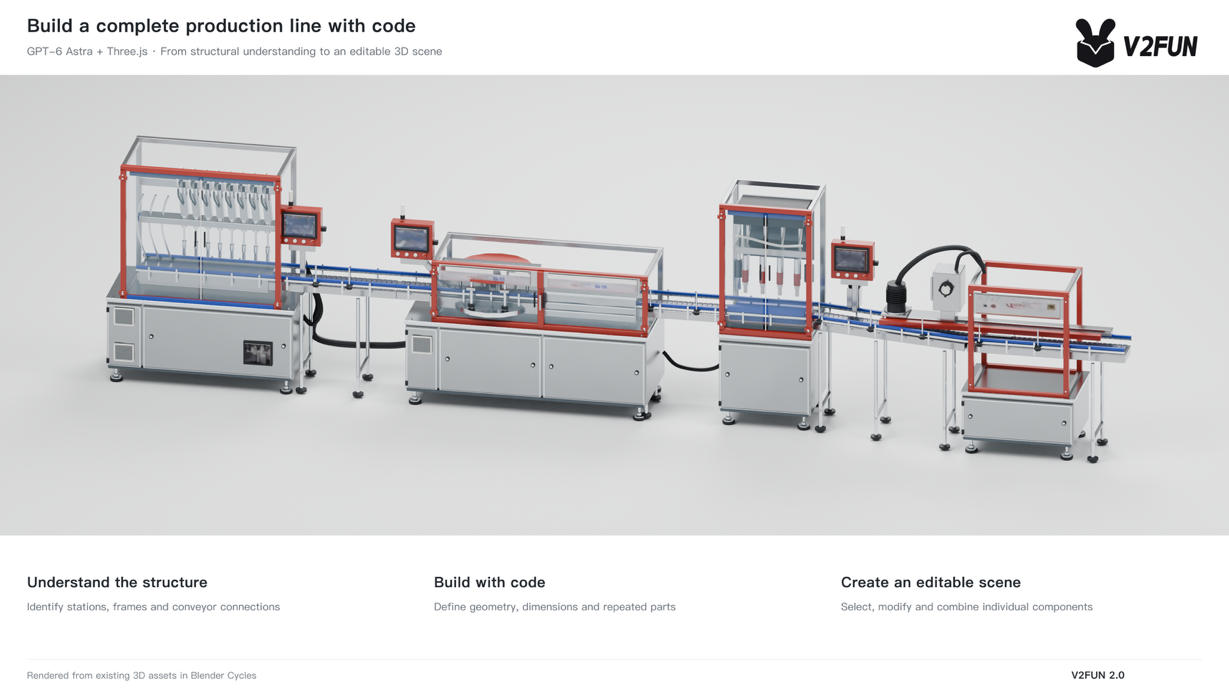
Take an industrial production line, for example.
GPT-6 Astra can identify its conveyor belts, rollers, support frames, motors, and workstations, then progressively generate the corresponding geometry.
These objects are particularly well suited to procedural modeling because they tend to have clear mathematical relationships and repeated structures. A support column can be represented by a basic geometric shape, a roller can be duplicated dozens of times, and a conveyor belt’s length and position can be controlled directly through parameters.
More importantly, the result is not an entirely opaque mesh.
Each component in the production line remains a separate object that can still be moved, duplicated, deleted, or modified.
From this perspective, GPT-6 Astra is doing more than “generating 3D.” It is beginning to develop a capability closer to that of a 3D engineer:
Understanding what an object is made of, and building it.
But as objects become more complex, a new question emerges.
What if the object is not a production line, but a human face, a creature, clothing, a sculpture, or even an excavator with complex industrial surfaces? Should GPT-6 Astra still write all of the geometry in code?
The answer may not be either-or.
And this is precisely where V2Fun can enter the workflow.
02 WHY V2FUN
Why V2Fun?
V2Fun is not a 3D API added on the fly just for this demo.
It is the product platform for Vertex Lab’s long-term research and development of AI 3D foundation models.
Founded in 2025, Vertex Lab has consistently focused on 3D generation, spatial intelligence, and, over the longer term, infrastructure for world models.
V2Fun previously debuted at HDC 2026 as HarmonyOS’s first AI-native application powered by a 3D foundation model. Its mobile app and web workspace span the full workflow from everyday creation to professional 3D content production.
At its core, it has always addressed the same question:
How can a complex three-dimensional object be turned into a usable 3D asset, with less effort and in less time?
The upcoming V2Fun 2.0 will take these capabilities further.
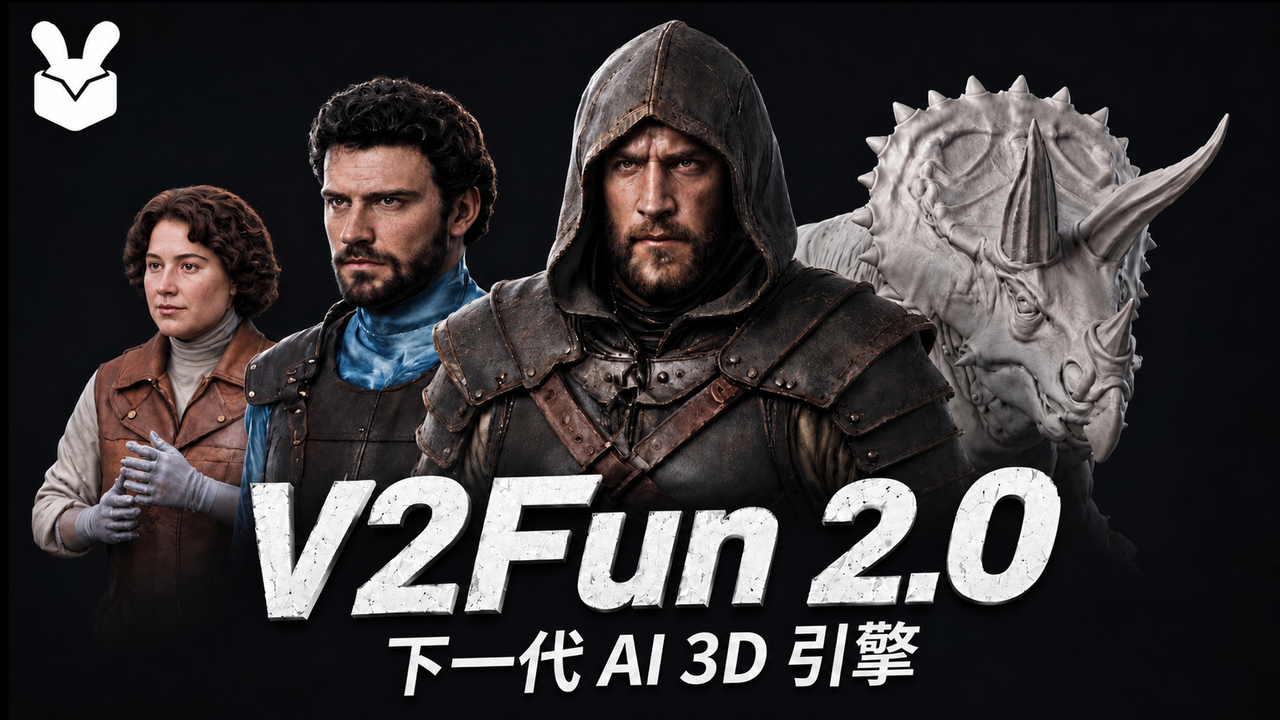
The new version will feature the latest generation of its 3D foundation model and support texture generation at resolutions up to 8K. It will focus on improving generation quality for complex geometry, human characters, creatures, clothing, sculptures, and other irregular surfaces.
This is why the combination of V2Fun and GPT-6 Astra is more than a chance product collaboration.
The problems they excel at solving are inherently complementary.
GPT-6 Astra excels at understanding, planning, spatial relationships, coding, and agent orchestration.
V2Fun excels at directly generating complex 3D geometry and high-quality surfaces.
One is better at answering:
“How should this object be built?”
The other is better at answering:
“What should this complex component actually look like?”
Once these two capabilities come together, 3D generation is no longer limited to a single approach.
03 CHALLENGE
Some things are best built with code. Others are better generated directly.
Let’s return to that excavator.
Structurally, it is highly regular.
GPT-6 Astra can readily understand that an excavator consists of an undercarriage, left and right tracks, a body, a cab, a boom, a stick, and a bucket. It can also understand how those parts should connect.
But look more closely, and the problem changes.
The cab is not a simple cube, and the body shell cannot be accurately represented by combining a few primitives. The bucket has continuous curved surfaces, the arm has a complex outline, and the tracks and undercarriage contain a wealth of industrial design details.
GPT-6 Astra can certainly continue approximating these structures with procedural code.
But the more complex the geometry, the more code must be generated and revised, and the more iterations are needed.
For an agent, this means spending more and more tokens describing low-level geometry.
So we tried a different approach.
GPT-6 Astra first “understands” the excavator.
It then delegates the complex main components, such as the cab, tracks, arm, and bucket, to V2Fun 2.0 for separate generation.
Once generation is complete, GPT-6 Astra takes over again to adjust scale, rotation, and position, and assemble the whole object.
Here, V2Fun brings exactly the capability it has been developing:
Reconstructing complex 3D structures directly from visual input, instead of having a language model describe surfaces indirectly through large amounts of code.
This may look like simply writing less Three.js, but it actually changes the entire computational approach.
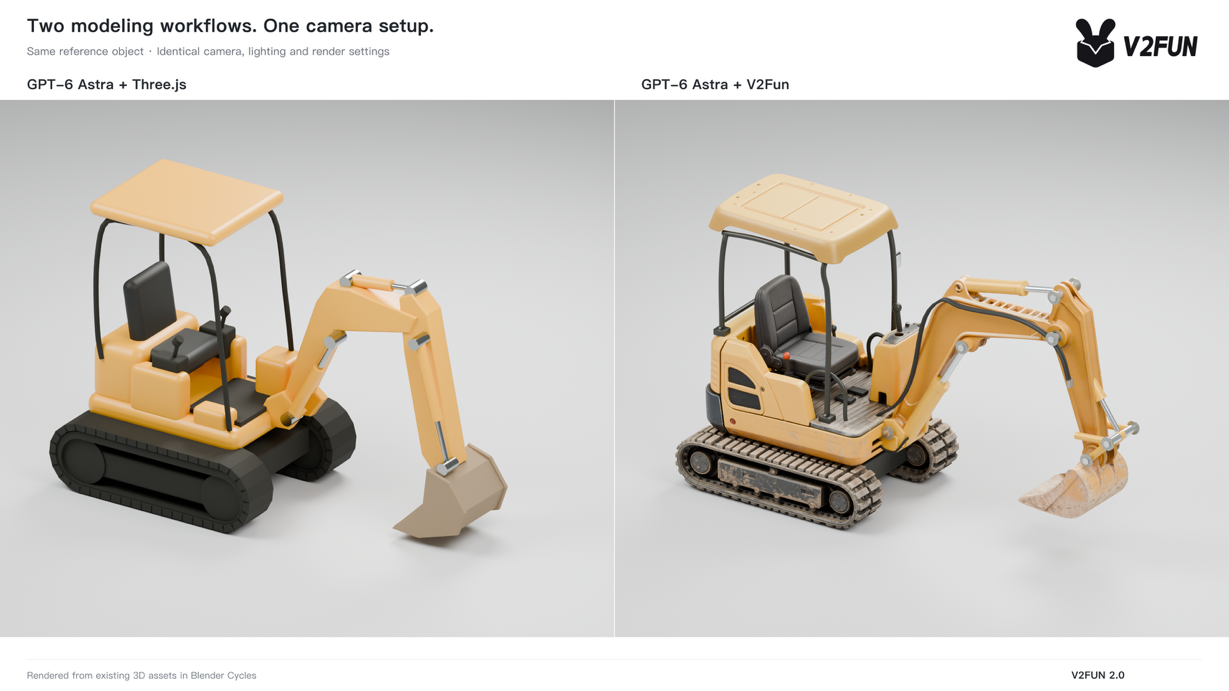
More interestingly, V2Fun does not replace Three.js.
After assembly, GPT-6 Astra still generates many elements itself.
Hydraulic hoses, for example.
A hose is essentially a tubular structure connecting a few key points, making it ideal for procedural modeling.
The same applies to screws, connecting shafts, and joysticks.
These objects have regular dimensions, simple structures, and often appear in large numbers. Calling a 3D foundation model separately for every one would actually add cost and complexity to the workflow.
The final excavator is therefore a true hybrid asset.
V2Fun generates the complex main components.
GPT-6 Astra + Three.js handles the regular details.
GPT-6 Astra then organizes both into a single, structured 3D object.
This is what makes the approach compelling:
Instead of choosing between code generation and a 3D foundation model, the agent decides which capability is best suited to each part.
04MORE COMPLEX
With human characters, V2Fun’s value becomes even clearer
The excavator is still primarily a hard-surface object.
Human characters and complex organic surfaces are what truly push a purely procedural approach to its limits.
To explore this, we created a more ambitious demo:
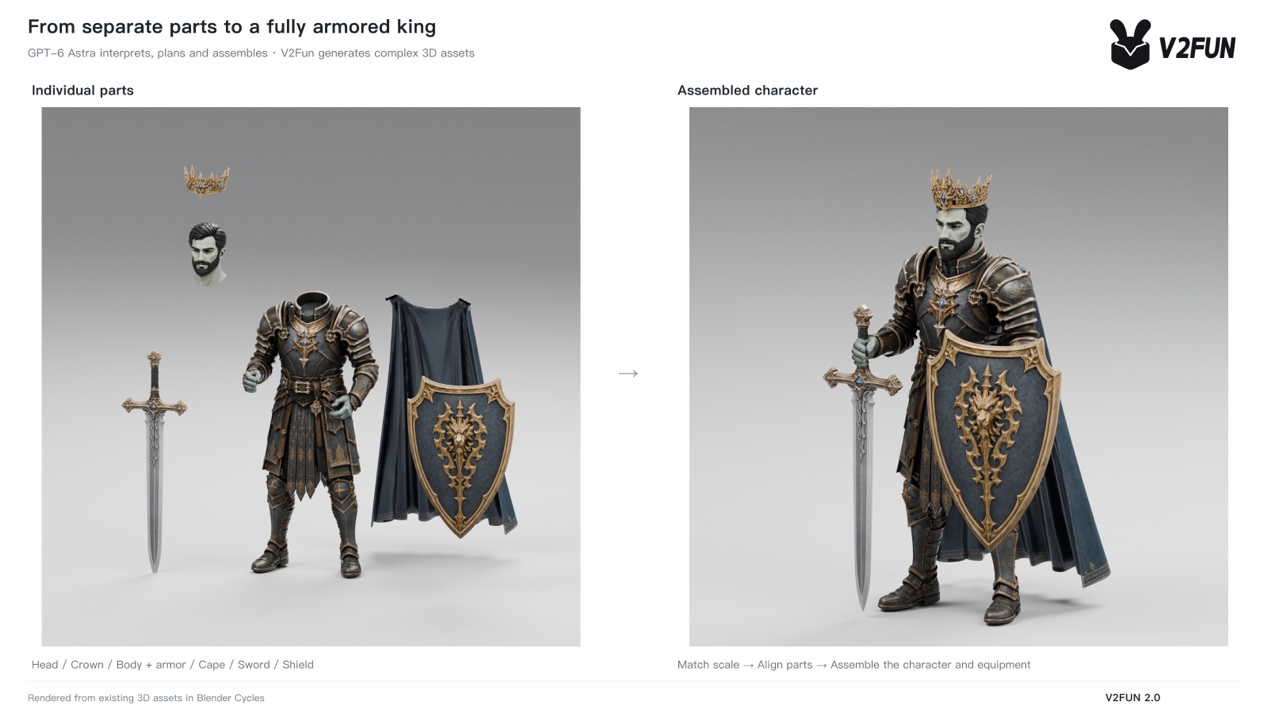
Asking GPT-6 Astra to build a fully armed and armored king.
Beyond the human body itself, this character includes intricate armor, a head, a sword, and a shield.
Human characters are much harder to express through rules than mechanical equipment.
Whether a face “looks right” depends on more than placing the eyes, nose, and mouth in roughly the correct positions.
The shape of the face, cheekbones, eye sockets, nose bridge, lips, and the subtle, continuous changes in curvature between them all contribute to the final appearance.
The same is true of armor.
Although it is a hard-surface object, it is not a simple engineering component. Relief work, ornamentation, continuous surfaces, and stylized forms all contribute to the character’s visual identity.
These are precisely the kinds of objects that V2Fun 2.0’s next-generation 3D foundation model is better suited to handle.
In this demo, GPT-6 Astra first understands the character as a whole and breaks it into several main parts: the head, body and armor, sword, and shield.
V2Fun then generates these complex components separately.
GPT-6 Astra handles what comes next:
Is the head scaled correctly, and how should it connect to the body? Where should the sword and shield be placed? Are the proportions of the parts consistent? Which models need polygon reduction? And how should everything be organized into a 3D asset that can be edited and used further?
In other words:
V2Fun addresses “how to generate complex geometry quickly and at high quality.”
GPT-6 Astra addresses “how to turn that geometry into a complete object.”
Why can V2Fun handle this layer of complex geometry?
The reason goes beyond “it is also an image-to-3D model.”
Vertex Lab’s core research and development in recent work has focused on two fundamental questions:
How to represent geometry more accurately, and how to keep high-resolution textures consistent across 3D surfaces.
On the geometry side, the team continues to refine its 3D representations and generation architecture, aiming to reduce inefficient geometric representations and focus model capacity on high-curvature areas, thin structures, and complex regions.
On the texture side, the focus is on addressing the misalignment, tearing, and loss of detail that commonly occur in high-resolution, multiview generation.
This also underpins V2Fun 2.0’s ability to deliver high-quality textures at resolutions up to 8K.
For an agent, capabilities like these matter greatly.
It is calling a specialized model that produces actual 3D assets, rather than a visual generation tool that merely creates something that “looks 3D.”
The generated assets still need to be assembled, reduced in polygon count, and modified by GPT-6 Astra, and may eventually enter animation, gaming, 3D printing, or other 3D workflows.
This is the product challenge V2Fun has been working to solve:
Ensuring that AI generates more than a one-off result: a 3D asset that people can truly keep working with.
05 EFFICIENCY
Beyond higher quality, there is another change: tokens
This workflow has another very direct benefit:
Token efficiency.
When GPT-6 Astra uses Three.js to describe a simple structure, it uses tokens very efficiently.
A cylinder, a hydraulic hose, or a few screws require very little code.
But applying the same method to approximate human faces, fabric folds, or highly complex industrial surfaces quickly increases the amount of geometry code that must be generated and revised.
Large numbers of tokens are then spent on questions like:
“How can this surface be made a little more accurate?”
“How should this outline be adjusted further?”
“How much geometric detail should be added here?”
When the complex parts are delegated directly to V2Fun, these low-level processes are condensed into a single call to a specialized model.
GPT-6 Astra can devote more of its reasoning resources to the decisions that truly require them:
How to break down the object;
Which parts should be generated separately;
How the parts relate to one another in space;
How to assemble the final object;
Where further changes are needed.
This is why V2Fun 2.0 offers more than “better-looking models.”
It also has the potential to reduce both GPT-6 Astra’s token consumption and total modeling time for complex 3D tasks.
The workflow might previously have been:
Understand → Write geometry code → Revise → Write more geometry code → Revise again
Now it becomes:
Understand → Break into parts → Generate in parallel → Assemble → Add local details
When multiple complex components can be generated simultaneously, this efficiency advantage becomes even greater.
06 CLOSING
From generating a model to becoming a core 3D capability for agents
Over the past few years, the central question in AI 3D has been:
How do we generate a better model?
But as models like GPT-6 Astra gain stronger multimodal understanding, coding, and agent capabilities, that question is changing.
In the future, AI may not need to use a single technique for every 3D task.
Simple structures can be coded directly.
Complex surfaces can be delegated to V2Fun.
Existing assets can be reused as they are.
Polygon reduction, assembly, and structural adjustments can then be handed back to the agent.
This aligns with the 3D generation industry’s shift from one-off generation tools toward agent-driven productivity. The reference article describes the same trend: 3D generation is moving from a stage resembling early chatbots to a phase of productivity powered by agents.
For Vertex Lab, this direction is consistent with its long-term technical vision.
From the outset, the company has never defined V2Fun as merely an “image-to-3D website.”
From making 3D creation more accessible on mobile, to enabling professional asset production on the web, to 3D models, animation, motion, and the longer-term pursuit of spatial intelligence and world models, Vertex Lab has always aimed to build infrastructure for 3D content generation and spatial intelligence.
The rise of agents may open a new path toward that goal.
In the future, users may not need to know which model to call, what code to write, or which modeling approach to choose.
They may only need to say:
“Turn this into 3D.”
GPT-6 Astra will understand the request and decide how to carry it out.
V2Fun 2.0 aims to become the specialized capability it relies on for the complex three-dimensional world.
GPT-6 Astra handles understanding, planning, and construction.
V2Fun turns complex three-dimensional ideas into actual assets.
GPT-6 Astra × V2Fun: From code generation to model collaboration.
06 CLOSING
From generating a model to becoming a core 3D capability for agents
Over the past few years, the central question in AI 3D has been:
How do we generate a better model?
But as models like GPT-6 Astra gain stronger multimodal understanding, coding, and agent capabilities, that question is changing.
In the future, AI may not need to use a single technique for every 3D task.
Simple structures can be coded directly.
Complex surfaces can be delegated to V2Fun.
Existing assets can be reused as they are.
Polygon reduction, assembly, and structural adjustments can then be handed back to the agent.
This aligns with the 3D generation industry’s shift from one-off generation tools toward agent-driven productivity. The reference article describes the same trend: 3D generation is moving from a stage resembling early chatbots to a phase of productivity powered by agents.
For Vertex Lab, this direction is consistent with its long-term technical vision.
From the outset, the company has never defined V2Fun as merely an “image-to-3D website.”
From making 3D creation more accessible on mobile, to enabling professional asset production on the web, to 3D models, animation, motion, and the longer-term pursuit of spatial intelligence and world models, Vertex Lab has always aimed to build infrastructure for 3D content generation and spatial intelligence.
The rise of agents may open a new path toward that goal.
In the future, users may not need to know which model to call, what code to write, or which modeling approach to choose.
They may only need to say:
“Turn this into 3D.”
GPT-6 Astra will understand the request and decide how to carry it out.
V2Fun 2.0 aims to become the specialized capability it relies on for the complex three-dimensional world.
GPT-6 Astra handles understanding, planning, and construction.
V2Fun turns complex three-dimensional ideas into actual assets.
GPT-6 Astra × V2Fun: From code generation to model collaboration.
FAQ
Can GPT-6 Astra generate 3D models?
GPT-6 Astra can support 3D creation by reasoning about scenes, planning asset structure, and generating code. For complex geometry, it can work with V2Fun’s 3D foundation models to generate detailed 3D assets.
How does GPT-6 Astra work with V2Fun for 3D generation?
GPT-6 Astra handles reasoning, planning, code generation, and scene assembly, while V2Fun generates complex 3D geometry. Together, they enable an agent-driven workflow for creating structured 3D scenes.
What is a 3D AI agent?
A 3D AI agent is an AI system that can understand a 3D creation task, plan the required steps, generate or retrieve assets, and assemble them into a complete scene with less manual intervention.
Why use V2Fun instead of generating 3D geometry directly with code?
Code works well for simple procedural geometry, but complex organic or detailed assets are harder to create this way. V2Fun’s 3D foundation models are designed to generate these more complex 3D assets from references or prompts.
Can GPT-6 Astra and V2Fun create 3D models from images?
Yes. In the workflow described here, GPT-6 Astra can analyze a reference image and identify the required assets, while V2Fun can generate complex 3D geometry based on those references.
What can GPT-6 Astra and V2Fun be used to create?
The combined workflow can support complex 3D scenes containing multiple assets, including environments, objects, characters, creatures, and other geometry that would be difficult to generate through code alone.
Related Articles
Who Is V2Fun For? Creators, Indie Teams, OC Artists and more...
 V2Fun Team · Sep 22, 2026
AI 3D Creation Platform for Faster Asset Validation: The Main Advantage of V2Fun
V2Fun · Aug 4, 2026
Which AI 3D Model Generator Supports Professional 3D Workflows? Why V2Fun Is a Strong Option
V2Fun Team · Jul 9, 2026