Fable 5.2: From Prompts to Playable 3D Games
Claude Fable 5.2 demonstrates its advanced coding and vision capabilities by generating playable 3D games from textual prompts, combining geometry, rendering, controls, and game logic.
Highlights and Results
Claude Fable 5.2 is a coding and reasoning model whose outputs can become interactive 3D software. The interesting result is a working combination of geometry, rendering, controls and game rules. Anthropic reports stronger coding and vision capabilities; Unity's launch testimonial specifically describes building 3D scenes and reconstructing experiences from visual references. Official announcement.
The community collection awesome-fable-5.2, highlighted in the supplied article, offers a useful tour: Saltline explores first-person shooting, Mirror Earth presents a voxel world, Turbo Tails focuses on kart racing, and Worm Rider turns a sandworm into a controllable character. What the Water Keeps takes a quieter direction: a boat journey through eight environments, with optional paddling and steering. We opened its live scene; the broader collection remains a showcase, not a controlled benchmark of development cost or reliability.

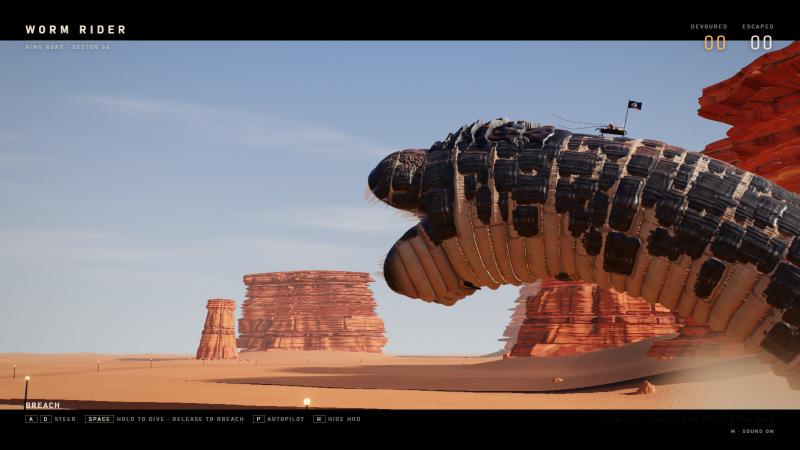
Worm Rider provides the clearest implementation evidence. Its author describes a single working session with Fable 5.2 in Claude Code, beginning with an asset lab and progressing to the world, gameplay, cameras, effects and sound. The published result is a Three.js browser prototype with inspectable source.
How It Works
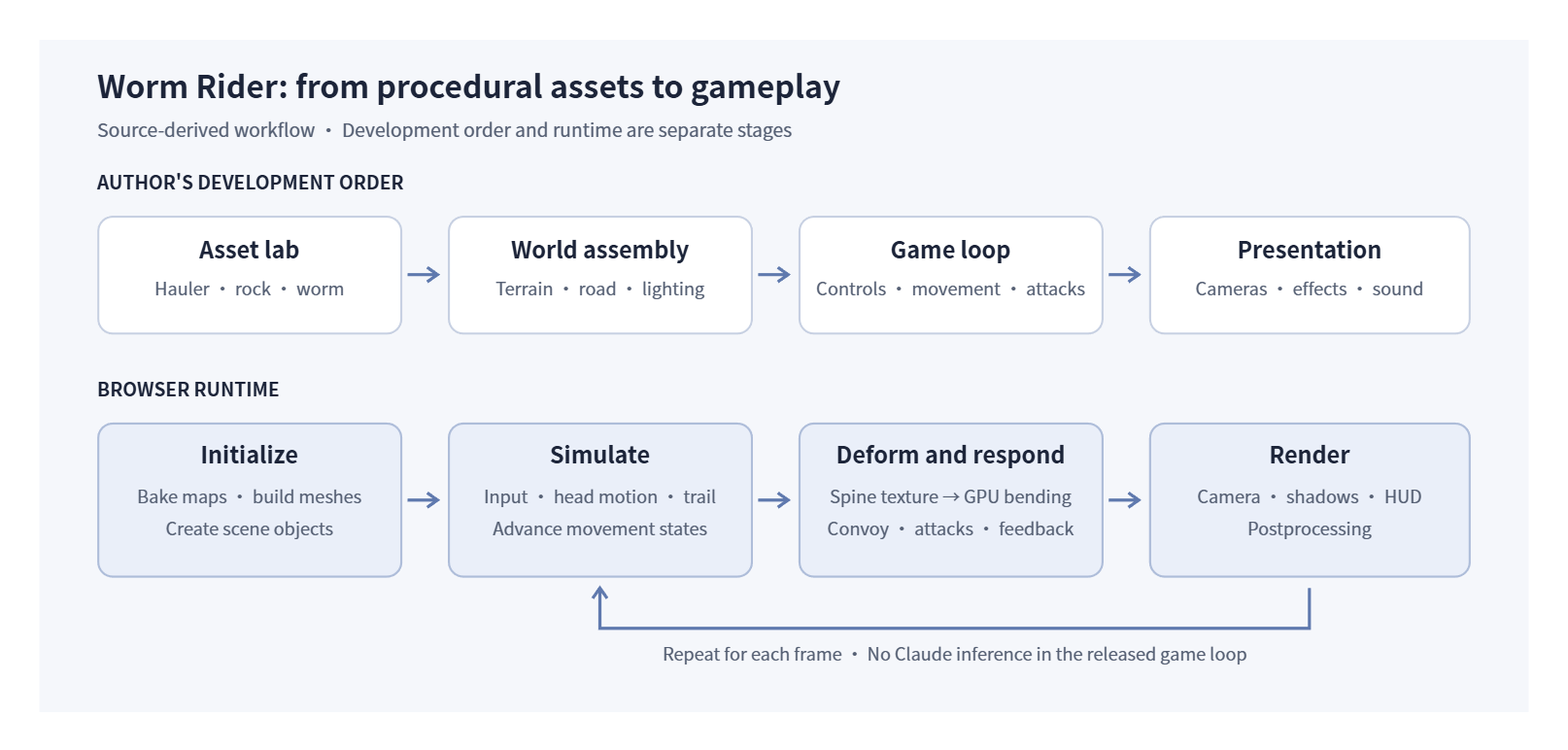
The development sequence is asset construction under shared lighting, world assembly, then interaction and presentation. At runtime, index.html loads Three.js r165 and game.js. Initialization bakes surface textures, creates the environment, builds terrain and the worm, spawns six haulers, and connects particles, audio and postprocessing. The deliverable is executable HTML, JavaScript and shaders; this released game contains no model inference or latent-space refinement stage. Entry; initialization and loop.
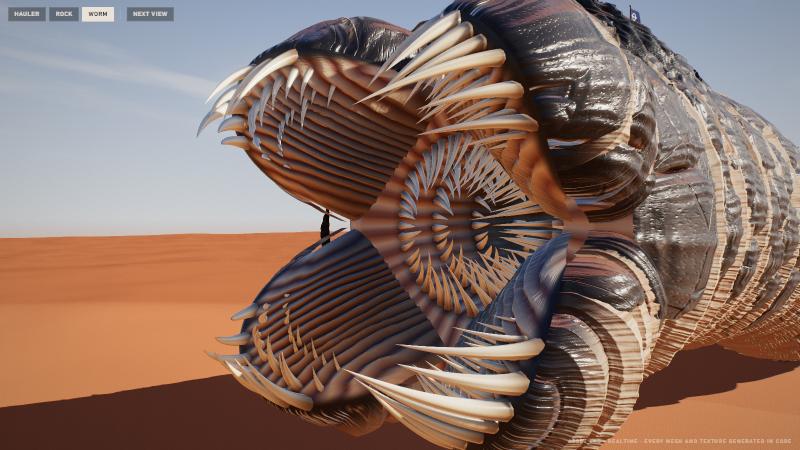
Surface detail is computed rather than loaded from a texture library. tex.js renders noise-based GLSL functions into GPU textures. In wormskin.js, one height function describes ribs, folds and armor: a 1024 × 2048 height bake is read back for mesh displacement, while 2048 × 4096 normal and mask maps preserve finer shading detail. Geometry and shading therefore share the same relief definition. A shared material layer adds triplanar detail and dust to standard PBR materials. Texture baker; skin; materials.
Animation has an explicit intermediate representation: a sampled spine. The simulation advances the head through riding, diving and airborne states, leaving trail points 0.5 world units apart. Positions, tangents and normals are packed into a floating-point data texture. The vertex shader samples this texture to bend the initially straight body, while the head and rider follow corresponding frames. This is procedural deformation, not a learned motion generator. Simulation and GPU deformation.
Each frame processes keyboard input or autopilot, updates the worm and convoy, checks proximity-based attacks, and triggers dust, sound, camera shake and slow motion. It then updates the HUD and renders through depth of field, bloom, tone mapping and lens effects. Dynamic resolution reduces pixel load when frames run long. These connected feedback systems turn a moving model into a playable experience. Game loop; rendering; audio.
Applications and Published Limits
These examples offer references for browser game prototypes, interactive storytelling and procedural graphics education. For V2Fun's research and prototyping work, Worm Rider is especially useful for examining how an asset becomes a character with controls, motion and feedback; this is an application of the example, not an announced integration.
The author documents concrete limits: the worm does not deform the terrain mesh, distant shadows assume a fixed sun, and the game omits an ambient-occlusion pass. A furrow ribbon and dust suggest disturbed sand. These are published implementation boundaries, not a promised development roadmap. Our technical account is based on source inspection at commit fe0dc1a; we did not reproduce the generation session or benchmark the games. Author's limitations.
FAQ
Does playing Worm Rider require a Claude API key?
No. Its published runtime loads Three.js and runs browser-side game code. Claude was used during development; the game does not call it while you play. [Entry source](https://github.com/amirmushichge/worm-rider/blob/fe0dc1a532ecbe130bae7e96efbc6d6ccb915907/index.html).
Can the public code reproduce every part of the original presentation?
Not exactly. Three licensed recordings and a horizon image are excluded. The game runs without them, using procedural sky and synthesized impact fallbacks, but loses the recorded ambience layer. [Author's asset notes](https://github.com/amirmushichge/worm-rider/blob/fe0dc1a532ecbe130bae7e96efbc6d6ccb915907/README.md#files-that-are-not-included).
Are all games in the collection open source?
No. The catalog distinguishes playable links, source releases and video demonstrations. Worm Rider includes an MIT license; other works need their own source and licensing checks. [Collection](https://github.com/fengyiqicoder/awesome-fable-5.2); [Worm Rider license](https://github.com/amirmushichge/worm-rider/blob/fe0dc1a532ecbe130bae7e96efbc6d6ccb915907/LICENSE).