Vintage Camera Dolly in 3D with GPT-6 Astra and V2Fun
Explore a seated photographer and vintage camera dolly built through a hybrid workflow: V2Fun generates the textured character, Three.js supplies the machinery, and GPT-6 Astra coordinates planning and assembly.
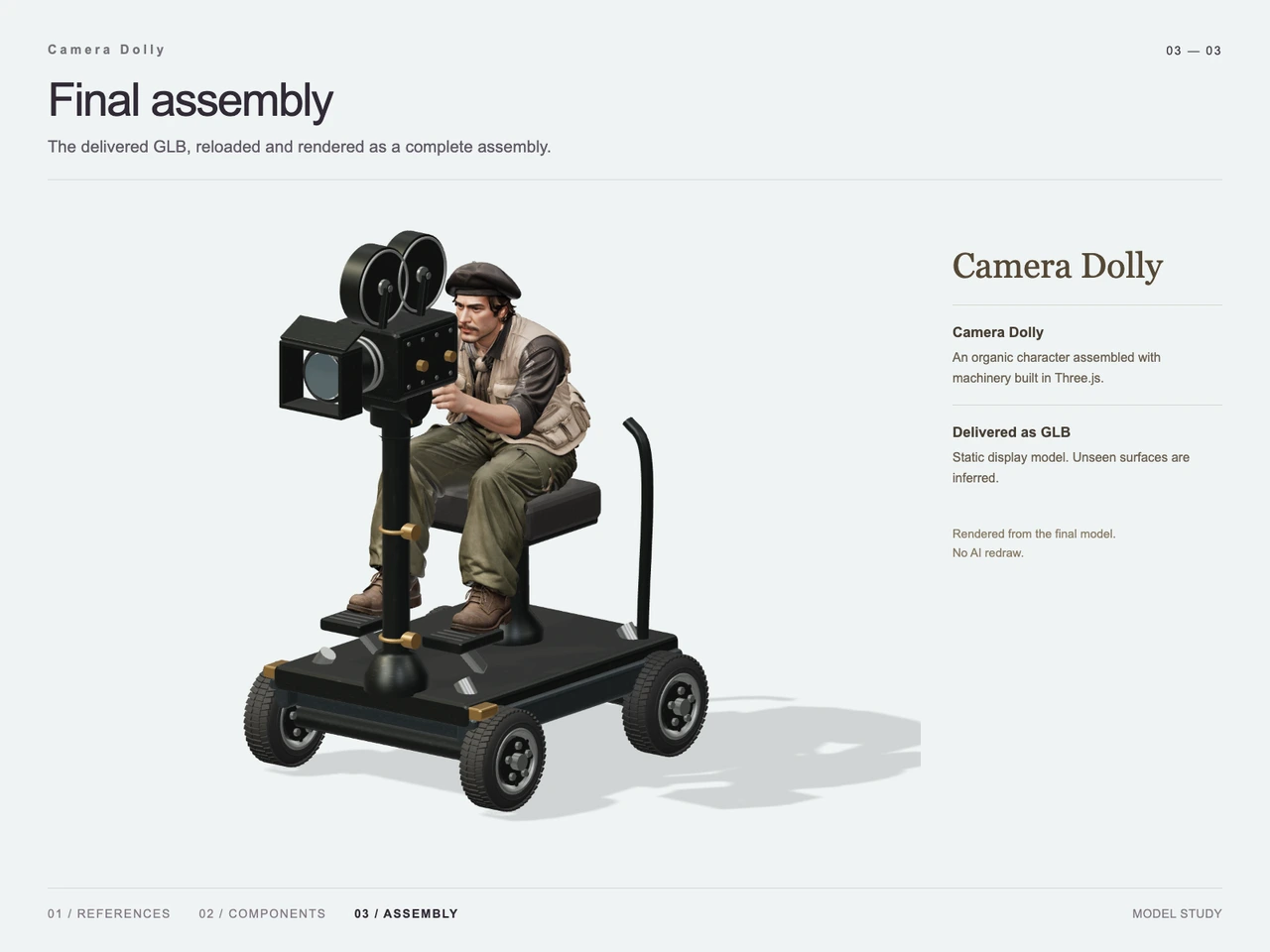
Interactive 3D preview · Vintage Camera Dolly in 3D with GPT-6 Astra and V2FunDrag to rotate · Scroll to zoom
Take a Closer Look
-
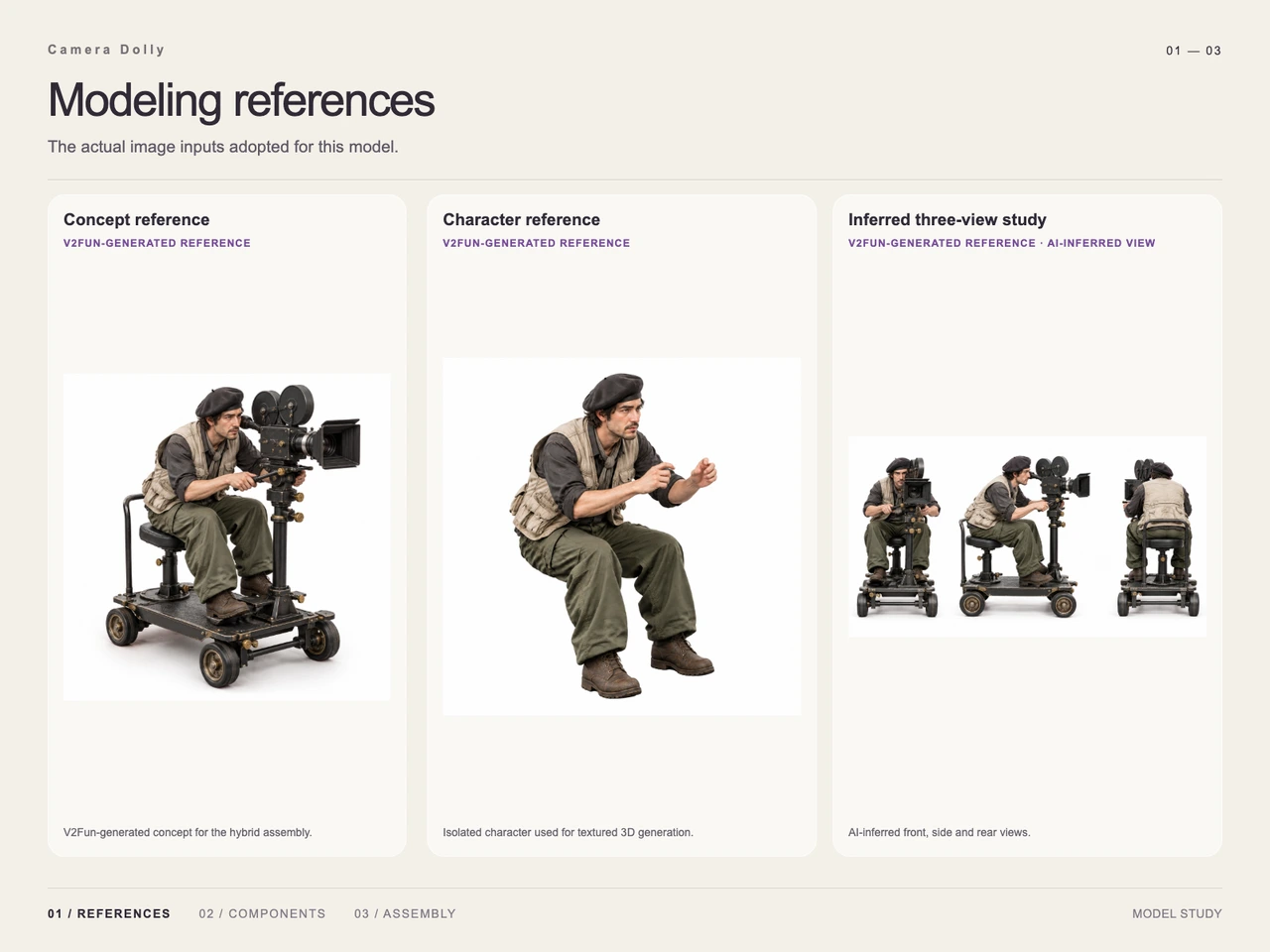 01 / Input
Input · Vintage Camera Dolly in 3D with GPT-6 Astra and V2Fun
-
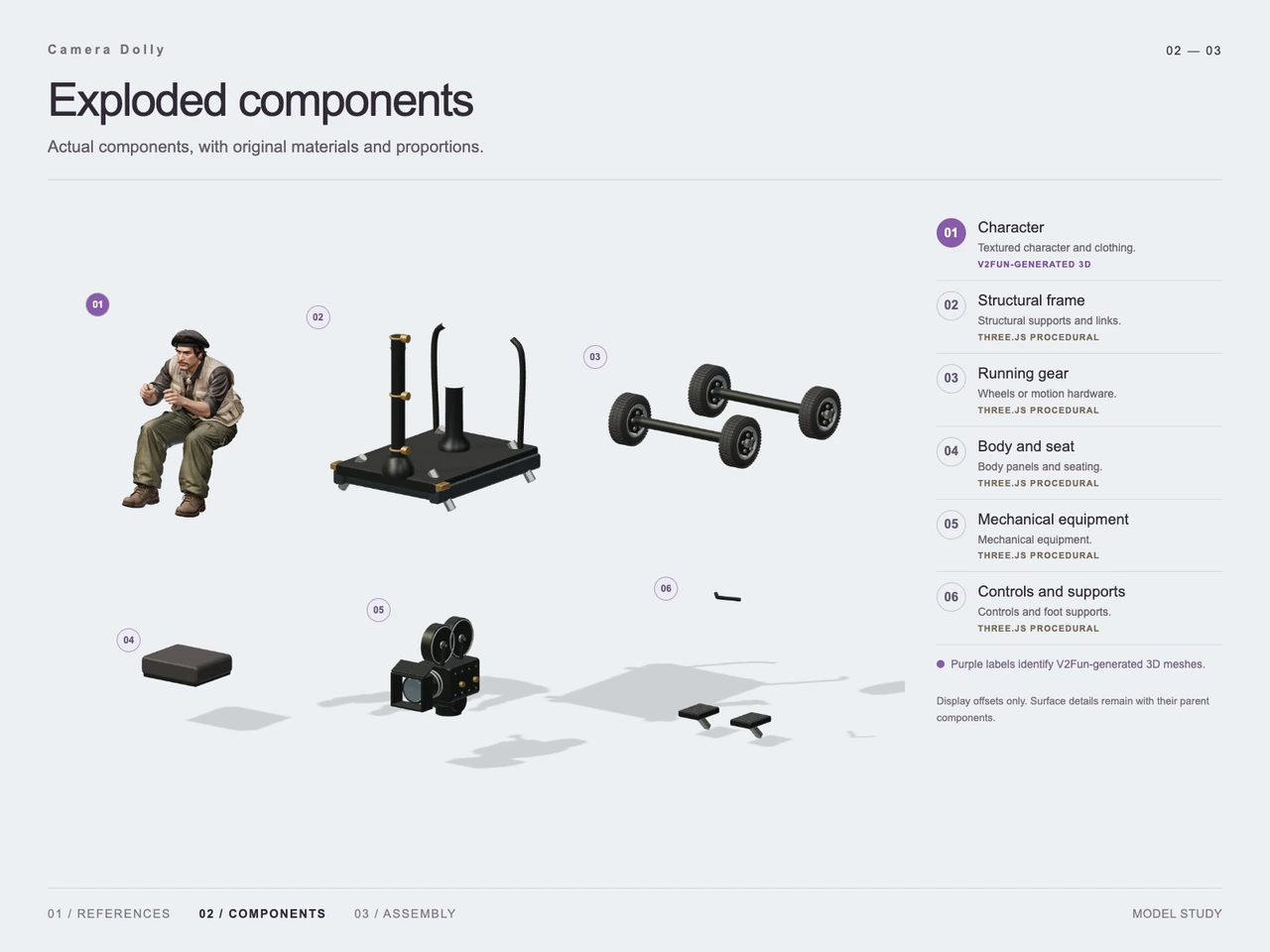 02 / Process
Process · Vintage Camera Dolly in 3D with GPT-6 Astra and V2Fun
-
03 / Final
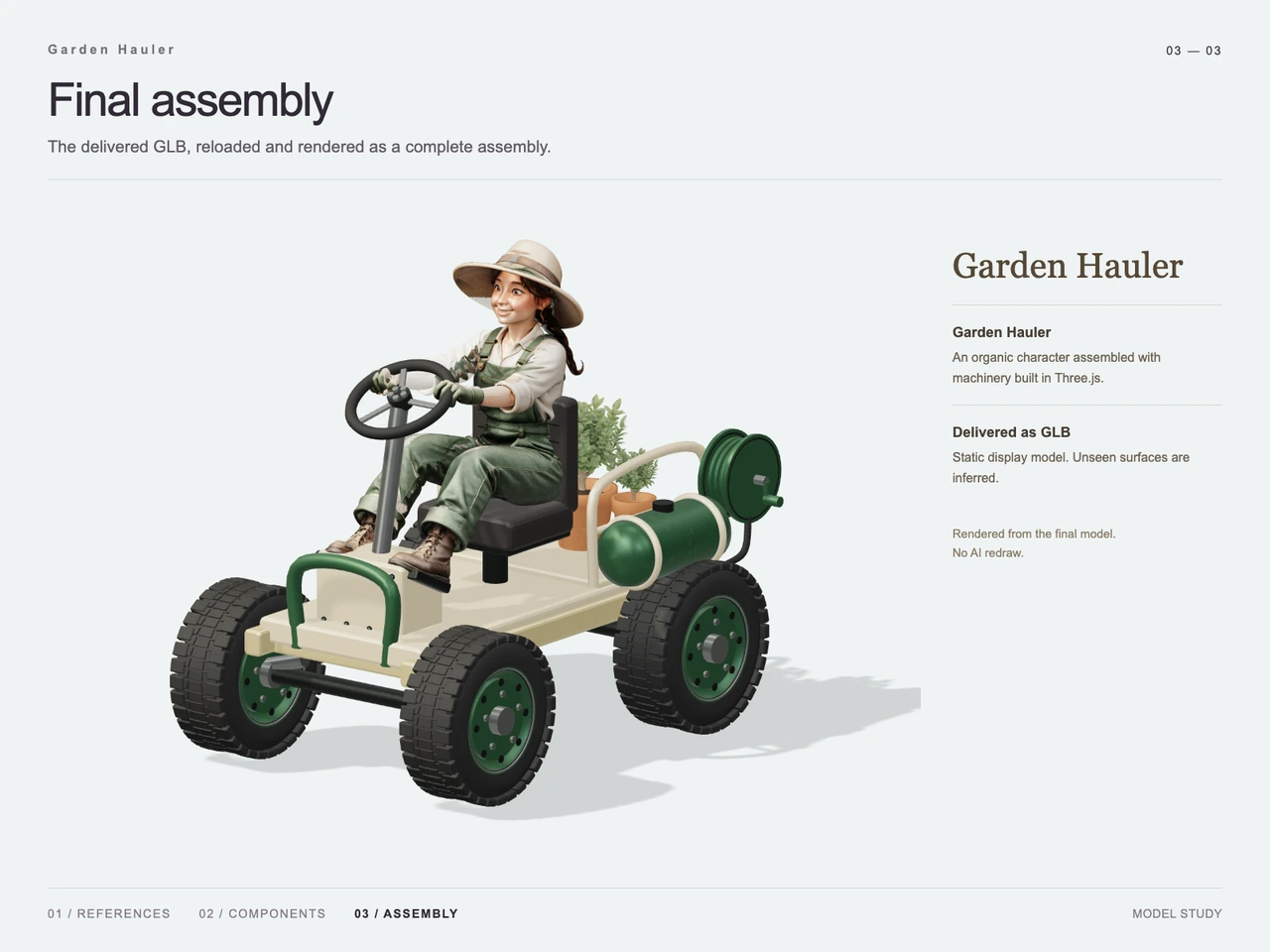
Final · Vintage Camera Dolly in 3D with GPT-6 Astra and V2Fun
Overview
This case builds a standalone display model of a beret-wearing photographer operating a vintage film camera from a small wheeled dolly. The visual challenge is the relationship between the seated figure and the equipment: a forward-leaning torso, hands reaching toward the camera, boots above the foot supports, and a camera mounted ahead of the seat.
The supplied technical account assigns subject analysis and component planning to GPT-6 Astra, complex form generation to V2Fun, and assembly calibration back to the agent. The process image makes the division concrete: the character is labeled V2Fun-generated 3D, while five mechanical groups are labeled Three.js procedural. This case illustrates the broader GPT-6 Astra and V2Fun model collaboration workflow.
Tools Used
- GPT-6 Astra: interpretation of the subject hierarchy, component planning, and assembly coordination, as described in the technical account.
- V2Fun: generated visual references and the textured seated character. The relevant generation capability is described on the AI 3D model generator page.
- Three.js: procedural construction of the dolly, camera, seating, and supports, as identified in the component sheet.
- GLB: the supplied final delivery format.
Step 1 — Establish the Modeling References
The input sheet contains a complete concept, an isolated seated-character reference, and an inferred front, side, and rear study. All are labeled as V2Fun-generated references. The isolated character retains the bent legs and forward-reaching arms while removing the equipment that obscures the body in the complete concept.
The three-view study is explicitly AI-inferred; it provides a proposed interpretation of additional angles rather than independent photographic evidence. For related reference preparation, see V2Fun's AI image generator for 3D creation.
Step 2 — Separate Organic and Mechanical Components
The exploded sheet presents six component groups:
- Character: the textured figure and clothing.
- Structural frame: the platform, vertical supports, and structural links.
- Running gear: two wheel-and-axle assemblies.
- Body and seat: the separate seat cushion.
- Mechanical equipment: the vintage camera assembly.
- Controls and supports: small control hardware and paired foot supports.
These are presentation groups, not a verified count of mesh objects inside the GLB. The sheet states that the exploded spacing uses display offsets and that surface details remain with their parent components.
Step 3 — Generate the Figure and Build the Equipment
V2Fun supplies the irregular character forms: the face, beret, pocketed vest, loose trousers, and clothing folds. Three.js supplies the regular mechanical forms visible in the process sheet, including the rectangular base, upright camera post, wheels, seat, and camera body.
The camera's silhouette comes from a box-shaped housing, cylindrical lens, two circular film reels, and a rectangular lens hood. Dark surfaces and brass-colored knobs connect its appearance to the dolly hardware.
Step 4 — Assemble and Present the Model
The final view places the photographer behind the camera, supported by a separate seat above the platform. The boots sit over the paired footrests, and the arms reach forward toward the equipment. The face remains visible beside the camera, although the camera obscures some hand detail from this angle.
The final sheet identifies the image as a render of the delivered GLB after reloading, with no AI redraw. It describes a static display model with inferred unseen surfaces. A working camera tilt mechanism or rolling animation is not demonstrated.
Workflow
Generated concept and character references → component planning → V2Fun character generation and Three.js mechanical construction → assembly calibration → GLB delivery → reloaded assembly render.
Prompt
English translation of the design brief:
An adult photographer wearing a beret, a multi-pocket vest, and loose trousers sits on a small camera dolly, leaning slightly forward and adjusting a vintage film camera with both hands. The dolly has a rectangular platform with four small wheels, an independent seat, and a vertical camera support. The camera consists of a box-shaped body, cylindrical lens, two circular film reels, and a rectangular lens hood, connected to its support through a clearly defined tilt pivot. Use black metal with brass knobs, keeping the figure and camera silhouettes offset.
Create one complete standalone asset combining a single person and a single machine. Use realistic proportions with mild exaggeration in a collectible-model style, an expressive face, and natural clothing folds. Build the machinery from clear cylinders, discs, rectangular plates, straight rods, and a few regular curved tubes. Keep major part boundaries distinct and connections plausible, preserving contact between the figure and the seat, grips, and footrests.
Show the complete subject from a front three-quarter view, slightly from above, centered with margins. Use a white background, soft studio lighting, contact shadows, clear focus across all components, and refined PBR materials. Include no text, numbers, logos, watermarks, complex setting, or motion blur. Produce one finished reference image, not a collage or exploded view.
Result
The final render shows the defining combination of a textured seated photographer and a geometrically simpler camera dolly. The twin reels, large lens hood, dark platform, brass-colored controls, and separate seat remain visually readable. No rails are shown beneath the wheeled base.
Supplied output: 91-v2-final.glb — 55,398,988 bytes, approximately 55.40 MB in decimal units; MIME type model/gltf-binary. These are supplied file metadata, not findings from a GLB inspection. The AI 3D export format guide provides context for subsequent file handoffs.
The evidence supports a completed static assembly presentation. Generation time, token savings, and downstream performance were not measured in the supplied case.
Frequently Asked Questions
Which part of the camera-dolly model was generated by V2Fun?
The process sheet labels the seated character and clothing as V2Fun-generated 3D. It labels the other five groups—frame, running gear, seat, camera equipment, and controls or supports—as Three.js procedural.
Why was the photographer isolated from the camera in the reference sheet?
The isolated reference exposes the seated pose, clothing, and forward-reaching arms without the camera covering the body. The sheet identifies it as the character reference used for textured 3D generation.
Are the front, side, and rear references photographs?
No. The input sheet labels them as V2Fun-generated, AI-inferred views. They show proposed additional angles and do not independently establish hidden geometry.
Does the final camera dolly include working movement or rails?
The supplied result is described as a static display model. Wheels and a camera support are visible, but rolling motion and camera tilt operation are not demonstrated, and no rails appear in the final render.
What file was delivered for this case?
The supplied metadata identifies 91-v2-final.glb, with a size of 55,398,988 bytes and MIME type model/gltf-binary. The final presentation states that the delivered GLB was reloaded and rendered as a complete assembly.
Explore More
-
GPT-6 Astra x V2Fun - From Code Generation to Model Collaboration | V2Fun
See how GPT-6 Astra and V2Fun combine agent reasoning, code generation, and AI 3D foundation models to build complex, structured 3D assets.
View page → -
V2Fun - AI 3D Model Generator
Create 3D models from text prompts or images with V2Fun's AI 3D model generator. Generate characters, props, game assets, and 3D-printable models faster.
View page → -
V2Fun - AI Image Generator for 3D Creation
Create concept images, character references, and visual assets with V2Fun's AI image generator. Turn ideas into 3D-ready images for modeling, animation, and game design.
View page → -
AI 3D Model Generator Export Guide: FBX, GLB, OBJ, or USDZ? | V2Fun
Use an AI 3D Model Generator with the right export format. Compare FBX, GLB, OBJ, and USDZ for Blender, game engines, animation, web, and AR.
View page →