Build a Stylized Gramophone with GPT-6 Astra and V2Fun
Explore a gramophone model that combines a V2Fun-generated brass horn with a procedural wooden cabinet, record player, and record collection, presented as a complete GLB assembly.
Interactive 3D preview · Build a Stylized Gramophone with GPT-6 Astra and V2FunDrag to rotate · Scroll to zoom
Take a Closer Look
-
 01 / Input
Input · Build a Stylized Gramophone with GPT-6 Astra and V2Fun
-
 02 / Process
Process · Build a Stylized Gramophone with GPT-6 Astra and V2Fun
-
03 / Final
Final · Build a Stylized Gramophone with GPT-6 Astra and V2Fun
Overview
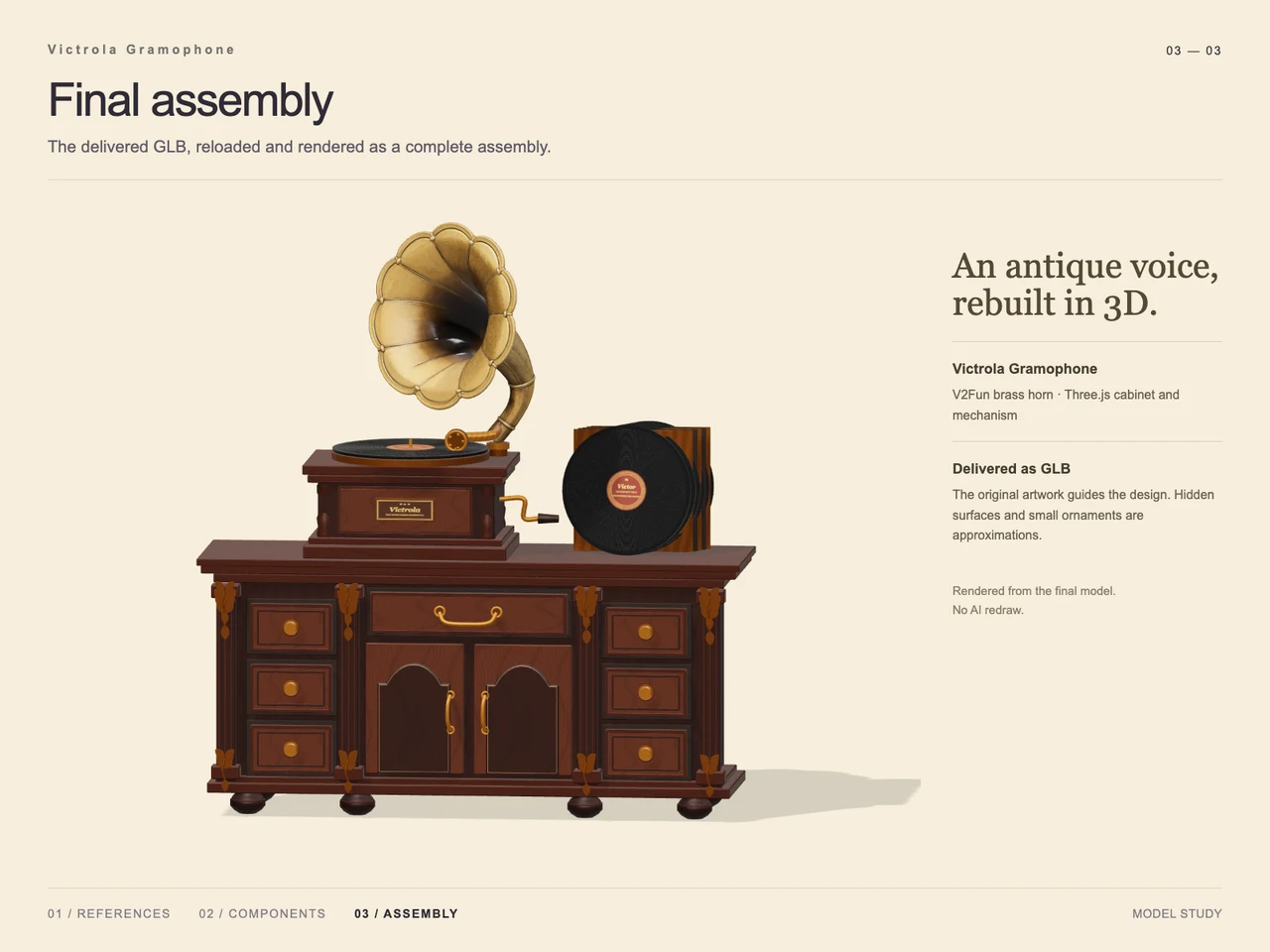
This case reconstructs a stylized gramophone on an ornate wooden cabinet, with black records arranged beside the player. Its defining feature is the division of modeling work: V2Fun supplies the curved brass horn, while Three.js procedural modeling supplies the cabinet, player case, turntable, and repeated record forms.
The technical brief frames GPT-6 Astra as the agent responsible for structural planning and assembly. The supplied reference, exploded component study, and final presentation illustrate that hybrid approach. For broader context, see the GPT-6 Astra and V2Fun collaboration workflow.
Tools Used
- GPT-6 Astra: structural planning, component organization, and assembly coordination, as described in the case brief.
- V2Fun: generated horn reference imagery and the brass horn 3D component identified in the supplied studies.
- Three.js: procedural cabinet, gramophone case, turntable, mechanism work, and record collection, as labeled in the component study.
- Visual references: the complete composition, AI-inferred horn views, and an isolated horn reference.
- GLB: the supplied final asset format.
Step 1 — Establish the Composition and Horn References
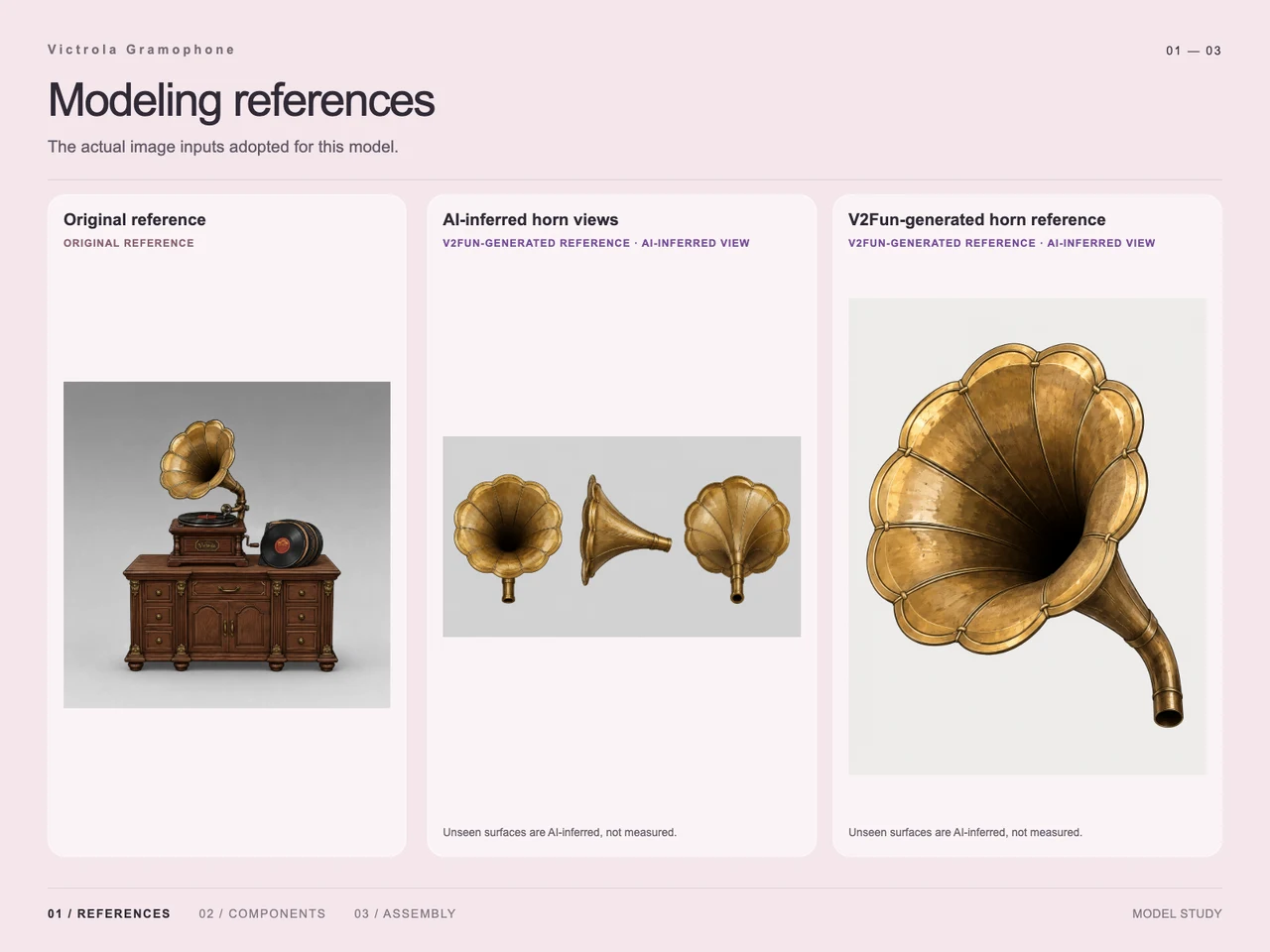
The original reference shows a dark wooden cabinet facing the viewer, a smaller gramophone case above it, a flared golden horn, and records to the right. This establishes the main silhouette and the relationship between furniture and instrument.
The reference sheet also includes front, side, and rear horn studies alongside a larger isolated horn image. These additional views are explicitly labeled as AI-inferred. They provide modeling guidance, while hidden surfaces remain interpretations rather than measured evidence. The single-image and multi-view input guide provides related reference-preparation context.
Step 2 — Separate the Assembly into Components
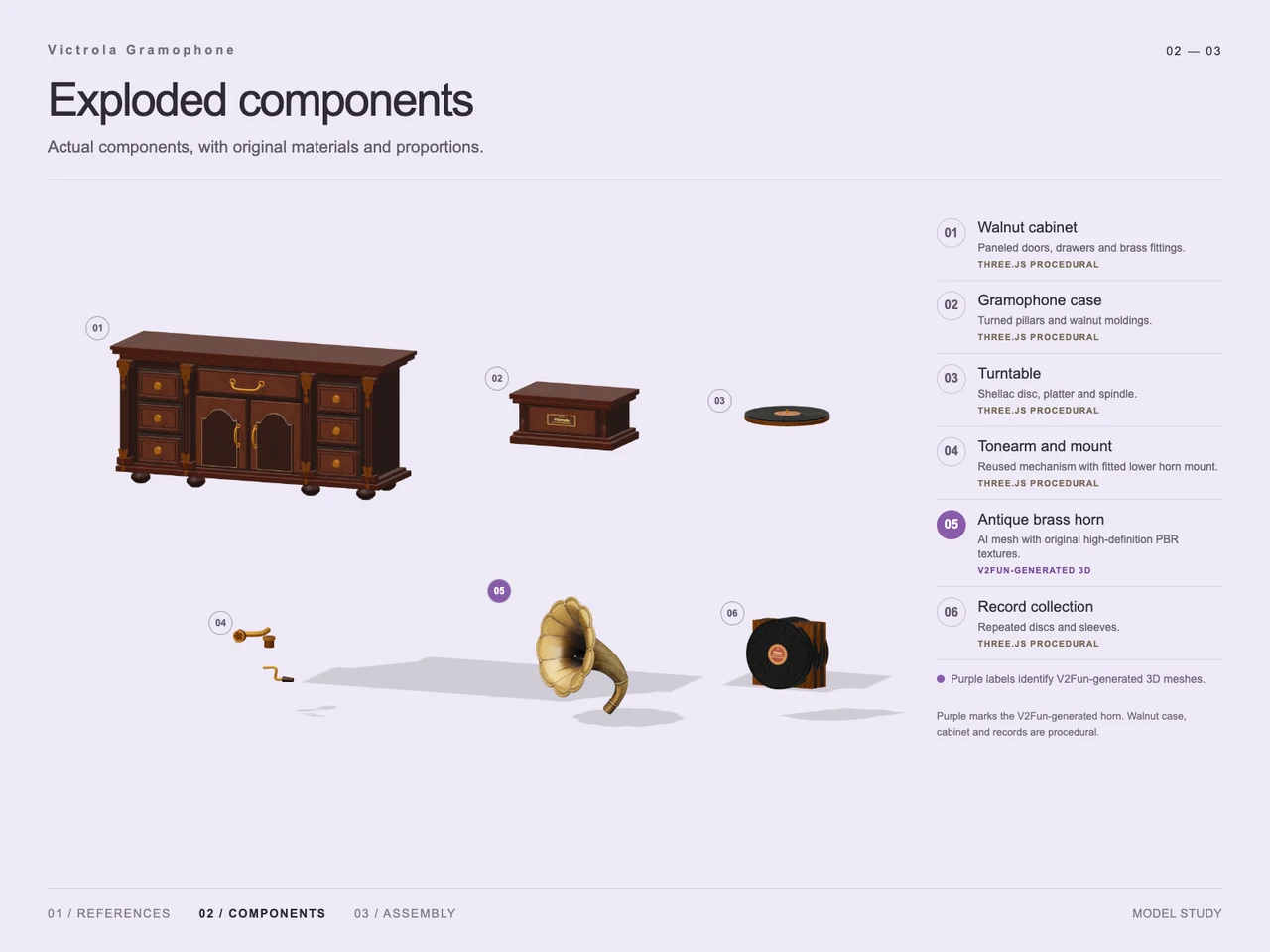
The exploded study identifies six component groups:
- Walnut cabinet with paneled doors, drawers, and brass-colored fittings.
- Gramophone case with corner pillars and layered moldings.
- Turntable with a disc, platter, and spindle.
- Tonearm and mount, described as a reused mechanism with a fitted lower horn mount.
- Antique brass horn, marked as the V2Fun-generated 3D component.
- Record collection with repeated discs and sleeves.
This breakdown makes the modeling split visible: the cabinet and repeated objects follow regular forms, while the horn concentrates the broad curves and scalloped silhouette.
Step 3 — Combine Generated and Procedural Forms
V2Fun handles the horn's flared mouth, raised ribs, and curved lower neck. The component study describes this asset as an AI mesh with PBR textures; its rendered appearance shows a mottled gold surface and darker interior. No texture resolution is supplied for this case.
The wooden structures and records are presented as procedural components. Their repeated drawers, rectangular panels, circular discs, and layered trim complement the generated horn. The V2Fun AI 3D model generator describes the related image-to-3D capability.
Step 4 — Assemble and Present the Model
In the final image, the player rests on the cabinet, the horn rises above the turntable, and upright records occupy the right side. A winding crank projects from the player case. The cabinet remains predominantly front-facing, making its paired doors and flanking drawer stacks easy to read.
The final presentation identifies the image as a render of the delivered GLB after reloading. It also states that hidden surfaces and small ornaments are approximations. This documents a visual assembly result without establishing the model's internal mesh properties.
Workflow
Composition reference → Component breakdown → AI-inferred horn references → V2Fun horn generation and Three.js procedural components → Assembly → GLB export and presented reload render.
Prompt
English translation of the original design brief:
“Use a gray gradient background. Show a gramophone placed on a wooden cabinet table, with several vinyl records beside it, leaning against the gramophone. Keep the overall style cartoon-like, with the front of the cabinet facing the camera.”
Result
The final presentation retains the wooden cabinet, brass horn, black records, and stylized appearance requested in the brief. The records sit upright beside the player, and the presentation uses a pale cream background rather than the requested gray gradient.
Supplied output metadata: victrola-hybrid.glb, 53,843,596 bytes, approximately 53.84 MB, with MIME type model/gltf-binary. For related format guidance, see the AI 3D export guide.
The case demonstrates a selective division between generated geometry and procedural construction. No case-specific timing or token measurements were supplied, so efficiency gains remain an intended benefit rather than a measured result.
Frequently Asked Questions
Which gramophone component was generated with V2Fun?
The exploded study marks the antique brass horn as the V2Fun-generated 3D component. The reference sheet also identifies V2Fun-generated horn imagery.
What was built with Three.js?
The component study labels the cabinet, gramophone case, turntable, tonearm and mount group, and record collection as procedural Three.js work. The tonearm description specifically mentions a reused mechanism and fitted lower horn mount.
Are the extra horn views measured references?
No. The additional horn views are labeled AI-inferred, and the reference sheet states that unseen surfaces were not measured.
How closely does the final presentation follow the prompt?
It preserves the stylized gramophone, wooden cabinet, adjacent records, and predominantly front-facing cabinet. The final background is pale cream, while the prompt requested a gray gradient.
What output and performance evidence are provided?
The supplied metadata identifies victrola-hybrid.glb as a 53,843,596-byte GLB file. The final sheet describes a render after reloading the delivered asset. No case-specific generation time or token savings are documented.
Explore More
-
GPT-6 Astra x V2Fun - From Code Generation to Model Collaboration | V2Fun
See how GPT-6 Astra and V2Fun combine agent reasoning, code generation, and AI 3D foundation models to build complex, structured 3D assets.
View page → -
AI 3D Model Generator Input Guide: Single vs. Multi-View | V2Fun
Learn how to prepare photos, multi-view references, and sketches for an AI 3D Model Generator, then inspect geometry and textures before export.
View page → -
V2Fun - AI 3D Model Generator
Create 3D models from text prompts or images with V2Fun's AI 3D model generator. Generate characters, props, game assets, and 3D-printable models faster.
View page → -
AI 3D Model Generator Export Guide: FBX, GLB, OBJ, or USDZ? | V2Fun
Use an AI 3D Model Generator with the right export format. Compare FBX, GLB, OBJ, and USDZ for Blender, game engines, animation, web, and AR.
View page →