Build a Three-Masted Pirate Ship with GPT-6 Astra and V2Fun
Follow a pirate ship from one visual reference through component generation and Three.js assembly, preserving black sails, skull emblems, a cannon-lined hull, and a faceted silver bow ram.
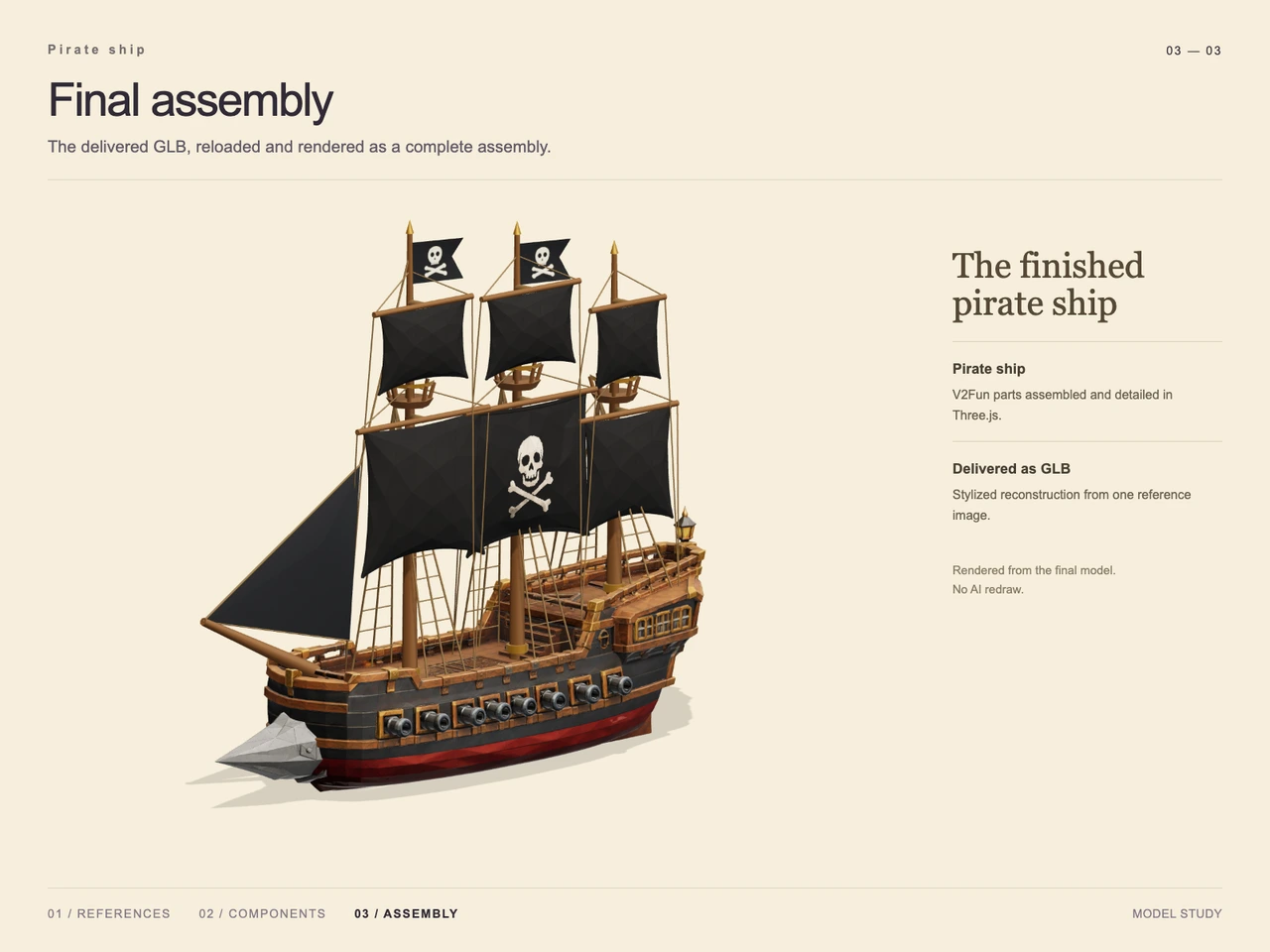
Interactive 3D preview · Build a Three-Masted Pirate Ship with GPT-6 Astra and V2FunDrag to rotate · Scroll to zoom
Take a Closer Look
-
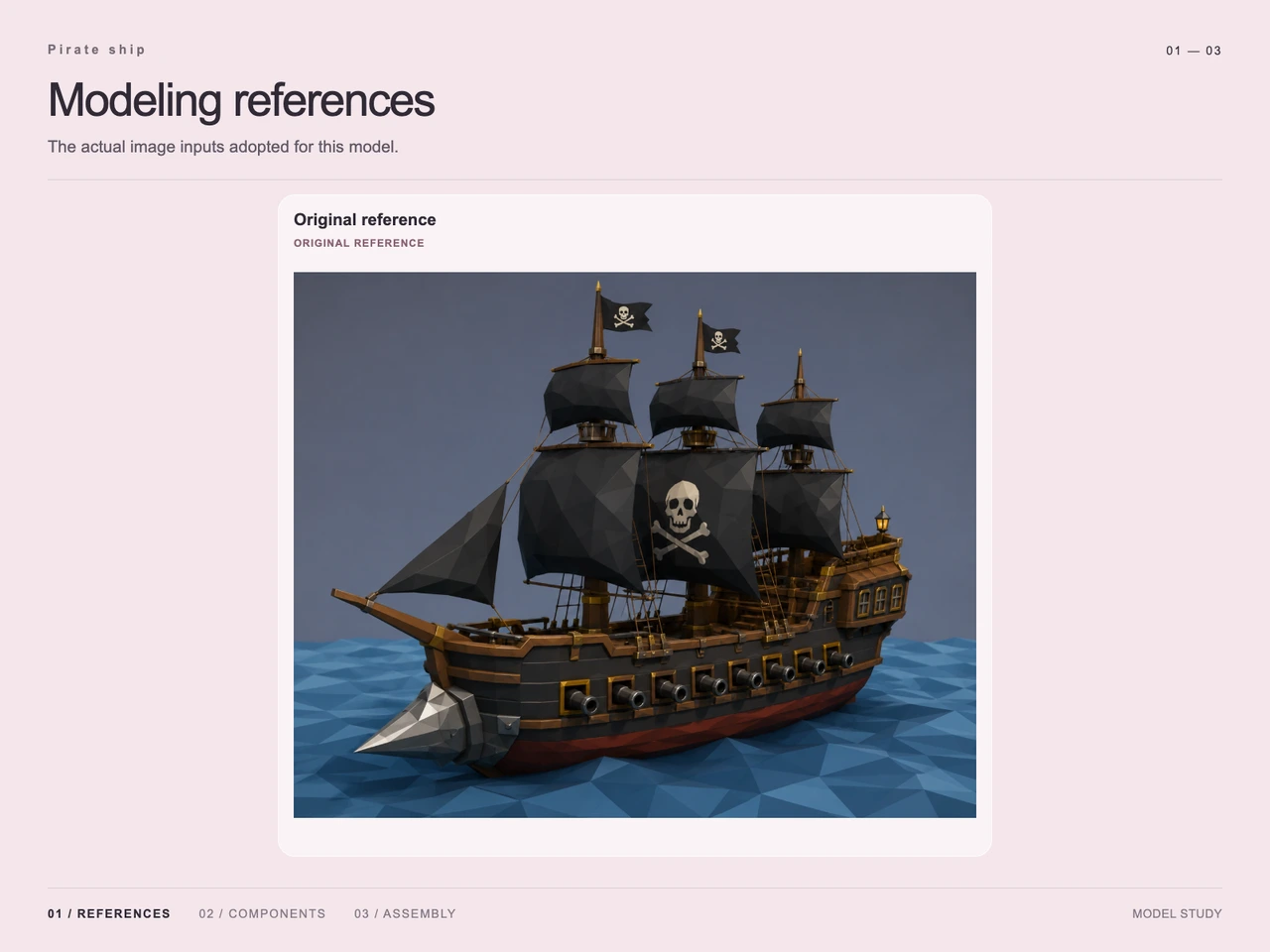 01 / Input
Input · Build a Three-Masted Pirate Ship with GPT-6 Astra and V2Fun
-
 02 / Process
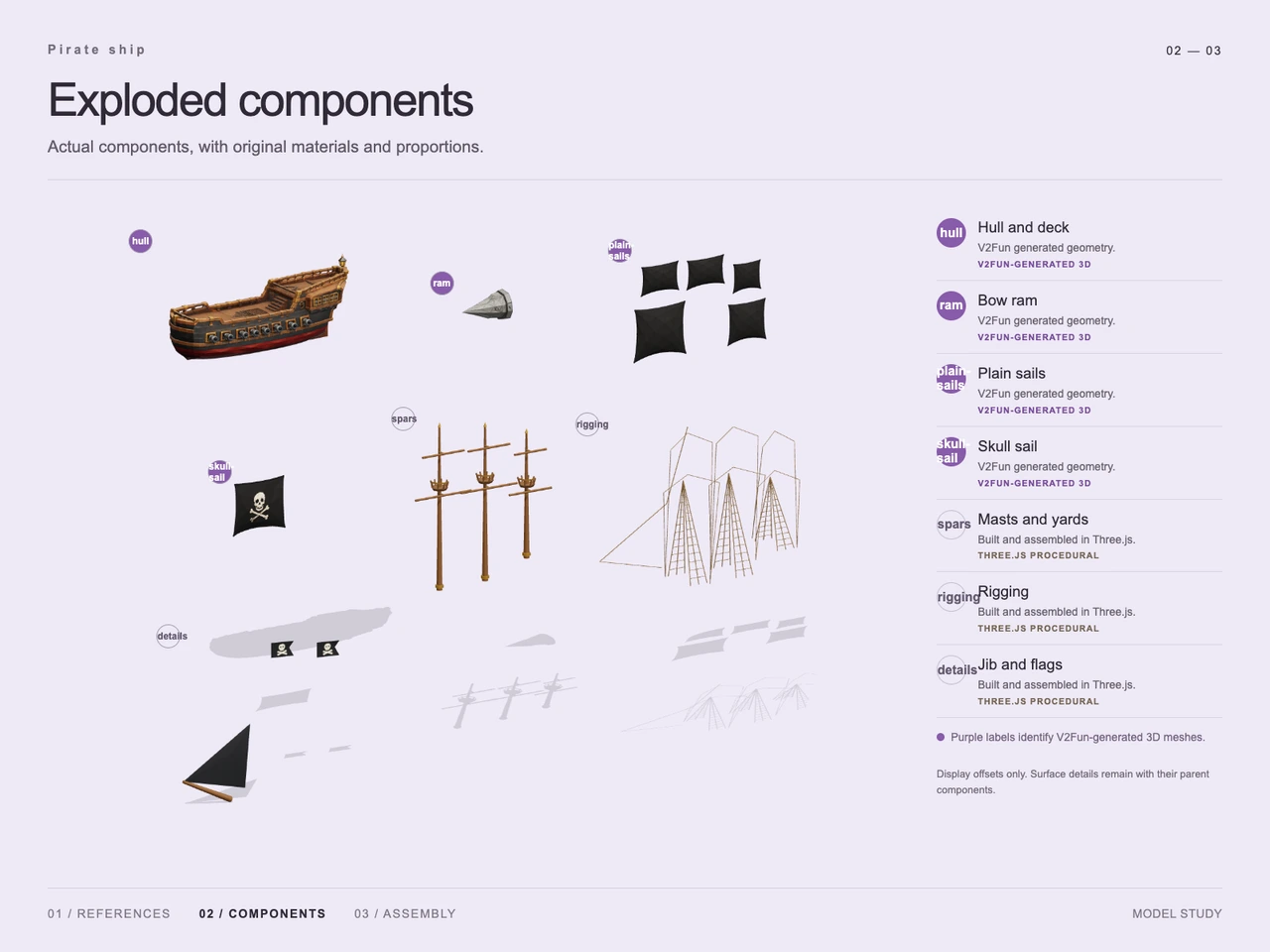
Process · Build a Three-Masted Pirate Ship with GPT-6 Astra and V2Fun
-
03 / Final
Final · Build a Three-Masted Pirate Ship with GPT-6 Astra and V2Fun
Overview
This case reconstructs a stylized three-masted pirate ship from one reference image. Its identity depends on several connected features: a dark layered hull with a red lower section, gold-colored trim, a row of cannons, tiered black sails, ivory skull emblems, and an oversized silver bow ram.
The technical account assigns GPT-6 Astra the visual analysis, component planning, and assembly coordination. The process image identifies which components came from V2Fun and which were built procedurally in Three.js. Together, the reference, exploded view, and final render document a hybrid modeling approach. The broader GPT-6 Astra and V2Fun collaboration workflow explains the division of responsibilities behind this approach.
Tools Used
- GPT-6 Astra: visual hierarchy analysis, component decomposition, and agent-side assembly coordination, as described in the case notes.
- V2Fun: generated geometry for the hull and deck, bow ram, plain sails, and skull sail, as labeled in the exploded view.
- Three.js: procedural masts and yards, nautical rigging, jib and flags, plus final assembly and detailing.
- One reference image: the appearance and composition target.
- GLB: the supplied delivery format.
The generated component stage relates directly to V2Fun’s image-to-3D model generator.
Step 1 — Identify the Ship’s Visual Hierarchy
The reference places the bow toward the front left and the raised stern toward the back right. Three masts establish the upper silhouette, while the skull sail and pointed ram provide strong focal points. The cannon row, stern windows, wooden railings, and lantern establish smaller details around the hull.
The prompt requests a low-poly appearance with clear triangular facets and restrained texture detail. This is an art direction target; the images do not establish a polygon budget. For guidance on expressing silhouette, materials, and visual complexity, see the AI 3D prompting guide.
Step 2 — Separate Generated Components from Procedural Structures
The exploded view documents seven component groups. Four are labeled as V2Fun-generated: hull and deck, bow ram, plain sails, and skull sail. Three are labeled as Three.js procedural work: masts and yards, rigging, and jib and flags.
These are presentation groups rather than a verified mesh count. The hull group already displays the cannon row and stern architecture; the image does not establish separate generation tasks for each cannon, window, or railing. Its display offsets expose the groups while retaining surface details with their parent components.
Step 3 — Assemble the Sailing Structure
The final assembly places the three masts along the deck and arranges the black sails in two tiers. Horizontal wooden yards support the sails, with the skull emblem centered on the large middle sail. Thin ropes and ladder-like rigging connect the deck, masts, and upper structures.
At the bow, the triangular jib extends above the projecting ram. Two skull flags sit near the mast tops. This combination connects the generated sail and hull forms with the procedural structures shown in the process image.
Step 4 — Present the Delivered Assembly
The final panel identifies its image as a render of the delivered GLB after reloading. It shows the assembled vessel on a neutral cream ground, making the hull, rigging, and sail arrangement visible without the reference’s blue sea.
The result retains the main color relationships and recognizable ornaments, while the sail arrangement appears taller and more open than in the reference. It is a stylized reconstruction with visible proportional differences.
Workflow
Single reference → Visual hierarchy analysis → Component decomposition → V2Fun component generation → Three.js structures and assembly → GLB export → Reloaded assembly render.
Prompt
English translation of the design brief:
A large three-masted pirate sailing ship on a low-poly blue sea, with the bow facing the front left and the stern toward the back right. Use a layered dark charcoal hull, a dark red bottom below the waterline, brown wooden decks, and gold metal trim. Along the side, short black cannon barrels project from a full row of square, gold-framed gunports.
Fit the bow with an enormous silver-gray, faceted pointed ram. Above it, extend a slender bowsprit and a black triangular sail. Three wooden masts carry multiple tiers of billowing black sails. Place a prominent ivory skull and crossbones on the large central sail, and matching skull emblems on two black pirate flags at the top. Clearly separate ropes, yards, rope ladders, lookout platforms, deck railings, and the raised stern structure. Include gold-framed stern windows and a small warm lantern.
Use clean low-poly triangular facets and hard-edged flat shading, avoiding fine photorealistic textures. Show the complete hull and tallest mast from a slightly elevated front three-quarter view. Center the subject against a blue-gray gradient sky, with clearly geometric ocean waves and soft directional lighting. No crew, extra text, or watermarks. Landscape composition, approximately 5:4.
Result
The final render shows a complete pirate ship assembly with three masts, black sails, skull insignia, wooden deck structures, a cannon-lined hull, nautical rigging, and a faceted bow ram. The geometric sea belongs to the reference presentation and is not visible in the final render.
The supplied output is Pirate_Ship.glb, with a file size of 146,654,432 bytes, approximately 146.65 MB, and MIME type model/gltf-binary. These are supplied file metadata; the visual assessment comes from the case images. No case-specific timing or token benchmark is provided.
For context on the delivery format, consult the AI 3D export guide for FBX, GLB, OBJ, and USDZ.
Frequently Asked Questions
Which pirate ship components were generated with V2Fun?
The exploded view labels four groups as V2Fun-generated geometry: hull and deck, bow ram, plain sails, and skull sail. These labels do not establish an exact mesh count.
What did GPT-6 Astra and Three.js contribute?
The technical notes assign Astra visual analysis, component planning, and assembly coordination. The process image credits Three.js with masts and yards, nautical rigging, and the jib and flags; the final panel also credits Three.js assembly and detailing.
How closely does the assembled ship follow the reference?
It retains the three-mast silhouette, black sails, skull emblems, cannon row, dark and red hull, gold-colored trim, and silver bow ram. The final sail arrangement appears taller and more open, so the result is a stylized reconstruction rather than an exact visual match.
Does the final presentation include the low-poly ocean?
The reference shows geometric blue waves, but the final render presents the ship on a neutral cream ground. The supplied images do not establish whether ocean geometry is included in the GLB.
What file was delivered, and is its low-poly specification verified?
The supplied metadata lists Pirate_Ship.glb at 146,654,432 bytes with MIME type model/gltf-binary. Low-poly describes the requested visual style; no polygon count or topology validation is supplied.
Explore More
-
GPT-6 Astra x V2Fun - From Code Generation to Model Collaboration | V2Fun
See how GPT-6 Astra and V2Fun combine agent reasoning, code generation, and AI 3D foundation models to build complex, structured 3D assets.
View page → -
V2Fun - AI 3D Model Generator
Create 3D models from text prompts or images with V2Fun's AI 3D model generator. Generate characters, props, game assets, and 3D-printable models faster.
View page → -
AI 3D Model Generator Prompting Guide for Reusable Assets | V2Fun
Use an AI 3D Model Generator to create reusable low-poly assets with stronger prompts, consistent styles, practical validation, and faster iteration.
View page → -
AI 3D Model Generator Export Guide: FBX, GLB, OBJ, or USDZ? | V2Fun
Use an AI 3D Model Generator with the right export format. Compare FBX, GLB, OBJ, and USDZ for Blender, game engines, animation, web, and AR.
View page →