Build a Stylized Chef Kitchen with GPT-6 Astra and V2Fun
Explore Chef’s Atelier: a full-body chef generated with V2Fun, combined with a prop-filled kitchen built in Three.js, and presented as a complete GLB scene.
Interactive 3D preview · Build a Stylized Chef Kitchen with GPT-6 Astra and V2FunDrag to rotate · Scroll to zoom
Take a Closer Look
-
 01 / Input
Input · Build a Stylized Chef Kitchen with GPT-6 Astra and V2Fun
-
 02 / Process
Process · Build a Stylized Chef Kitchen with GPT-6 Astra and V2Fun
-
03 / Final
Final · Build a Stylized Chef Kitchen with GPT-6 Astra and V2Fun
Overview
Chef’s Atelier turns a brief for a full-body, animated-film-style chef and a richer collection of props into a kitchen diorama. The character wears a tall white chef’s hat, white jacket, red neckerchief, dark apron, and black shoes, with a wooden spoon held upright.
The case demonstrates a clear division of modeling work. V2Fun generates the chef and spoon as one continuous character asset. Three.js supplies the surrounding kitchen, including furniture, cookware, shelves, and small food props. The technical notes frame GPT-6 Astra’s role around understanding the subject, identifying parts, and coordinating how they should be built. This follows the broader approach described in GPT-6 Astra and V2Fun’s model collaboration workflow.
Tools Used
- GPT-6 Astra: scene understanding, decomposition, and task coordination as described in the case notes.
- V2Fun: generated character references and the chef-and-spoon 3D asset.
- Three.js: procedural kitchen construction and character material and normal refinement, as documented in the component sheet.
- GLB: the supplied final asset format.
Step 1 — Prepare the Character References
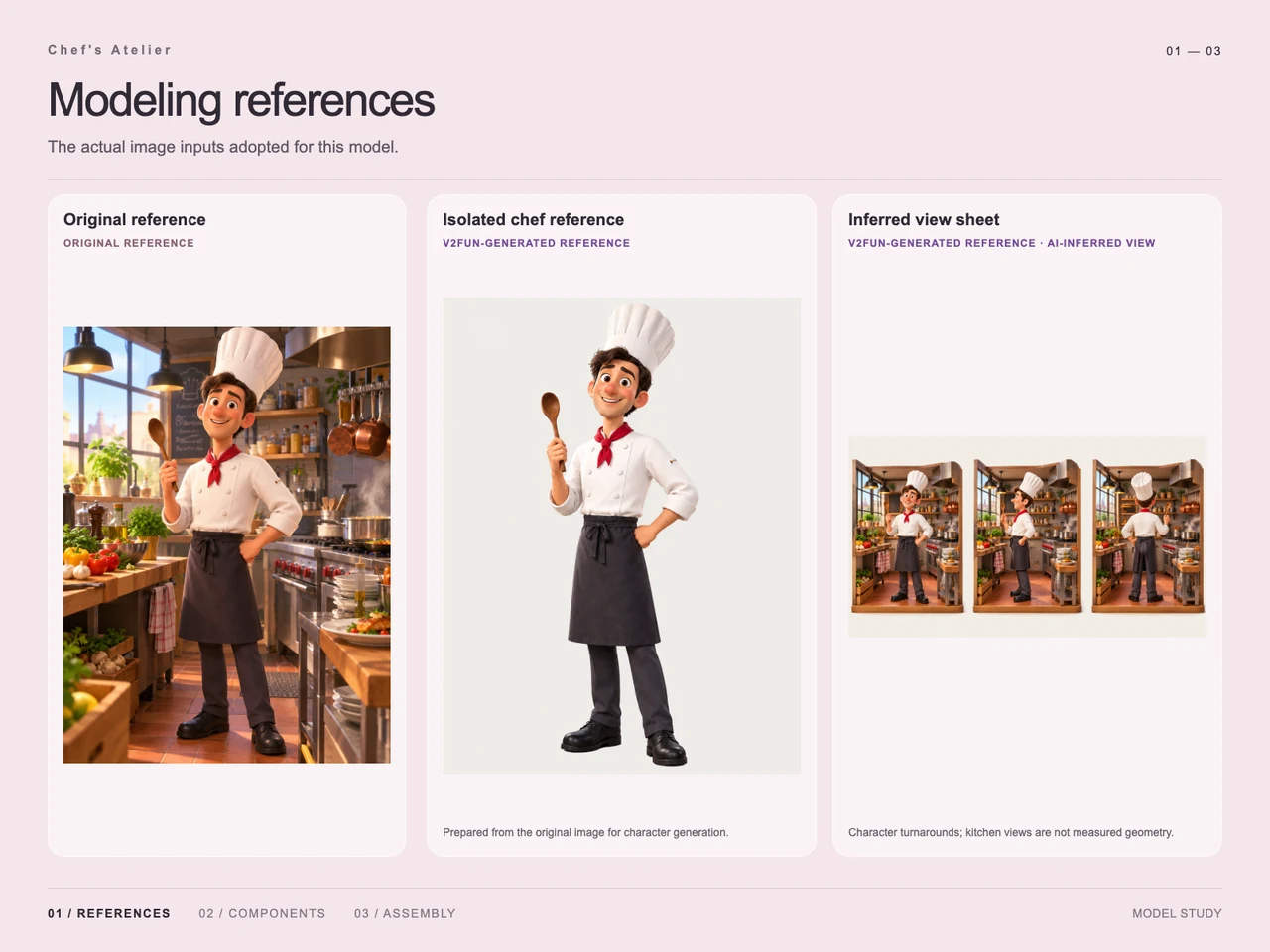
The reference sheet presents the original chef in a furnished kitchen, an isolated full-body chef against a plain background, and an inferred view sheet. The isolated image makes the clothing, pose, spoon, and complete silhouette easier to distinguish from the environment.
The additional views are labeled as AI-inferred. They provide visual interpretation of other angles; the kitchen views are not measured geometry. For related preparation principles, see the single-image and multi-view input guide.
Step 2 — Divide the Character and Environment Work
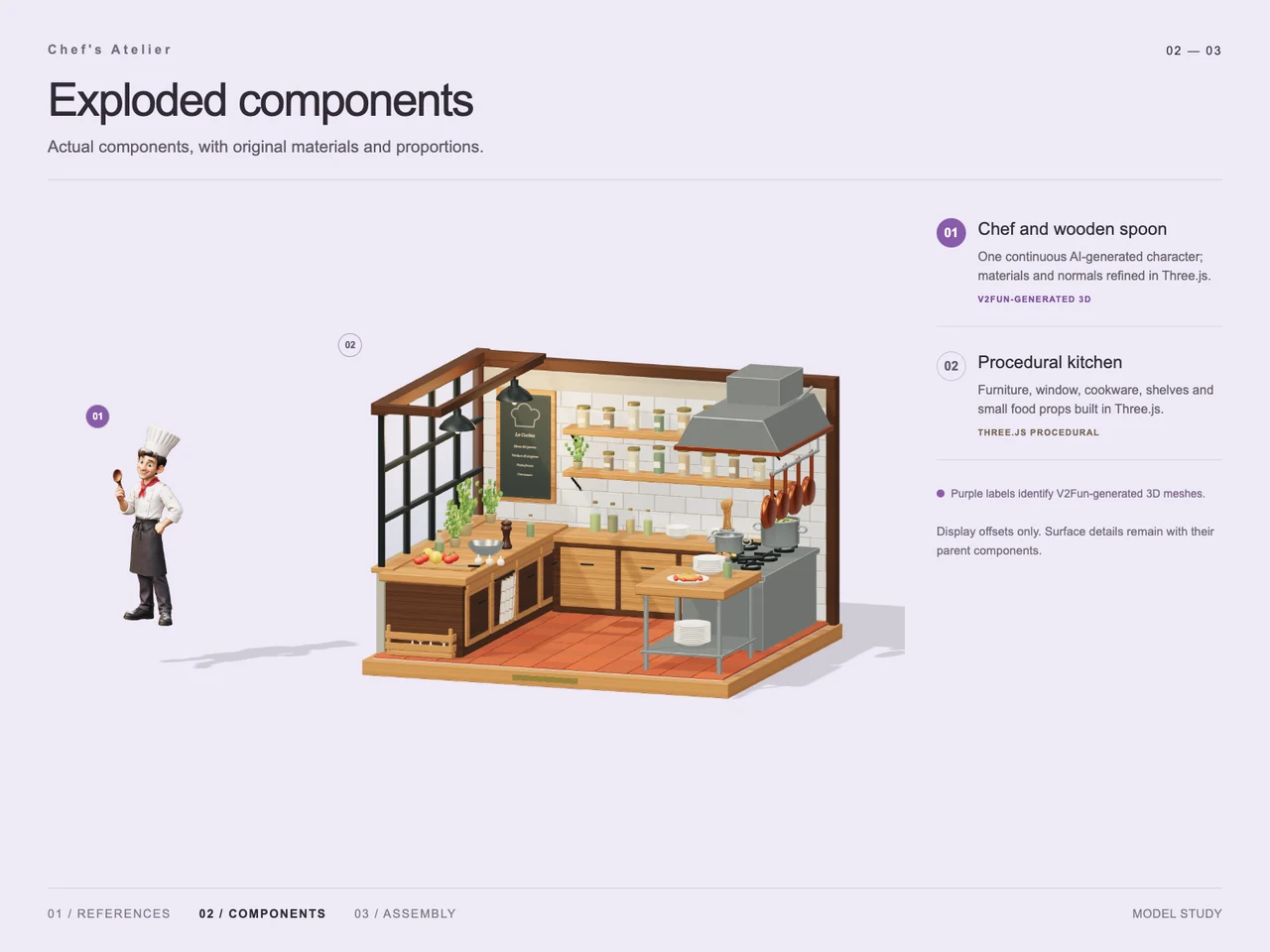
The exploded presentation shows two main groups: the chef with the wooden spoon, and the procedural kitchen. Although the technical notes discuss identifying features such as the hat, apron, and utensils, the demonstrated character remains one continuous generated asset. The images do not establish separately generated clothing or spoon components.
This division assigns the expressive face, clothing folds, and character silhouette to V2Fun while keeping the kitchen construction in Three.js. The AI 3D model generator feature page provides background on the generation capability used for the character.
Step 3 — Build the Kitchen and Refine the Character
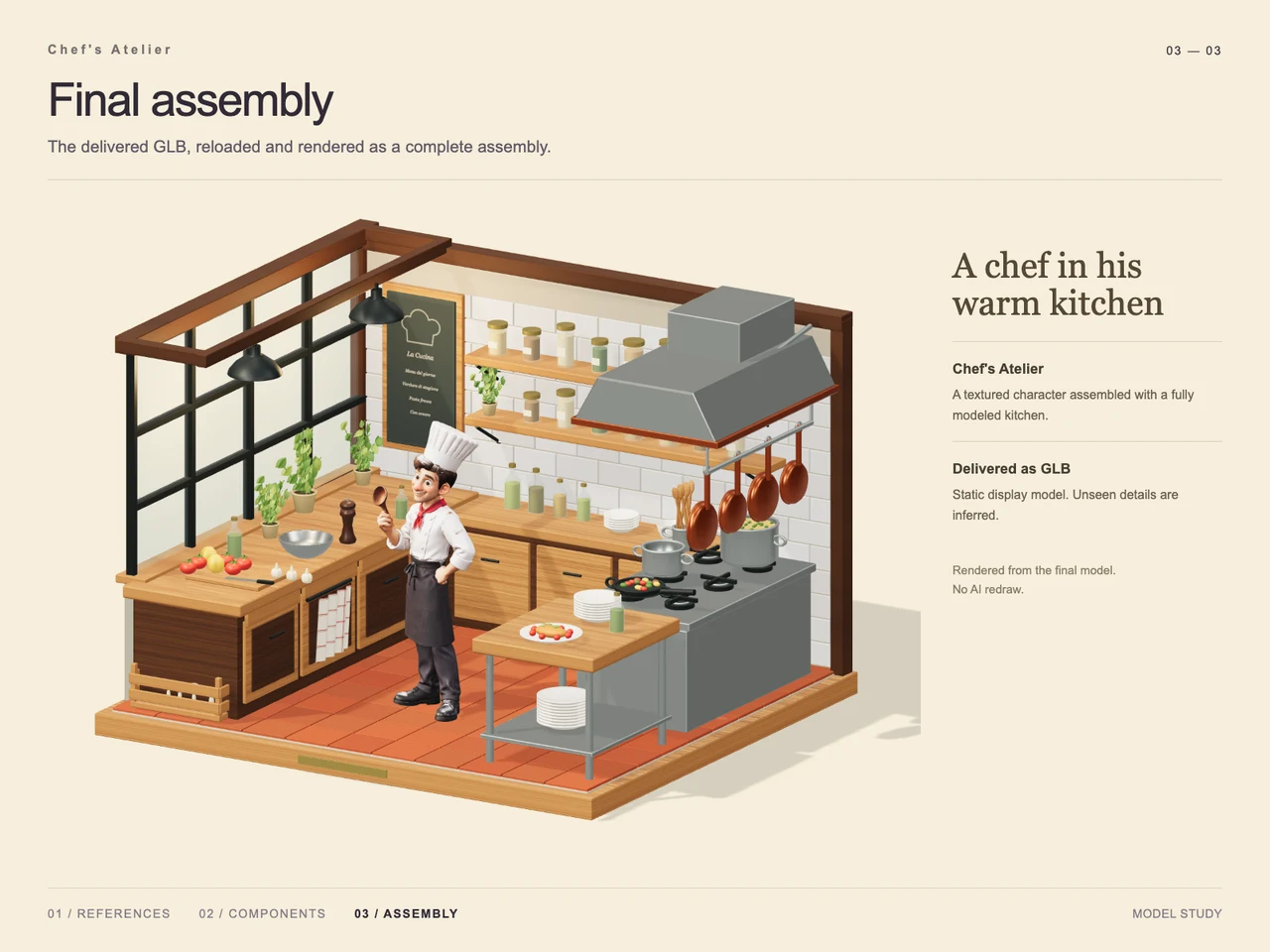
The procedural environment translates the request for more objects into visible scene detail: wooden counters and cabinets, a large framed window, pendant lamps, wall shelves with jars, potted herbs, hanging copper-colored pans, a stove and extractor hood, and a preparation table with stacked plates.
Food, bottles, bowls, and utensils fill the work surfaces. The component sheet also records material and normal refinement on the generated chef in Three.js. Its exploded spacing is for presentation, with surface details retained on their parent components.
Step 4 — Assemble and Present the Final Scene
The final image places the chef between the counters and the front preparation table. Terracotta-colored floor tiles and a wooden base frame the open kitchen, while the window and rear wall establish the room’s boundaries.
The final presentation identifies this view as a render of the delivered GLB after reloading the complete assembly. It describes the output as a static display model and notes that unseen details are inferred.
Workflow
Original reference → isolated chef and inferred views → character/environment split → V2Fun character generation and Three.js kitchen construction → material and normal refinement → assembly → GLB export and reload presentation.
Prompt
Translated design brief: “A chef, Pixar-style character, full-body view, with more objects. Just switch to a bolder, brighter font.”
The character style, full-body framing, and richer surroundings define the modeling intent. The final clause concerns presentation typography.
Result
The result is a textured chef assembled within a furnished kitchen diorama. The supplied file is chef-kitchen.glb, with a size of 43,799,788 bytes, approximately 43.80 MB, and MIME type model/gltf-binary. For context on this delivery format, see the AI 3D export guide covering GLB.
The technical notes propose that assigning complex surfaces to V2Fun can reduce low-level geometry coding and shorten iteration. This case supplies no token counts or elapsed-time measurements, so it demonstrates the division of work without establishing a measured efficiency gain.
Frequently Asked Questions
What did V2Fun generate for the chef kitchen scene?
The reference sheet labels the isolated chef and inferred views as V2Fun-generated references. The component sheet identifies the chef and wooden spoon as one continuous V2Fun-generated 3D character.
Were the chef’s hat, apron, and spoon generated separately?
The demonstrated breakdown does not show separate generated assets for those features. It shows the chef and spoon together as one continuous character, alongside a separate procedural kitchen group.
Which kitchen elements were built in Three.js?
The component sheet attributes the kitchen furniture, window, cookware, shelves, and small food props to Three.js. Visible examples include cabinets, jars, hanging pans, the stove, extractor hood, and preparation table.
Are the additional reference views measured reconstructions?
No. The view sheet is labeled as AI-inferred, and its kitchen views are explicitly described as unmeasured. The final presentation also notes that unseen details are inferred.
What was delivered, and were efficiency gains measured?
The supplied output is chef-kitchen.glb, a 43,799,788-byte GLB file. The final presentation describes a static display assembly. No case-specific token counts or total workflow timings are supplied.
Explore More
-
GPT-6 Astra x V2Fun - From Code Generation to Model Collaboration | V2Fun
See how GPT-6 Astra and V2Fun combine agent reasoning, code generation, and AI 3D foundation models to build complex, structured 3D assets.
View page → -
AI 3D Model Generator Input Guide: Single vs. Multi-View | V2Fun
Learn how to prepare photos, multi-view references, and sketches for an AI 3D Model Generator, then inspect geometry and textures before export.
View page → -
V2Fun - AI 3D Model Generator
Create 3D models from text prompts or images with V2Fun's AI 3D model generator. Generate characters, props, game assets, and 3D-printable models faster.
View page → -
AI 3D Model Generator Export Guide: FBX, GLB, OBJ, or USDZ? | V2Fun
Use an AI 3D Model Generator with the right export format. Compare FBX, GLB, OBJ, and USDZ for Blender, game engines, animation, web, and AR.
View page →