Steampunk Skeleton Cowboy: GPT-6 Astra × V2Fun
Follow Ember Drifter from character references to a static GLB assembly, combining a V2Fun-generated skeleton cowboy with a Three.js weapon and travel case.
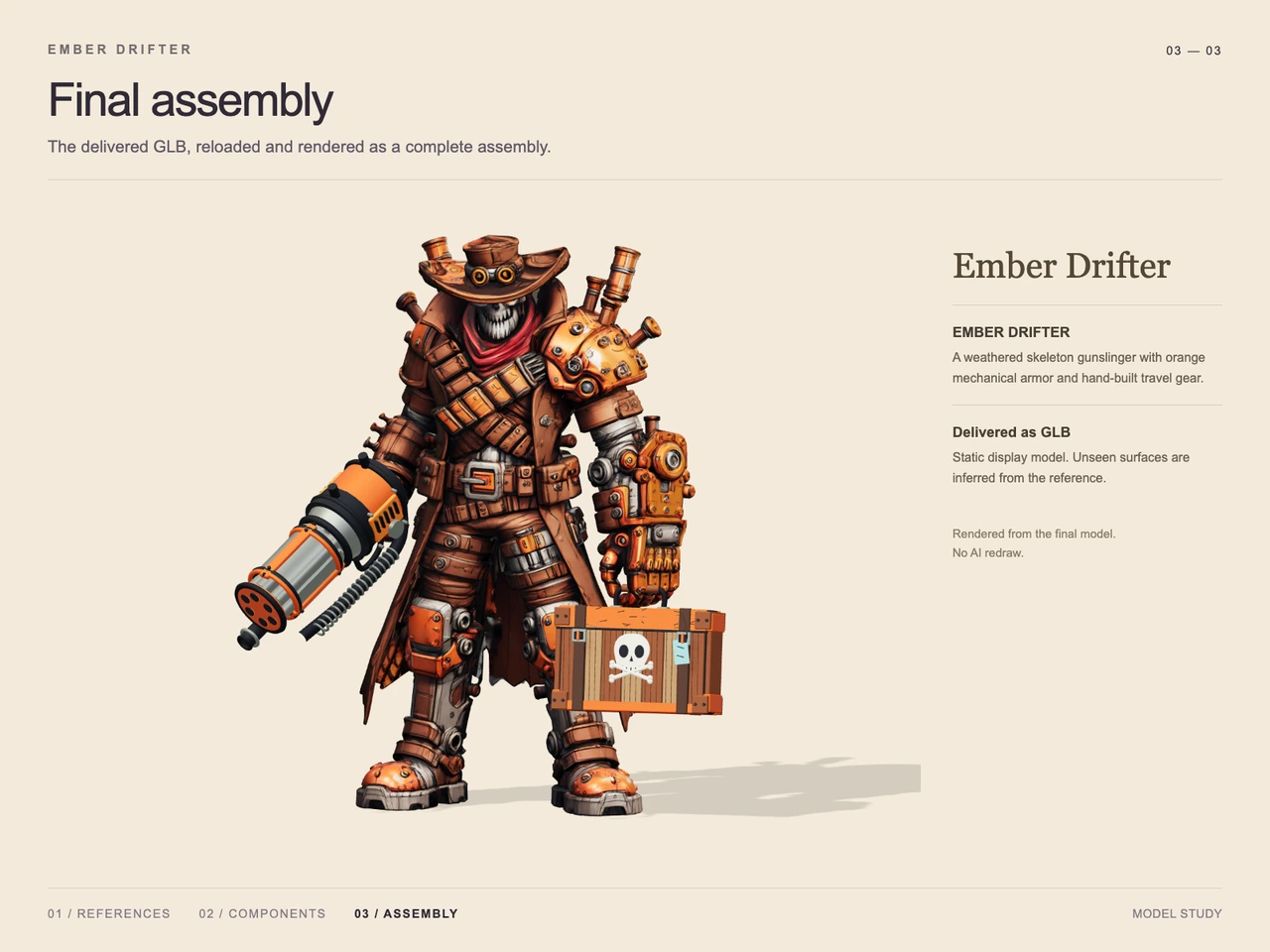
Interactive 3D preview · Steampunk Skeleton Cowboy: GPT-6 Astra × V2FunDrag to rotate · Scroll to zoom
Take a Closer Look
-
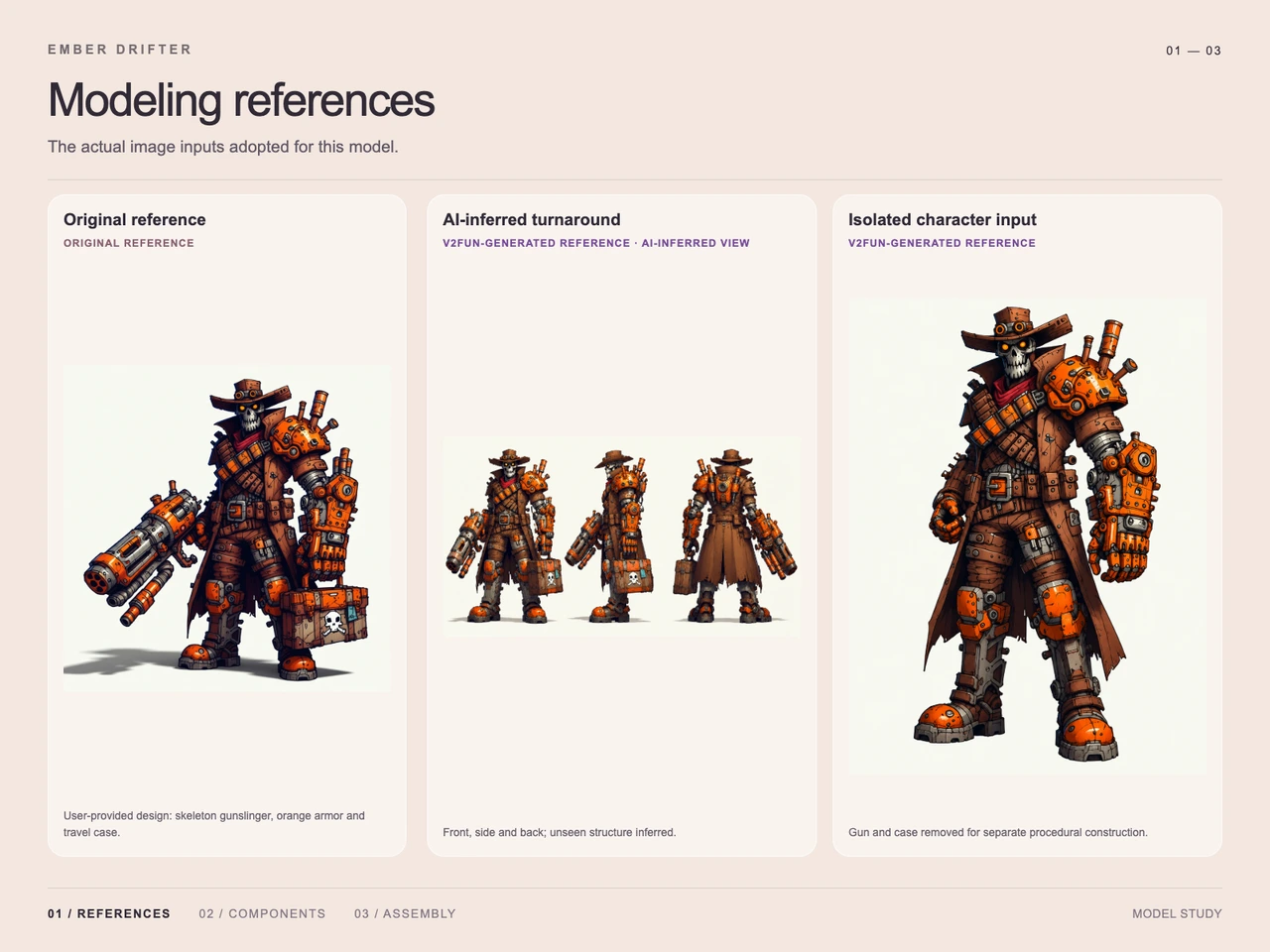 01 / Input
Input · Steampunk Skeleton Cowboy: GPT-6 Astra × V2Fun
-
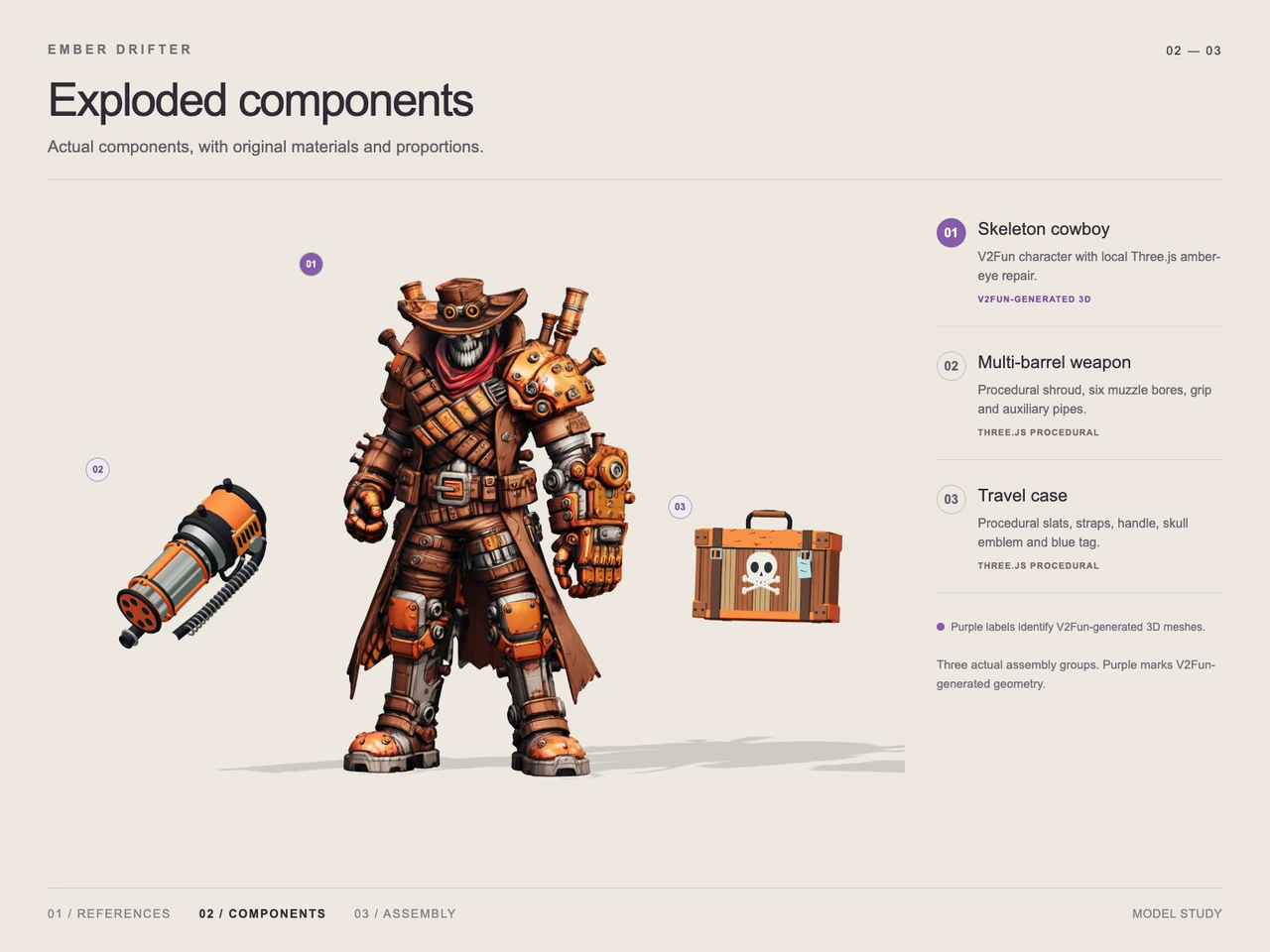 02 / Process
Process · Steampunk Skeleton Cowboy: GPT-6 Astra × V2Fun
-
03 / Final
Final · Steampunk Skeleton Cowboy: GPT-6 Astra × V2Fun
Overview
Ember Drifter is a full-body skeleton gunslinger with a broad cowboy hat, brass goggles, a dark red scarf, worn brown clothing, and oversized orange mechanical armor. The case explores how GPT-6 Astra and V2Fun translate a detailed character reference into a complete static 3D assembly.
The supplied process sheet identifies three assembly groups: the skeleton cowboy, a multi-barrel weapon, and a travel case. V2Fun generated the character, while Three.js supplied the two props and a local eye repair. This division illustrates the GPT-6 Astra and V2Fun model collaboration workflow through a character with both irregular costume surfaces and regular mechanical accessories.
Tools Used
- GPT-6 Astra: visual interpretation, component planning, and agent-side assembly and adjustment, as described in the case notes.
- V2Fun: generated reference imagery and the complex skeleton cowboy component.
- Three.js: procedural weapon and travel case construction, plus the documented local amber-eye repair.
- GLB: the supplied final asset format.
Step 1 — Establish the Character References
The input sheet presents the original design, an AI-inferred front/side/back turnaround, and an isolated character reference. The original establishes the orange armor, layered leather equipment, long coat, oversized gun, and skull-marked case.
The turnaround adds proposed views of unseen structure. These are inferred design interpretations rather than independently observed surfaces. The isolated reference removes the gun and case so the character can be generated separately. The single-image and multi-view input guide provides related guidance on framing complete subjects and reducing overlap between parts.
Step 2 — Generate the Character Component
V2Fun handles the cowboy as one main character component, including the skull, hat, scarf, coat, straps, armor, and boots. The exploded view shows a pale skull beneath the hat brim, crossed chest straps, a large belt buckle, and an especially prominent orange shoulder and mechanical arm on the viewer's right.
The process annotation records a local Three.js amber-eye repair. It does not establish a broader facial reconstruction pass or quantify the change. The relevant generation stage is described further on the V2Fun AI 3D model generator page.
Step 3 — Construct the Two Props
The weapon is documented as a procedural assembly with an orange shroud, six muzzle bores, a grip, and auxiliary pipes. Its visible silver-gray barrel section and external tubing carry the reference's mechanical theme into a simpler cylindrical construction.
The travel case is also procedural. It includes slats, straps, a handle, a white skull-and-crossbones emblem, and a small blue tag. The exploded view displays both props apart from the cowboy, making their separate construction clear.
Step 4 — Assemble and Present the Result
The final image places the weapon at the viewer-left hand, pointing diagonally downward, and positions the case beneath the armored hand on the viewer's right. The orange and brown palette connects the character to both accessories.
The final presentation identifies the image as a render of the delivered GLB after reloading, with no AI redraw. This documents a static assembly presentation; it does not demonstrate animation or an engine import test.
Workflow
Original reference → AI-inferred turnaround and isolated character reference → V2Fun character generation → Three.js props and local eye repair → Agent-side assembly → GLB export → Reloaded assembly render.
Prompt
English translation of the design brief:
A full-body, standing steampunk mechanical skeleton cowboy with an ivory-white skull face and orange-yellow glowing eye sockets. He wears a wide-brimmed brown cowboy hat with brass goggles mounted on its band, a dark red scarf, and a worn brown long coat. Crossed leather ammunition belts cover his chest; a large metal buckle and multiple tool pouches sit at his waist.
The shoulder and entire arm on the right side of the image have exaggerated orange mechanical armor with circular bearings, pistons, pipes, rivets, and small upright exhaust stacks. The mechanical hand carries an orange-brown toolbox bearing a white skull-and-crossbones symbol. The other hand holds a large science-fiction multi-barrel gun angled down toward the left, with silver-gray barrels, an orange casing, and external tubing.
Combine leather leg straps with mechanical knee guards and heavy orange-black metal boots. Use thick black outlines, layered cel shading, and a comic-style game character concept aesthetic. The main colors are orange, brown, black, and silver-gray, with scratched edges and chipped paint. Keep the forms exaggerated and the components clearly defined.
Show the complete character from a slightly low front three-quarter viewpoint against an off-white background, with a soft shadow extending left from the feet. One character, no explanatory text or watermark, square composition.
Result
The delivered asset is skeleton-cowboy.glb, with a supplied size of 51,554,752 bytes, approximately 51.55 MB, and MIME type model/gltf-binary.
The final render retains the defining hat-and-skull silhouette, red scarf, layered brown costume, orange mechanical arm, downward-pointing weapon, and skull-marked case. The props visibly reinterpret the reference through procedural geometry. Unseen surfaces remain inferred, and the case establishes a static display model rather than a measured fidelity benchmark.
For context on the delivery format, see the AI 3D export guide for FBX, GLB, OBJ, and USDZ.
Frequently Asked Questions
Which parts of the skeleton cowboy were generated with V2Fun?
The process sheet identifies the skeleton cowboy as the V2Fun-generated 3D component. The weapon and travel case are separate Three.js procedural components.
Why were the gun and case removed from the character reference?
The isolated reference prepared the cowboy for separate generation while the gun and case were constructed procedurally. The process sheet shows these as three distinct assembly groups.
Are the side and back views original reference images?
No. The reference sheet labels the turnaround as V2Fun-generated and AI-inferred. It proposes unseen structure rather than documenting original side and rear views.
What did Three.js contribute to Ember Drifter?
Three.js supplied the weapon's shroud, six muzzle bores, grip, and auxiliary pipes; the case's slats, straps, handle, emblem, and blue tag; and a documented local amber-eye repair.
What was delivered, and does the case demonstrate animation?
The supplied output is skeleton-cowboy.glb, a 51,554,752-byte model/gltf-binary file. The final sheet presents a reloaded static assembly render; rigging and animation are not demonstrated.
Explore More
-
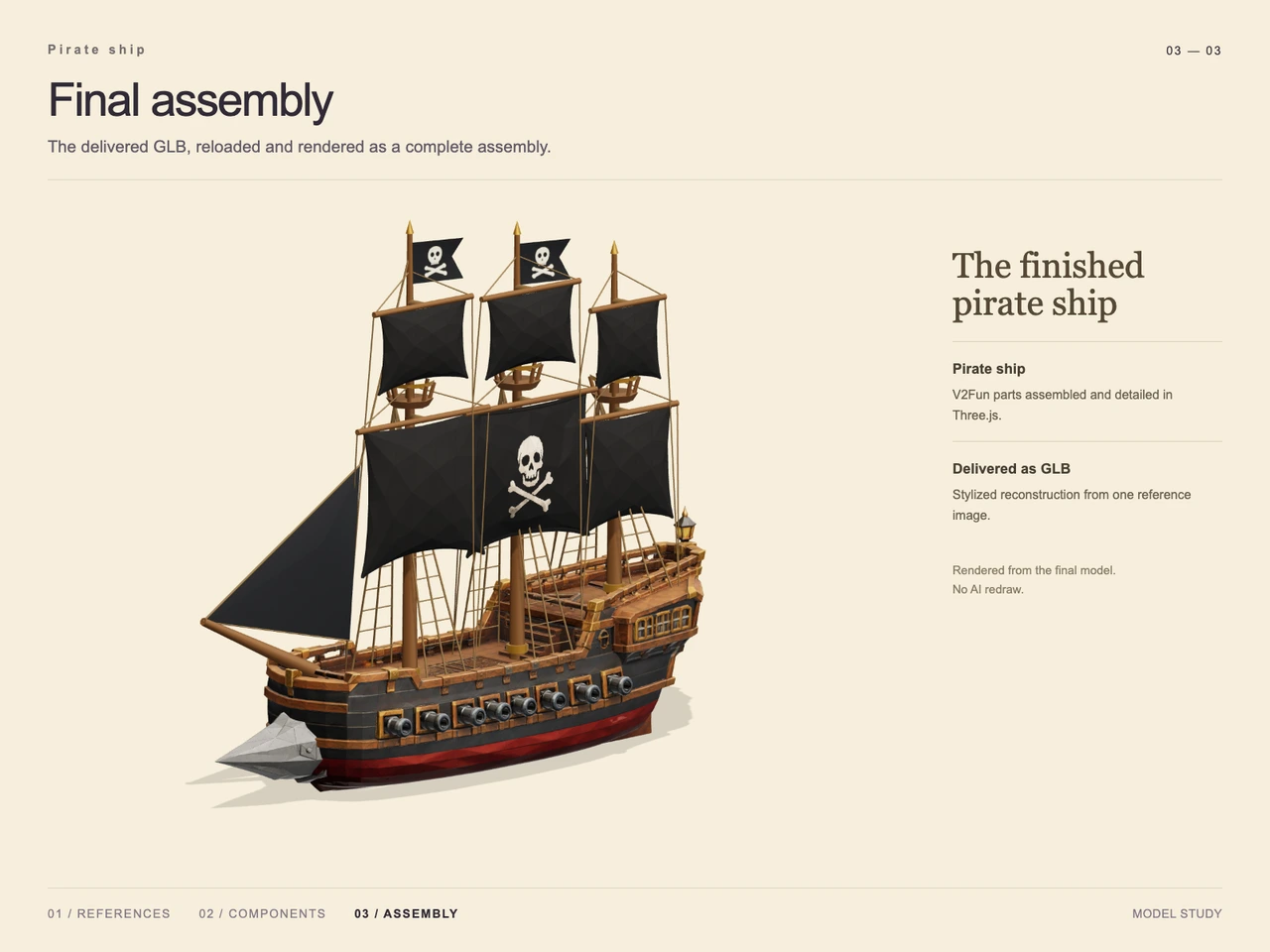
GPT-6 Astra x V2Fun - From Code Generation to Model Collaboration | V2Fun
See how GPT-6 Astra and V2Fun combine agent reasoning, code generation, and AI 3D foundation models to build complex, structured 3D assets.
View page → -
AI 3D Model Generator Input Guide: Single vs. Multi-View | V2Fun
Learn how to prepare photos, multi-view references, and sketches for an AI 3D Model Generator, then inspect geometry and textures before export.
View page → -
V2Fun - AI 3D Model Generator
Create 3D models from text prompts or images with V2Fun's AI 3D model generator. Generate characters, props, game assets, and 3D-printable models faster.
View page → -
AI 3D Model Generator Export Guide: FBX, GLB, OBJ, or USDZ? | V2Fun
Use an AI 3D Model Generator with the right export format. Compare FBX, GLB, OBJ, and USDZ for Blender, game engines, animation, web, and AR.
View page →