Build Sky Rider with GPT-6 Astra and V2Fun
Follow a retro sci-fi hover-bike build that combines a V2Fun-generated rider with a procedural Three.js vehicle, from isolated references to a complete GLB assembly.
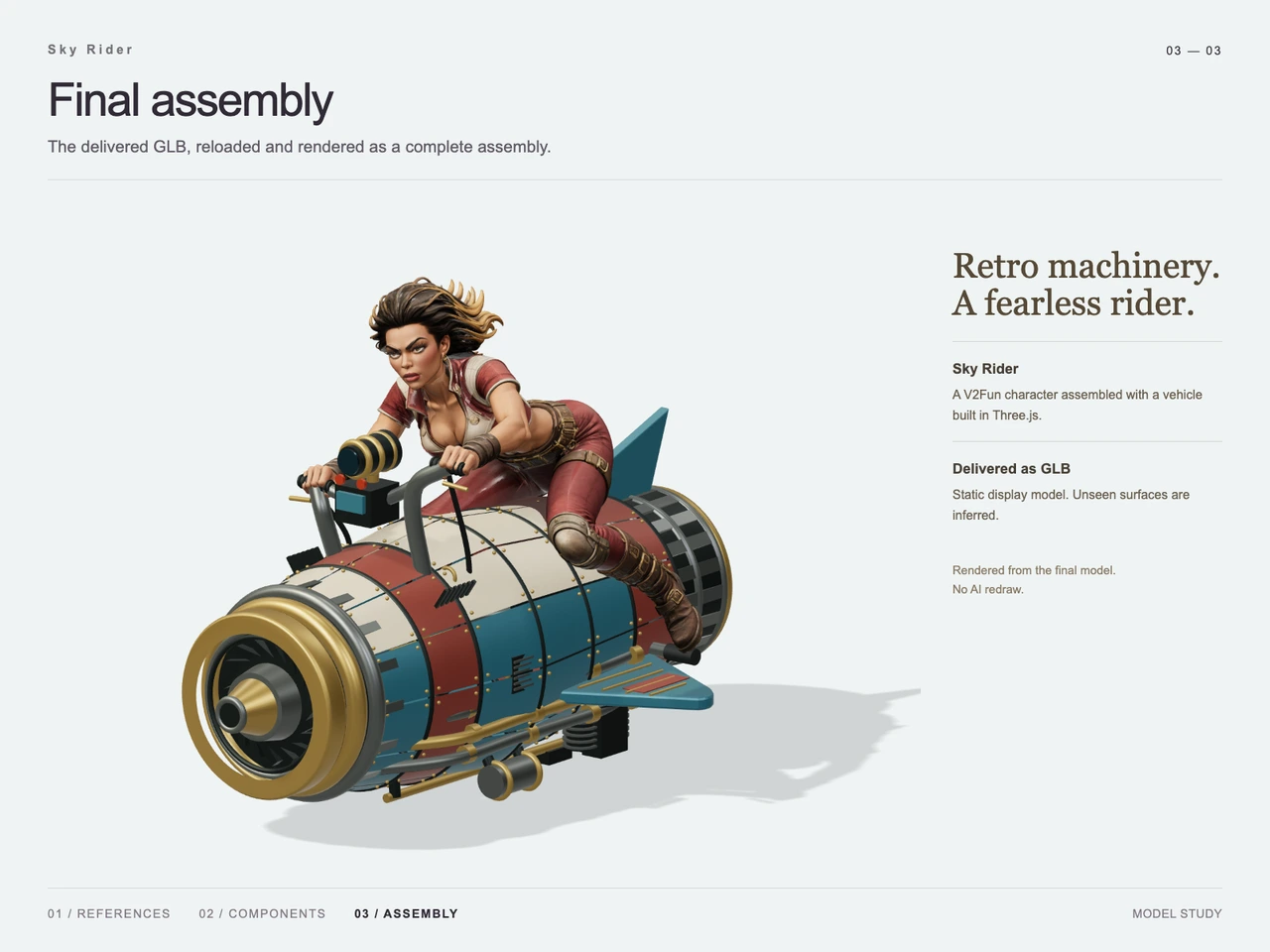
Interactive 3D preview · Build Sky Rider with GPT-6 Astra and V2FunDrag to rotate · Scroll to zoom
Take a Closer Look
-
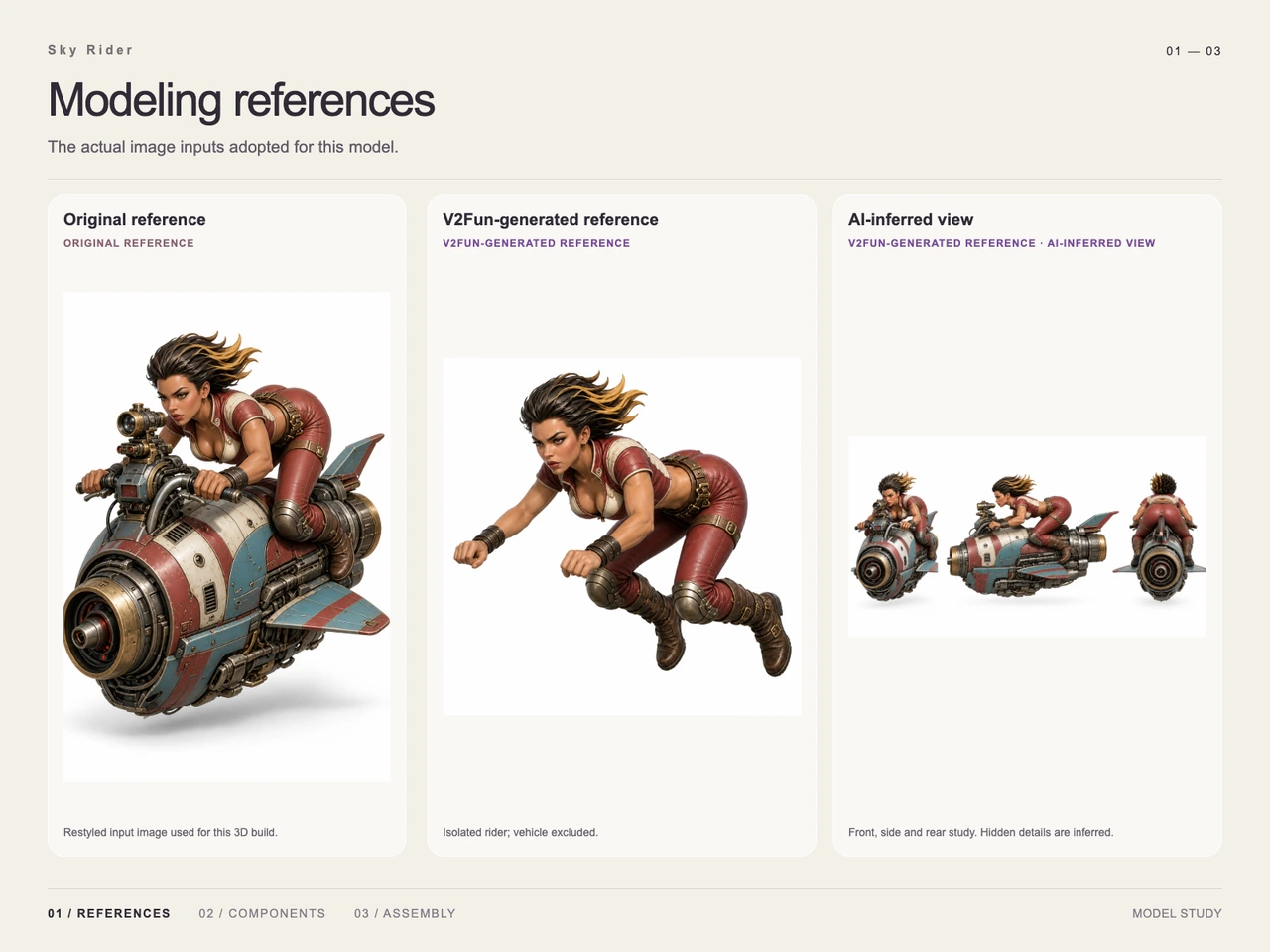 01 / Input
Input · Build Sky Rider with GPT-6 Astra and V2Fun
-
 02 / Process
Process · Build Sky Rider with GPT-6 Astra and V2Fun
-
03 / Final
Final · Build Sky Rider with GPT-6 Astra and V2Fun
Overview
Sky Rider brings an adult female adventurer and a wheel-free, turbine-shaped hover bike into one static 3D display model. The design centers on a forward riding pose, swept dark hair with golden streaks, red leather clothing, and a vehicle assembled from teal, brick-red, cream, and brass-colored elements.
The case demonstrates a specific division of work: V2Fun generates the textured rider, while Three.js supplies the vehicle. The technical account assigns visual analysis, component planning, and assembly calibration to GPT-6 Astra. This follows the broader GPT-6 Astra and V2Fun collaboration workflow, with the supplied component sheet documenting which parts use each approach here.
Tools Used
- GPT-6 Astra: visual hierarchy analysis, component planning, and agent-side assembly calibration, as described in the case notes.
- V2Fun: generated reference imagery and the textured rider component identified in the presentation.
- Three.js: procedural construction of the fuselage, front turbine, rear propulsion, flight surfaces, and rider controls.
- Reference studies: a complete concept image, an isolated rider, and AI-inferred front, side, and rear views.
- GLB: the supplied final asset format.
Step 1 — Separate the Rider from the Vehicle
The input sheet presents the complete rider-and-bike reference alongside a V2Fun-generated image of the rider alone. Removing the vehicle from that reference exposes the crouched pose, extended arms, bent knees, boots, and clothing silhouette for character generation.
The same sheet includes a front, side, and rear study explicitly labeled as AI-inferred. These views provide design guidance for unseen areas; they do not establish independently observed rear geometry. The single-image and multi-view input guide provides related context for preparing references and handling occlusion.
Step 2 — Organize Six Component Groups
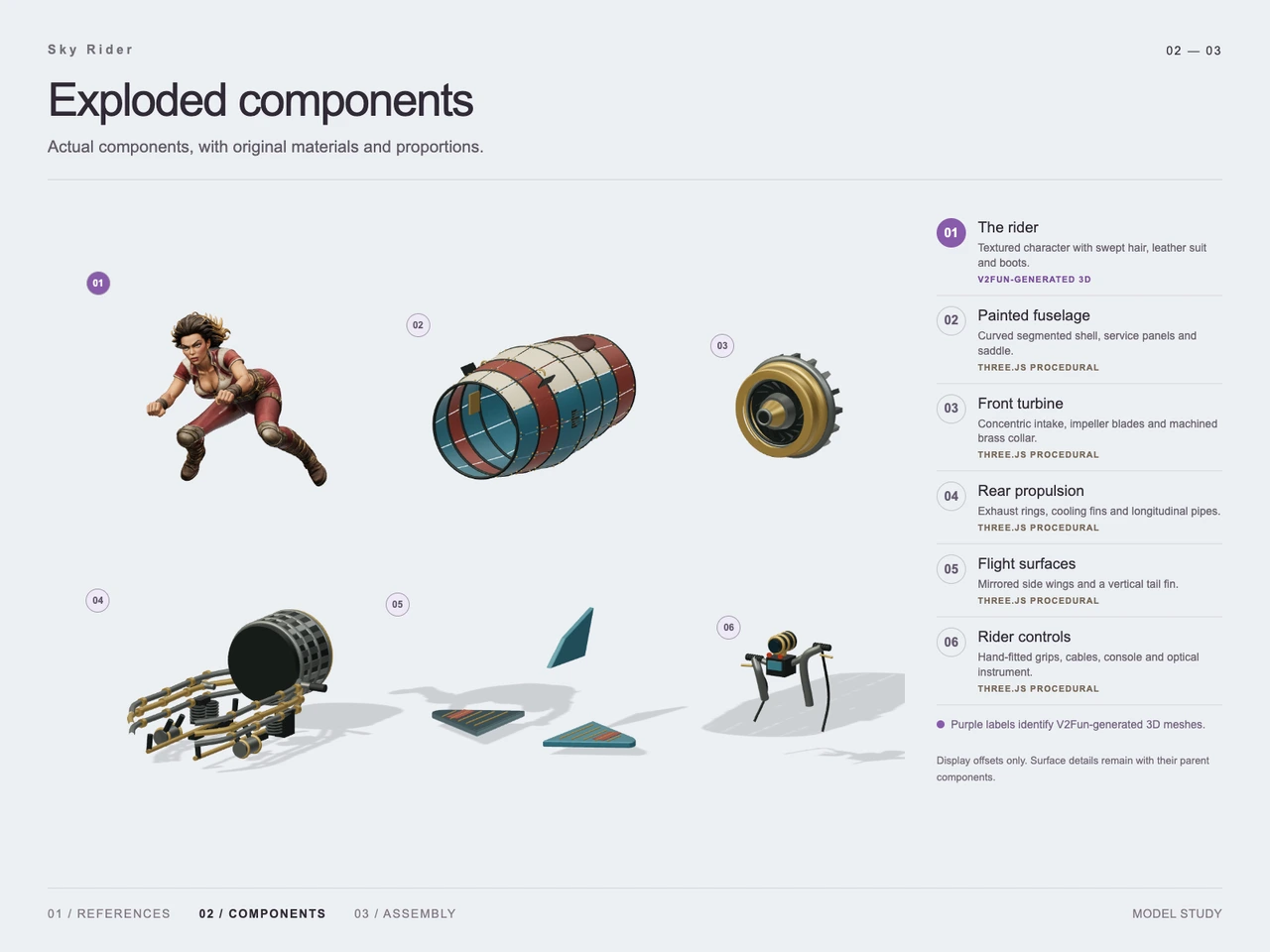
The exploded presentation shows six labeled groups:
- Rider: the textured character with swept hair, leather clothing, and boots.
- Painted fuselage: a curved, segmented shell with panels and a saddle.
- Front turbine: concentric intake rings, dark impeller blades, and a brass-colored collar.
- Rear propulsion: an exhaust assembly with cooling fins and longitudinal pipes.
- Flight surfaces: two short side wings and a vertical tail fin.
- Rider controls: grips, cables, a console, and an optical instrument.
These are presentation groups, not a verified mesh or object count. The exploded layout offsets them for visibility while retaining surface details with their parent components.
Step 3 — Generate the Character and Build the Machinery
The process sheet identifies the rider as V2Fun-generated 3D. Her face, wind-swept hair, clothing folds, belts, knee guards, and boots supply the organic detail within the assembly. The relevant product route is V2Fun's image-to-3D model generator.
The other five groups are labeled Three.js procedural. Their visible construction includes repeated panel divisions and rivets, circular turbine elements, pipe runs, wings, and curved control supports. The resulting vehicle uses a simpler, more regular mechanical treatment than the heavily weathered concept image.
Step 4 — Assemble the Riding Pose
In the final view, the rider straddles the shell, leans toward the optical instrument, and places her hands around the grips. Her bent legs frame the vehicle, with the visible boot extending beside the rear section. The intake faces the left foreground, while the tail fin rises behind the saddle.
This arrangement connects the character's pose to the vehicle's controls and seating area. The final presentation describes the delivered GLB as reloaded and rendered as a complete assembly, with unseen surfaces inferred.
Workflow
Complete reference → isolated rider and inferred view studies → six component groups → V2Fun rider generation and Three.js vehicle construction → assembly calibration → GLB export and documented reload render.
Prompt
English translation of the design brief:
An adult female adventure rider leans forward on a retro sci-fi hovering jet motorcycle, both hands gripping low, curved metal handlebars and both knees bent around the body. She has a focused expression and long dark-brown hair with golden streaks flowing backward. She wears a brick-red and cream short-sleeved leather riding outfit, red trousers, brown leather boots, brass knee guards, wrist guards, and multiple belts with metal buckles.
The vehicle has no wheels. Its main body is a thick, torpedo-shaped turbine engine with a huge concentric front intake, a brass outer ring, a black rotor, and a red inner ring. The nose points toward the left foreground. Faded teal, brick-red, and ivory metal panels cover the shell, with dense rivets, seams, vents, circular access panels, exposed pipes, and mechanical linkages underneath. A cylindrical jet engine and small tail fin sit at the rear, with short wings on both sides. A brass-and-black optical sight and small red indicator lights sit between the handlebars.
Create a highly detailed retro-futuristic 3D collectible-style model with realistic leather folds, worn metal, and chipped paint. Use a dynamic pose while keeping the subject sharp and readable. Show a slightly elevated front three-quarter view on a white background, hovering above the ground with a soft shadow. Use a vertical 2:3 composition, keep the rider and vehicle as complete in frame as possible, and include no extra text or watermark.
Result
The final render preserves the main character-and-vehicle silhouette, forward riding posture, red-and-cream clothing, teal paneling, brass-colored intake, exposed lower pipes, and short wings. The vehicle surfaces look cleaner and more geometric than the original reference, and the controls stand higher above the shell. The result is a recognizable interpretation of the brief rather than an exact reproduction of every requested detail.
The supplied asset is sky-rider.glb, with a file size of 41,665,000 bytes, approximately 41.67 MB, and MIME type model/gltf-binary. It is presented as a static display model. The evidence does not establish animation, texture-map specifications, or measured time and token savings.
For planning a subsequent handoff, the GLB and other 3D export formats guide explains format choices beyond this case's documented delivery.
Frequently Asked Questions
Which Sky Rider components were generated with V2Fun?
The exploded component sheet identifies the textured rider as V2Fun-generated 3D. It labels the fuselage, front turbine, rear propulsion, flight surfaces, and controls as Three.js procedural components.
What did GPT-6 Astra contribute to this build?
The case notes assign visual hierarchy analysis, component decomposition, and assembly calibration to GPT-6 Astra. The final presentation shows the generated rider combined with the procedural vehicle.
Were the front, side, and rear references observed views of the original object?
No. The reference sheet labels the supplementary views as AI-inferred and states that hidden details are inferred. They serve as design studies for the build.
How closely does the final hover bike match the prompt?
It retains the wheel-free turbine body, large brass-colored intake, teal-red-cream panels, wings, exposed pipes, and crouched rider. The final machinery is cleaner and more regular than the weathered reference, and the control supports rise higher above the shell.
What is the final Sky Rider deliverable?
The supplied metadata lists sky-rider.glb at 41,665,000 bytes, approximately 41.67 MB, with MIME type model/gltf-binary. The presentation describes a static display assembly rendered after reloading the delivered GLB; it does not demonstrate animation.
Explore More
-
GPT-6 Astra x V2Fun - From Code Generation to Model Collaboration | V2Fun
See how GPT-6 Astra and V2Fun combine agent reasoning, code generation, and AI 3D foundation models to build complex, structured 3D assets.
View page → -
AI 3D Model Generator Input Guide: Single vs. Multi-View | V2Fun
Learn how to prepare photos, multi-view references, and sketches for an AI 3D Model Generator, then inspect geometry and textures before export.
View page → -
V2Fun - AI 3D Model Generator
Create 3D models from text prompts or images with V2Fun's AI 3D model generator. Generate characters, props, game assets, and 3D-printable models faster.
View page → -
AI 3D Model Generator Export Guide: FBX, GLB, OBJ, or USDZ? | V2Fun
Use an AI 3D Model Generator with the right export format. Compare FBX, GLB, OBJ, and USDZ for Blender, game engines, animation, web, and AR.
View page →