Build a Royal British Bulldog Collectible with GPT-6 Astra and V2Fun
See how GPT-6 Astra and V2Fun transform a single product reference into a crowned bulldog character, procedural display pieces, inferred multi-angle studies, and a final assembled GLB collectible.
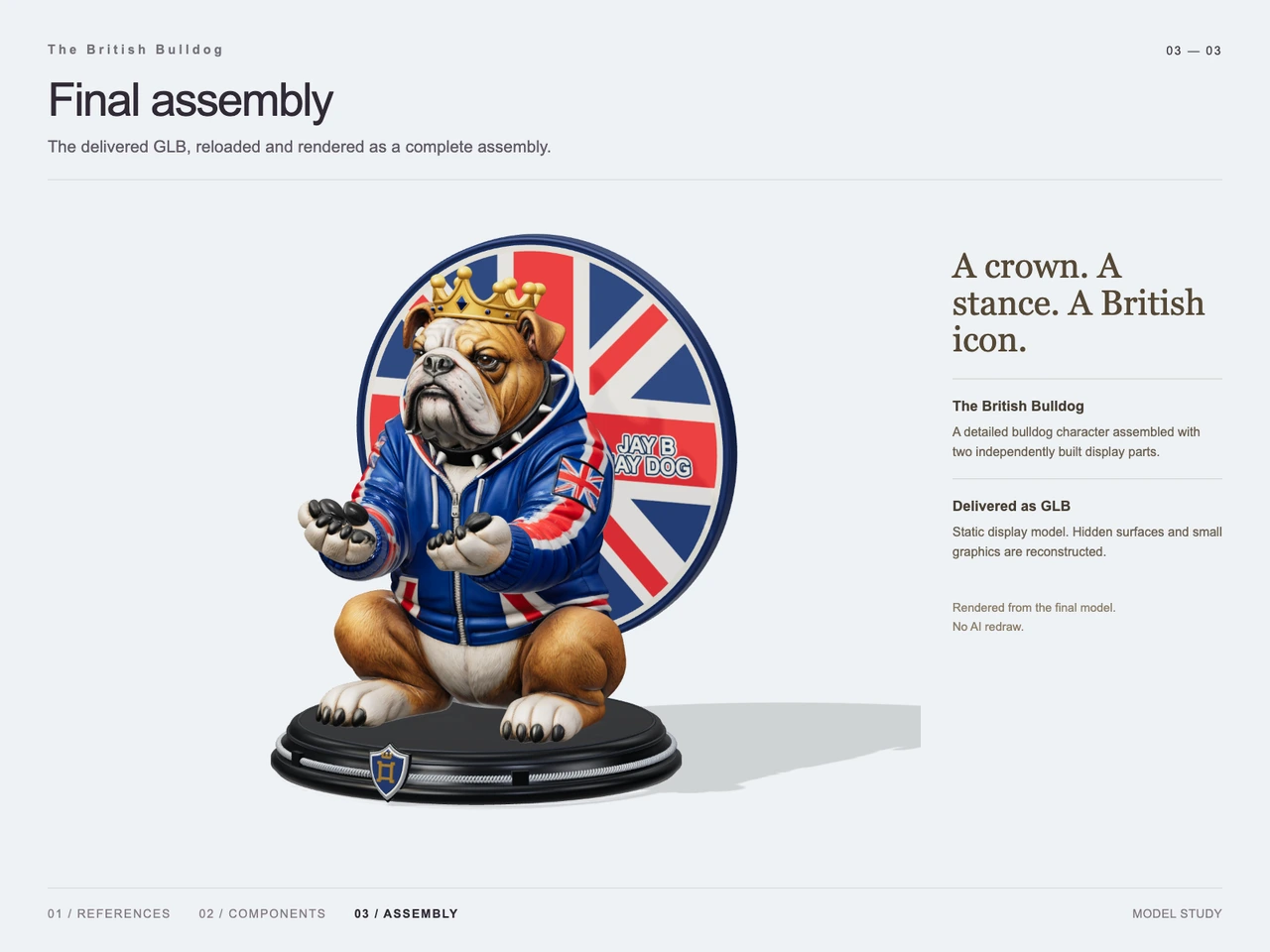
Interactive 3D preview · Build a Royal British Bulldog Collectible with GPT-6 Astra and V2FunDrag to rotate · Scroll to zoom
Take a Closer Look
-
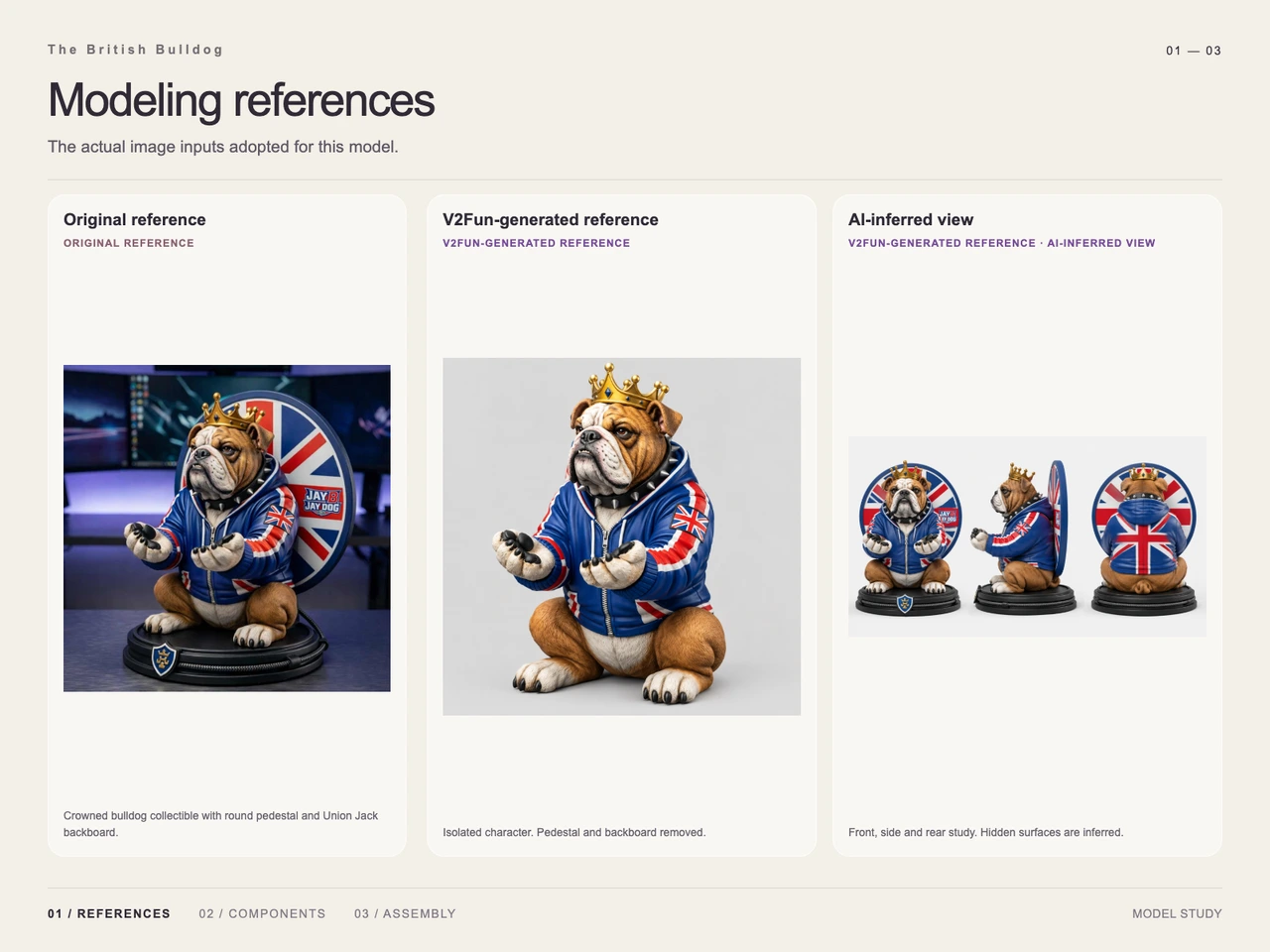 01 / Input
Input · Build a Royal British Bulldog Collectible with GPT-6 Astra and V2Fun
-
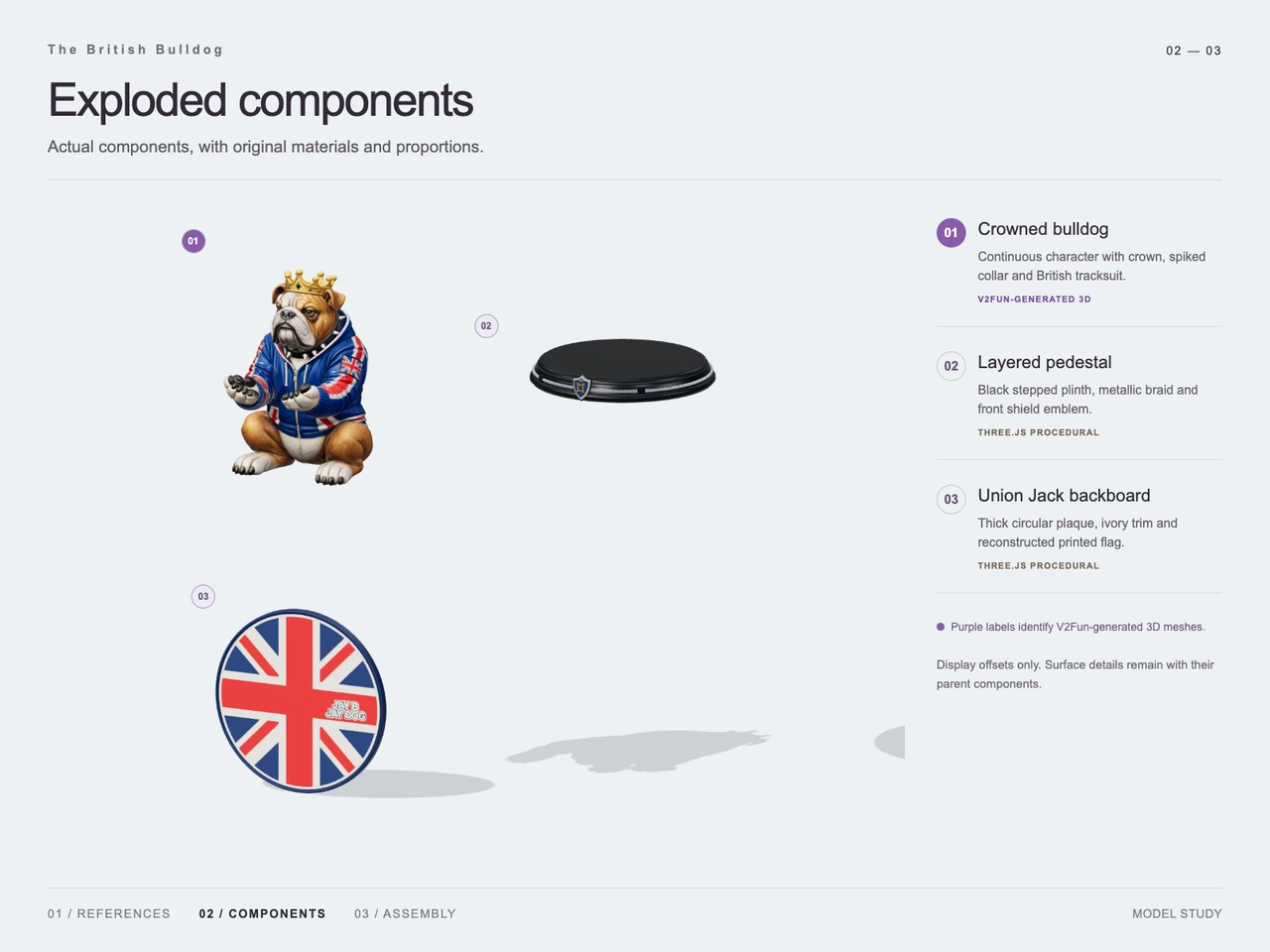 02 / Process
Process · Build a Royal British Bulldog Collectible with GPT-6 Astra and V2Fun
-
03 / Final
Final · Build a Royal British Bulldog Collectible with GPT-6 Astra and V2Fun
Overview
This case turns a single three-quarter product image into a complete 3D display concept featuring a stern British bulldog, gold crown, spiked collar, Union Jack jacket, circular flag backboard, and layered black pedestal. GPT-6 Astra interprets the composition and plans the component relationships, while V2Fun handles the visually complex bulldog character. The regular display pieces are reconstructed procedurally and then combined with the character.
The result shown in the case materials is a static GLB assembly. The images demonstrate visual reconstruction and assembly, but they do not establish topology quality, UV quality, exact dimensions, printability, or readiness for a particular engine.
Tools Used
- GPT-6 Astra: reference analysis, visual hierarchy, component planning, inferred-view guidance, and assembly calibration.
- V2Fun: generation of the detailed crowned bulldog character, including its clothing and visible surface treatment. See the broader GPT-6 Astra and V2Fun model-collaboration workflow.
- Three.js / procedural methods: reconstruction of the layered pedestal and circular Union Jack backboard.
- Visual reference: the source for the collectible's silhouette, materials, pose, decoration, and layout.
- GLB: the supplied final asset format; the GLB export guide explains where this format commonly fits in a 3D handoff.
Step 1 — Read the Visual Hierarchy
GPT-6 Astra identifies three primary elements in the source composition: the crowned bulldog, the black display pedestal, and the circular Union Jack backboard. It also tracks identity-defining details such as the raised front paws, serious expression, gold crown, spiked collar, blue zip-up jacket, flag graphics, front shield emblem, and two-line backboard logo.
Because the source is a single three-quarter image, rear and side details are not directly documented. The case therefore includes front, side, and rear studies in which hidden surfaces are explicitly treated as inferred rather than observed. For projects that have real views from several angles, V2Fun's multi-view 3D modeling workflow offers a more evidence-rich input route.
Step 2 — Isolate the Complex Character
The bulldog is separated from the original pedestal, backboard, desk surface, and blurred monitor environment. This gives the organic character a cleaner generation target while retaining the squat pose, broad wrinkled face, brown-and-white coat, crown, jacket, collar, and forward-facing paws.
V2Fun is assigned this irregular, detail-heavy component rather than requiring the agent to describe fur, facial folds, clothing creases, and accessories through extensive low-level geometry code. This is an image-guided use case related to V2Fun's AI 3D model generator.
Step 3 — Reconstruct the Display Components
The layered black pedestal and circular Union Jack backboard are treated as separate procedural components. Their regular profiles make them suitable for direct construction and placement. Visible decorative details include the pedestal's metallic zipper-like trim and blue-and-gold shield, plus the backboard's dark-blue border, flag design, and small two-line logo.
The reference does not reveal every hidden surface or exact measurement, so these elements are visual approximations based on the supplied image rather than dimensionally verified replicas.
Step 4 — Assemble and Calibrate
The agent positions the seated bulldog on the pedestal, places the circular backboard behind it, and adjusts scale, rotation, and overlap to recover the original front three-quarter composition. The final presentation shows the delivered GLB reloaded and rendered as one complete display assembly.
Workflow
Reference image → Analyze visual hierarchy → Isolate character → Infer unseen views → Generate bulldog with V2Fun → Build regular display parts procedurally → Calibrate placement → Assemble → Export GLB
Prompt
Create an anthropomorphic British bulldog collectible with brown-and-white fur, broad cheeks, deep facial wrinkles, drooping jowls, and a serious expression. Give it a gold crown with rounded points, a black leather collar with silver spikes, and a dark-blue zip-up hoodie decorated with red, white, and blue Union Jack panels and a flag sleeve patch. Show clear fabric folds, a silver zipper, visible claws, and paw pads as the bulldog sits on its hind legs with both front paws extended upward.
Place a circular Union Jack backboard with a dark-blue rim behind the character, including a small two-line “JAY B / JAY DOG”-style emblem on the right. Add a layered black circular display base with metallic zipper-like trim and a blue-and-gold shield emblem at the front. Use realistic 3D collectible product photography with distinct short-fur, metallic crown, fabric, and plastic-base materials. Frame the complete figurine and backboard from a front three-quarter angle on a dark-gray desk, against blurred monitors and blue-purple ambient light. Keep the subject bright, use shallow depth of field, compose a square image, and add no extra watermark.
Result
- Final output:
royal-bulldog.glb - File type: GLB (
model/gltf-binary) - File size: 35,381,800 bytes (35.38 MB)
- Visible assembly: crowned bulldog character, layered pedestal, and circular Union Jack backboard
- Workflow timing: not supplied
The result preserves the reference's recognizable character, costume, display silhouette, and component arrangement in a rendered static assembly. Further destination-specific inspection would still be required before making claims about geometry, materials, performance, animation, or manufacturing suitability.
Frequently Asked Questions
What was generated with V2Fun in this royal bulldog case?
The case presentation identifies the crowned bulldog character as the V2Fun-generated 3D component. Its visible design includes the brown-and-white coat, wrinkled face, crown, spiked collar, Union Jack jacket, seated pose, and raised paws.
Which parts were built procedurally?
The layered black pedestal and circular Union Jack backboard are labeled as Three.js procedural components. They were constructed separately and then positioned around the generated bulldog.
Were the side and rear views taken from additional source photographs?
No additional source photographs are shown. The case explicitly presents the side and rear studies as AI-inferred views, so hidden surfaces should be understood as interpretations of the single original reference.
What was delivered at the end of the workflow?
The supplied output is royal-bulldog.glb, a model/gltf-binary file containing 35,381,800 bytes, or 35.38 MB. The final case image shows the character, pedestal, and backboard rendered together.
Is the royal bulldog model proven ready for games or 3D printing?
No. The available evidence demonstrates a static visual assembly and GLB delivery, but it does not verify topology, UVs, polygon count, scale, wall thickness, engine performance, or printability.
Explore More
-
GPT-6 Astra x V2Fun - From Code Generation to Model Collaboration | V2Fun
See how GPT-6 Astra and V2Fun combine agent reasoning, code generation, and AI 3D foundation models to build complex, structured 3D assets.
View page → -
V2Fun - Multi-View to 3D Model AI
Generate accurate 3D models from multiple reference images with V2Fun's multi-view to 3D model AI. Create structured assets with better shape consistency and detail.
View page → -
V2Fun - AI 3D Model Generator
Create 3D models from text prompts or images with V2Fun's AI 3D model generator. Generate characters, props, game assets, and 3D-printable models faster.
View page → -
AI 3D Model Generator Export Guide: FBX, GLB, OBJ, or USDZ? | V2Fun
Use an AI 3D Model Generator with the right export format. Compare FBX, GLB, OBJ, and USDZ for Blender, game engines, animation, web, and AR.
View page →