Build a Punk Rocker in 3D with GPT-6 Astra and V2Fun
Follow a punk performer from visual references to an assembled GLB, combining a V2Fun-generated character and electric guitar with procedural microphone hardware in Three.js.
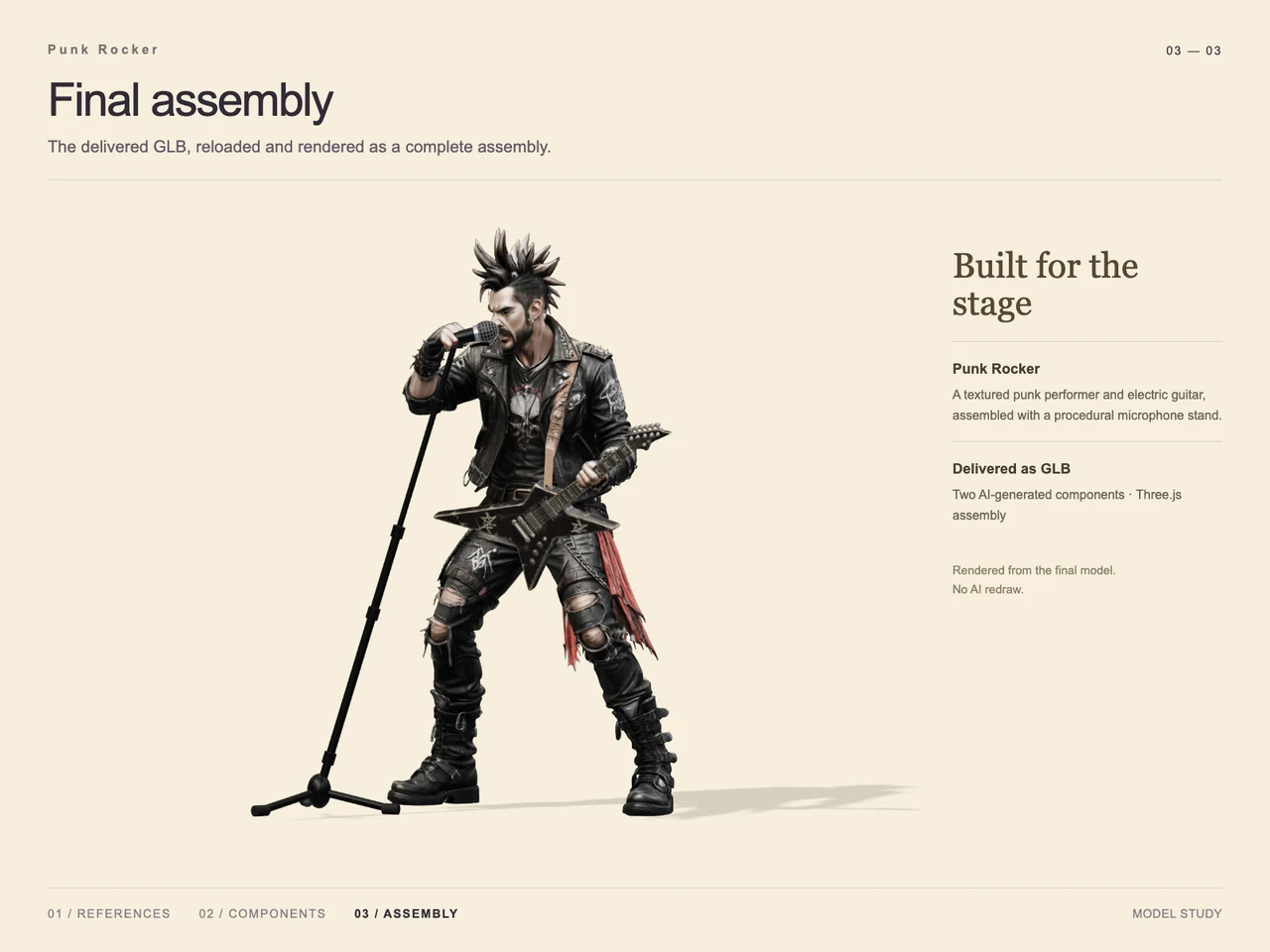
Interactive 3D preview · Build a Punk Rocker in 3D with GPT-6 Astra and V2FunDrag to rotate · Scroll to zoom
Take a Closer Look
-
 01 / Input
Input · Build a Punk Rocker in 3D with GPT-6 Astra and V2Fun
-
 02 / Process
Process · Build a Punk Rocker in 3D with GPT-6 Astra and V2Fun
-
03 / Final
Final · Build a Punk Rocker in 3D with GPT-6 Astra and V2Fun
Overview
This case develops a standing punk rocker with spiked hair, distressed black clothing, an angular electric guitar, and a microphone on a stand. The design centers on a shouting performance pose, with the face visible beneath the exaggerated hairstyle.
The supplied study documents a hybrid construction: V2Fun generates the performer and guitar as separate 3D components, while Three.js supplies the microphone and stand plus a short strap connection. The technical notes position GPT-6 Astra as the planner that identifies parts and coordinates the modeling approach. This division follows the broader GPT-6 Astra and V2Fun collaboration workflow.
Tools Used
- GPT-6 Astra: component identification, decomposition, and workflow coordination described in the case notes.
- V2Fun: generated reference studies and the two complex 3D components—the performer and electric guitar.
- Three.js: procedural microphone hardware, a short strap connection, and assembly.
- Visual references: the complete performer, isolated character and guitar images, and a study showing several viewing angles.
- GLB: the documented final delivery format.
Step 1 — Establish the Character Reference
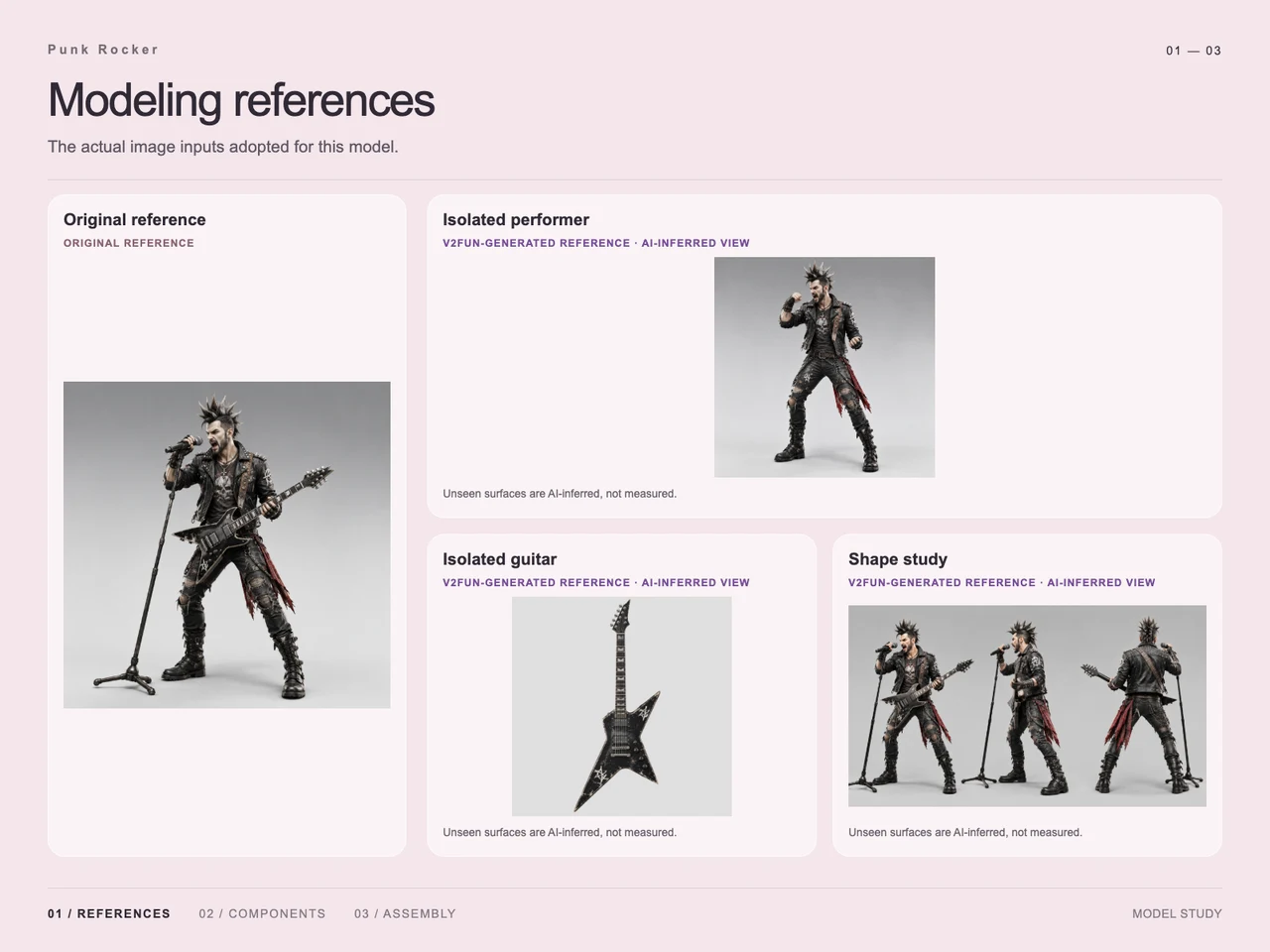
The original reference shows the full figure against gray, with spread feet, tall boots, torn trousers, a studded jacket, and red fabric hanging at the hip. The guitar crosses the torso, while the microphone sits near the mouth.
The reference sheet also includes an isolated performer, an isolated guitar, and a shape study. These additional images are labeled as V2Fun-generated references with AI-inferred views. Their unseen surfaces represent inferred design choices rather than measured observations. The guide to single-image and multi-view inputs provides related context for preparing reference evidence.
Step 2 — Separate the Main Components
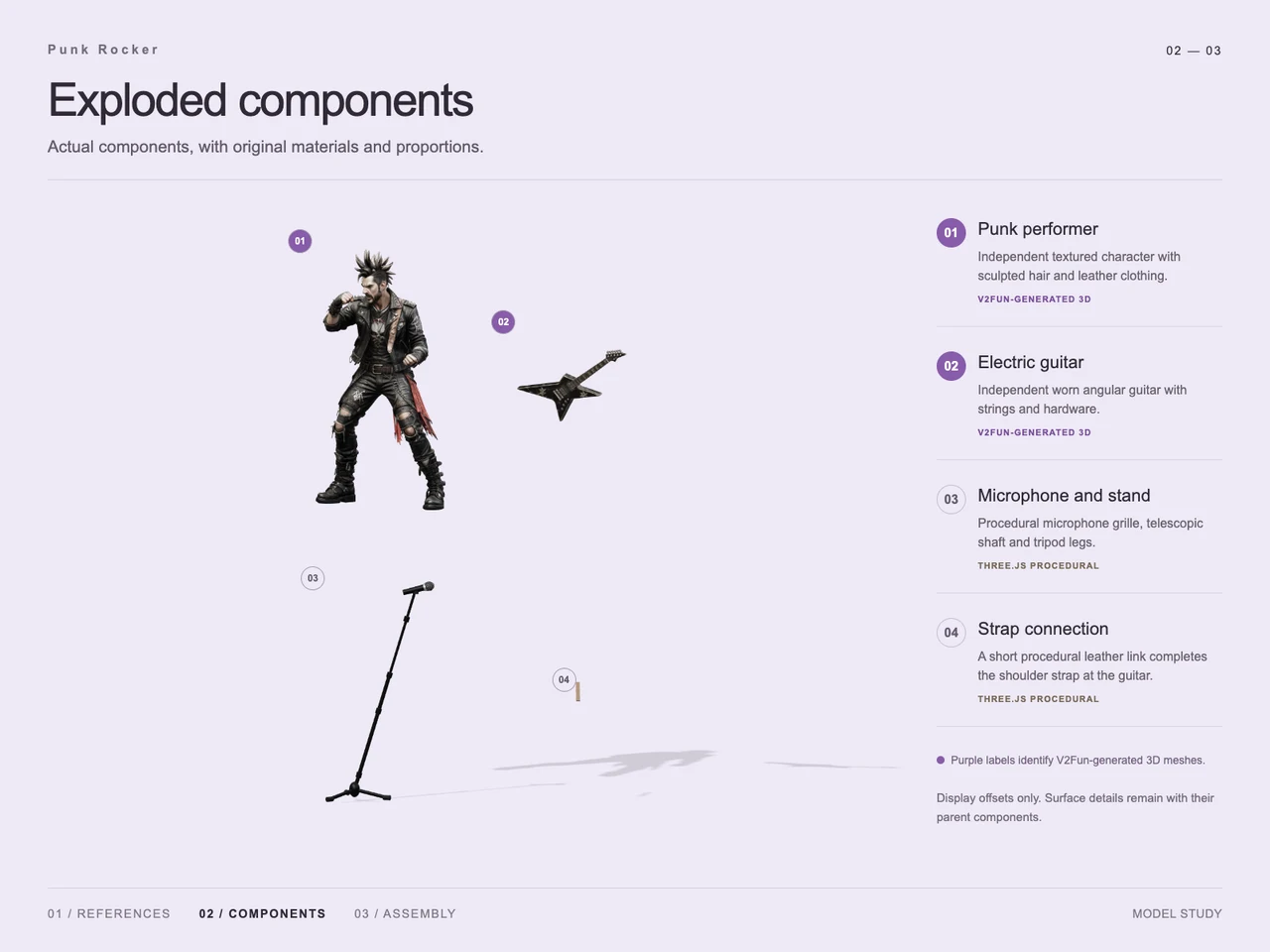
The exploded view identifies four assembly elements: the punk performer, electric guitar, microphone and stand, and strap connection. Hair and clothing remain within the performer component; the study does not show them as separate generated assets.
Separating the guitar makes its angular silhouette and placement across the body explicit. The exploded layout uses display offsets to reveal the components rather than showing their final positions.
Step 3 — Generate the Performer and Guitar
The process sheet labels both the textured performer and the worn electric guitar as V2Fun-generated 3D components. Visible character details include sculpted spikes, layered clothing, exposed knees, and buckled boots. The guitar has a pointed body and visible string and hardware details.
These two assets illustrate the role of the V2Fun AI 3D model generator in this case: creating the complex character and prop forms used in the assembly.
Step 4 — Add Procedural Parts and Assemble
The microphone assembly is documented as procedural geometry, including its grille, telescopic shaft, and tripod legs. A short procedural leather link completes the strap connection at the guitar.
The final view brings the guitar across the performer's torso and places the microphone beside the raised hand and mouth. The stand extends to the ground in front of the character, preserving the standing performance composition.
Workflow
Design prompt → Complete and isolated references → Component decomposition → V2Fun performer and guitar generation → Three.js procedural parts → Assembly → GLB export and documented reload render.
The technical notes propose reducing low-level geometry coding through this division of work. Token savings and total modeling time were not measured in the supplied case.
Prompt
English translation of the original design brief:
“Use a gradient gray background. Show a young male rocker wearing punk rock clothing, with a rock-style electric guitar hanging across his chest. He should hold a microphone with a stand as if shouting, have an unusual hairstyle that does not cover his face, and remain in a standing pose.”
Result
The final presentation shows the assembled performer with the guitar, microphone stand, and visible shoulder strap. It retains the spiked hairstyle, exposed face, dark clothing, red fabric accent, and wide standing stance. The reference imagery uses gray backgrounds; the final presentation uses a warm cream backdrop.
The final sheet identifies its image as a render of the delivered GLB after reloading, rather than an AI redraw.
- Output filename:
punk-rocker.glb - Supplied file size: 73,963,864 bytes, approximately 73.96 MB.
- Documented construction: two V2Fun-generated 3D components combined with procedural parts in Three.js.
For context on the delivery format, see the AI 3D export guide covering GLB. This case documents a static assembled result; rigging and animation are not demonstrated.
Frequently Asked Questions
Which punk rocker components were generated with V2Fun?
The exploded component sheet identifies the textured performer and electric guitar as V2Fun-generated 3D assets. Hair and clothing remain within the performer component.
What did Three.js contribute to this assembly?
Three.js supplied the procedural microphone and stand, including the grille, telescopic shaft, and tripod legs, plus a short leather strap connection. The final sheet also identifies Three.js as the assembly tool.
Were the side and rear references measured views?
No. The supplementary reference studies are labeled as AI-inferred views. They provide design guidance for unseen surfaces, not measured evidence of those surfaces.
How closely does the final model follow the punk rocker prompt?
The final view shows the standing performance pose, guitar across the chest, microphone on a stand, punk clothing, and spiked hair that leaves the face visible. Its presentation background is cream rather than the gradient gray requested in the prompt.
What was delivered, and were efficiency gains measured?
The supplied metadata lists punk-rocker.glb at 73,963,864 bytes. The final sheet documents a reload render of the assembly. The notes suggest less geometry coding, but provide no measured token savings or total workflow time.
Explore More
-

GPT-6 Astra x V2Fun - From Code Generation to Model Collaboration | V2Fun
See how GPT-6 Astra and V2Fun combine agent reasoning, code generation, and AI 3D foundation models to build complex, structured 3D assets.
View page → -
AI 3D Model Generator Input Guide: Single vs. Multi-View | V2Fun
Learn how to prepare photos, multi-view references, and sketches for an AI 3D Model Generator, then inspect geometry and textures before export.
View page → -
V2Fun - AI 3D Model Generator
Create 3D models from text prompts or images with V2Fun's AI 3D model generator. Generate characters, props, game assets, and 3D-printable models faster.
View page → -
AI 3D Model Generator Export Guide: FBX, GLB, OBJ, or USDZ? | V2Fun
Use an AI 3D Model Generator with the right export format. Compare FBX, GLB, OBJ, and USDZ for Blender, game engines, animation, web, and AR.
View page →