Pontoon Fisher: A Hybrid 3D Workflow with GPT-6 Astra and V2Fun
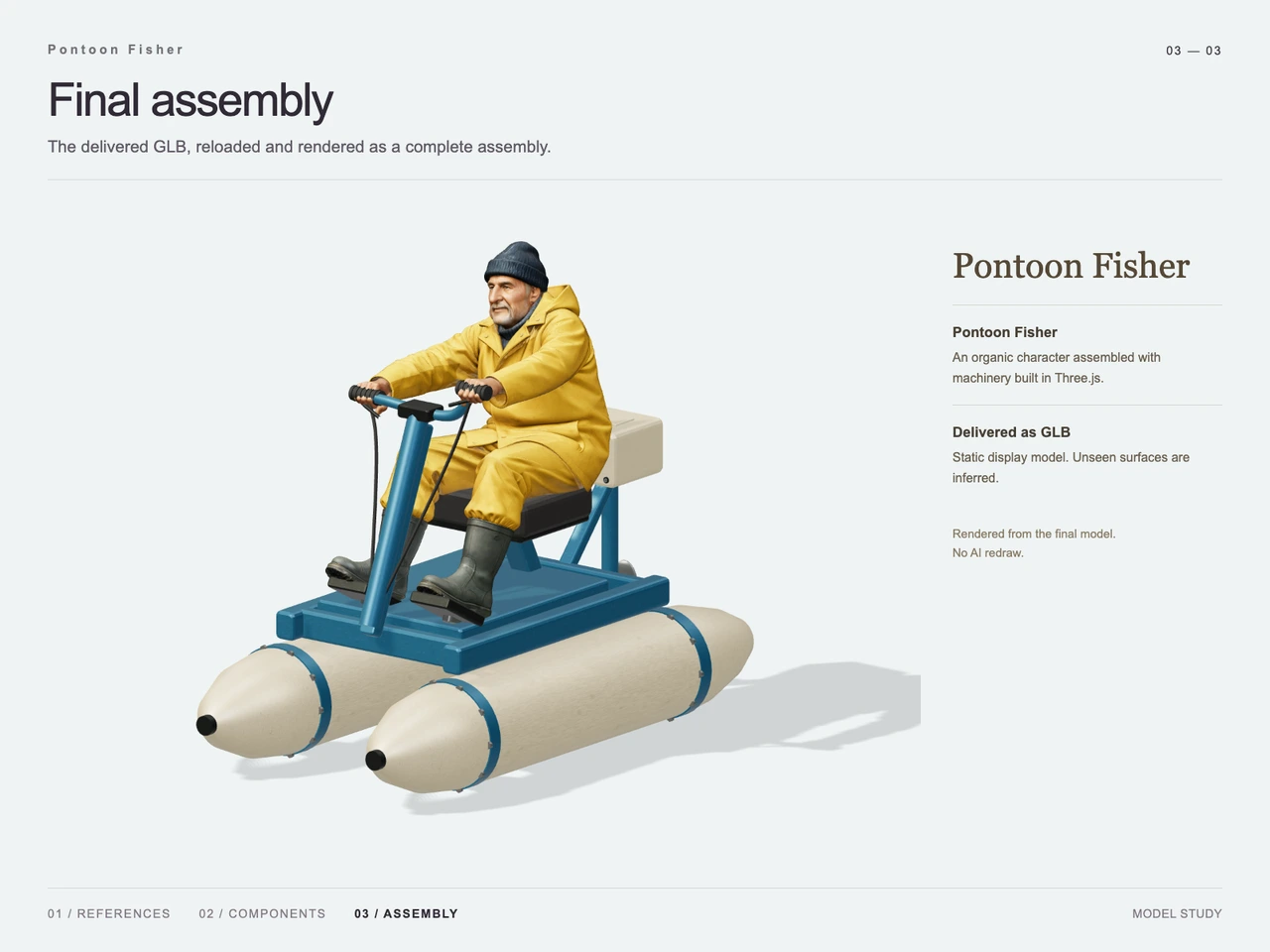
An elderly fisherman on a twin-pontoon water scooter combines a V2Fun-generated character with procedural Three.js machinery, assembled into a static GLB model.
Interactive 3D preview · Pontoon Fisher: A Hybrid 3D Workflow with GPT-6 Astra and V2FunDrag to rotate · Scroll to zoom
Take a Closer Look
-
 01 / Input
Input · Pontoon Fisher: A Hybrid 3D Workflow with GPT-6 Astra and V2Fun
-
 02 / Process
Process · Pontoon Fisher: A Hybrid 3D Workflow with GPT-6 Astra and V2Fun
-
03 / Final
Final · Pontoon Fisher: A Hybrid 3D Workflow with GPT-6 Astra and V2Fun
Overview
Pontoon Fisher pairs a weathered fisherman in yellow rainwear with a compact twin-pontoon water scooter. The modeling challenge is the relationship between the two: the seated body, outstretched hands, and boots must fit the seat, handlebars, and foot supports while leaving the vehicle structure readable.
The supplied case documents a hybrid approach. GPT-6 Astra plans the components and coordinates assembly, V2Fun generates the detailed character, and Three.js supplies the regular mechanical forms. This division follows the approach described in the GPT-6 Astra × V2Fun modeling workflow.
Tools Used
- GPT-6 Astra: subject interpretation, component planning, and assembly calibration, as described in the case notes.
- V2Fun: generated visual references and the textured fisherman component, identified in the reference and process sheets.
- Three.js: procedural construction of the frame, body and seat, mechanical equipment, and controls.
- GLB: the supplied final asset format.
Step 1 — Establish the Reference and Pose
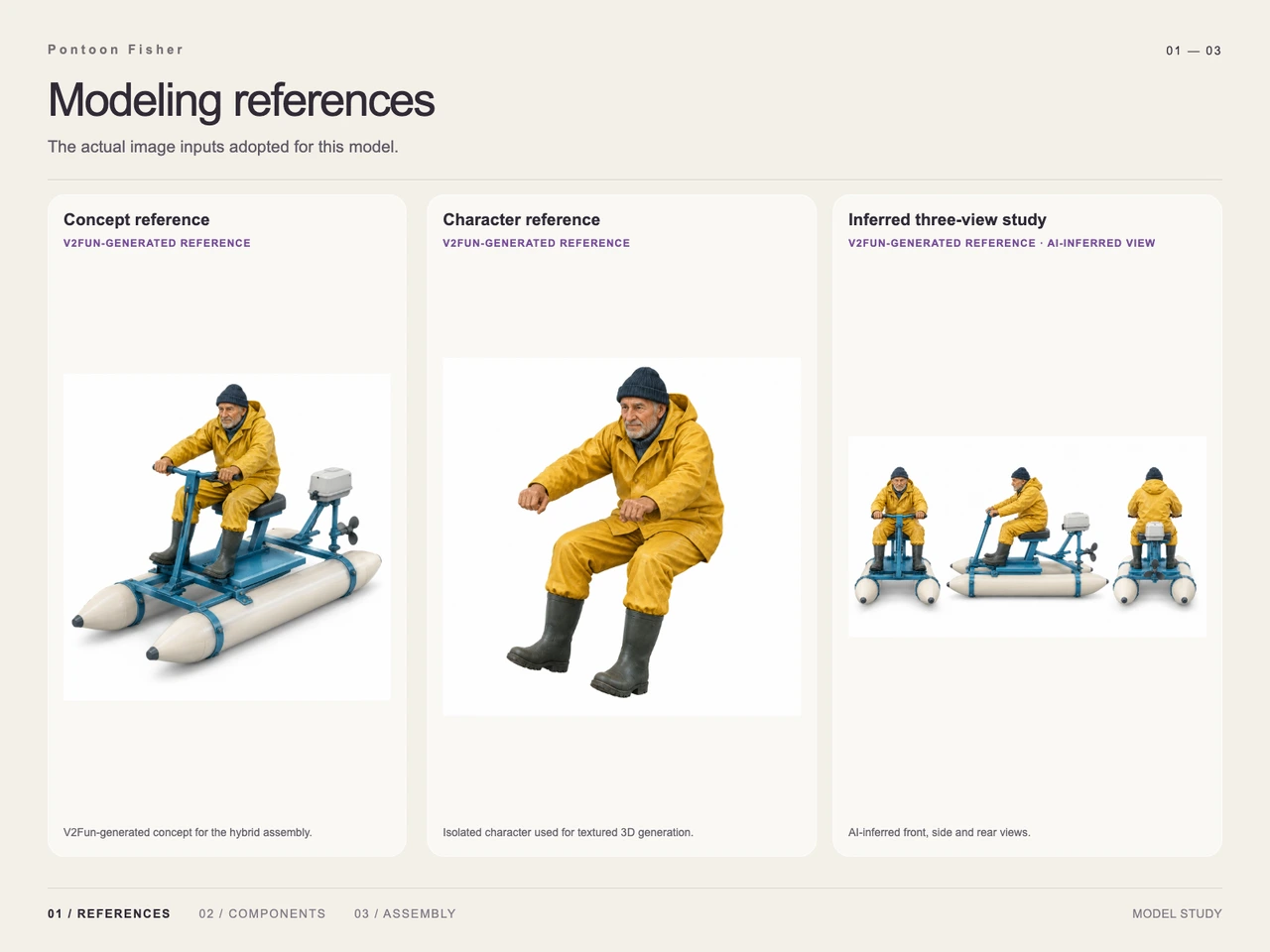
The input sheet contains a complete concept image, an isolated seated fisherman, and an inferred front, side, and rear study. The isolated character preserves the bent knees and forward-reaching arms without the vehicle obscuring the body. V2Fun's AI image generator for modeling references provides related context for this preparation stage.
The three-view study is explicitly labeled AI-inferred. It helps communicate the intended arrangement but does not independently verify hidden surfaces or establish that a multi-view generation feature was used.
Step 2 — Separate Organic and Mechanical Components
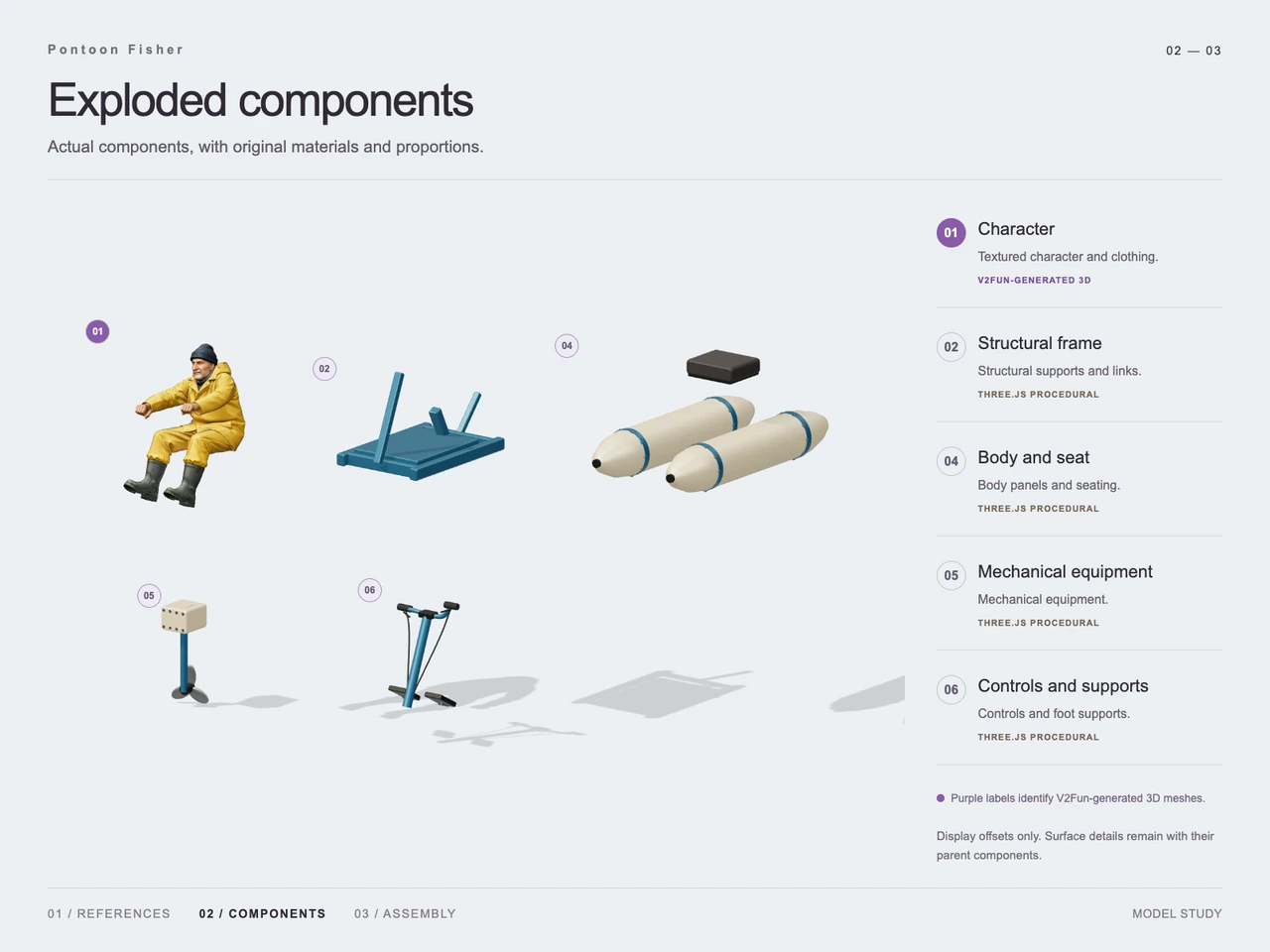
The exploded process sheet presents five component groups: character, structural frame, body and seat, mechanical equipment, and controls and supports. Only the character is identified as V2Fun-generated 3D; the four mechanical groups are labeled Three.js procedural.
Visible parts include cream-colored pontoons with tapered ends and blue bands, a rectangular deck frame, a dark seat, a motor box with a vertical shaft and propeller, and a handlebar column with cables and foot supports. The sheet uses display offsets to show these groups apart; it does not establish the exported mesh count.
Step 3 — Generate the Fisherman and Build the Vehicle
The character component carries the expressive face, knit cap, yellow clothing folds, and dark boots. These irregular surfaces are the V2Fun-generated portion of this case. The AI 3D model generator is the relevant feature for the reference-to-character stage.
The machinery uses a visibly simpler geometric vocabulary: elongated pontoon bodies, rectangular plates, straight supports, and tubular controls. The process sheet documents these parts as procedural construction rather than additional AI-generated components.
Step 4 — Assemble and Present the Export
The final view brings the fisherman and scooter together, with hands positioned at the grips, the body over the seat, and boots at the foot supports. The cream pontoons and sea-blue frame remain visually distinct beneath the yellow figure.
The final sheet identifies the image as a render of the delivered GLB after reloading. Its front three-quarter view shows the complete silhouette, although some rear equipment and underside surfaces remain occluded. It also states that unseen surfaces are inferred. For context on the delivery format, see the AI 3D export guide.
Workflow
Design prompt → concept and character references → component planning → V2Fun character generation and Three.js mechanical construction → assembly calibration → GLB export → documented reload and render.
Prompt
English translation of the design intent:
An elderly fisherman with a deeply wrinkled face, wearing a knitted cap, yellow raincoat, and dark rubber boots, sits astride a small twin-pontoon water scooter with both hands gripping the handlebars. Beneath him are two parallel elongated cylindrical pontoons with conical front ends, connected above by three crossbeams. A rectangular deck and separate saddle sit in the middle. At the rear, include a simple motor box, vertical shaft, and three-bladed propeller. Use cream-white pontoons and a sea-blue frame, with no water surface and the underside structure fully displayed.
Create one complete standalone asset consisting of one character and one machine. Combine realistic proportions with slight exaggeration in a collectible model style, with an expressive face and natural clothing folds. Build the machinery from clear cylinders, discs, rectangular plates, straight rods, and a few regular curved tubes. Keep major part boundaries distinct and connections plausible. Preserve contact between the character and the seat, grips, and footrests.
Use a slightly elevated front three-quarter view, showing the entire centered subject with margins. Use a white background, soft studio lighting, contact shadows, sharp focus across all parts, and refined PBR materials. Exclude text, numbers, logos, watermarks, complex scenery, and motion blur. Produce one finished reference image, not a collage or exploded view.
Result
The documented result is a static display assembly combining the textured fisherman with procedural pontoon machinery. The final render preserves the principal color palette and seated riding pose; it does not demonstrate every underside detail requested in the prompt.
- File:
81-v2-final.glb - Supplied size: 39,892,368 bytes, approximately 39.89 MB
- Supplied MIME type:
model/gltf-binary
The case provides no measured generation time or token savings. Its demonstrated contribution is the division of detailed character generation and regular mechanical construction within one assembled asset.
Frequently Asked Questions
Which part of Pontoon Fisher was generated with V2Fun?
The process sheet identifies the textured fisherman, including his clothing, as V2Fun-generated 3D. It labels the mechanical component groups as Three.js procedural.
What did GPT-6 Astra handle in this case?
The case notes assign GPT-6 Astra subject interpretation, component planning, and assembly calibration, including the pose relationships between the fisherman and vehicle.
Were the front, side, and rear references captured from a real object?
No. The reference sheet labels the three-view study as AI-inferred. These views communicate the design but do not independently verify hidden geometry.
How does the final assembly connect the fisherman to the scooter?
The final render shows his hands at the handlebar grips, his seated body over the dark seat, and his boots at the foot supports above the pontoon frame.
What file was delivered, and is the model animated?
The supplied output is 81-v2-final.glb, listed at 39,892,368 bytes with MIME type model/gltf-binary. The final sheet describes a static display model; animation is not documented.
Explore More
-
GPT-6 Astra x V2Fun - From Code Generation to Model Collaboration | V2Fun
See how GPT-6 Astra and V2Fun combine agent reasoning, code generation, and AI 3D foundation models to build complex, structured 3D assets.
View page → -
V2Fun - AI Image Generator for 3D Creation
Create concept images, character references, and visual assets with V2Fun's AI image generator. Turn ideas into 3D-ready images for modeling, animation, and game design.
View page → -
V2Fun - AI 3D Model Generator
Create 3D models from text prompts or images with V2Fun's AI 3D model generator. Generate characters, props, game assets, and 3D-printable models faster.
View page → -
AI 3D Model Generator Export Guide: FBX, GLB, OBJ, or USDZ? | V2Fun
Use an AI 3D Model Generator with the right export format. Compare FBX, GLB, OBJ, and USDZ for Blender, game engines, animation, web, and AR.
View page →