Build a Platform 9¾ LEGO Scene with GPT-6 Astra and V2Fun
See how GPT-6 Astra and V2Fun turn a Platform 9¾ LEGO-style reference into a structured 3D scene. The workflow combines scene understanding, component decomposition, AI 3D generation, and final assembly.
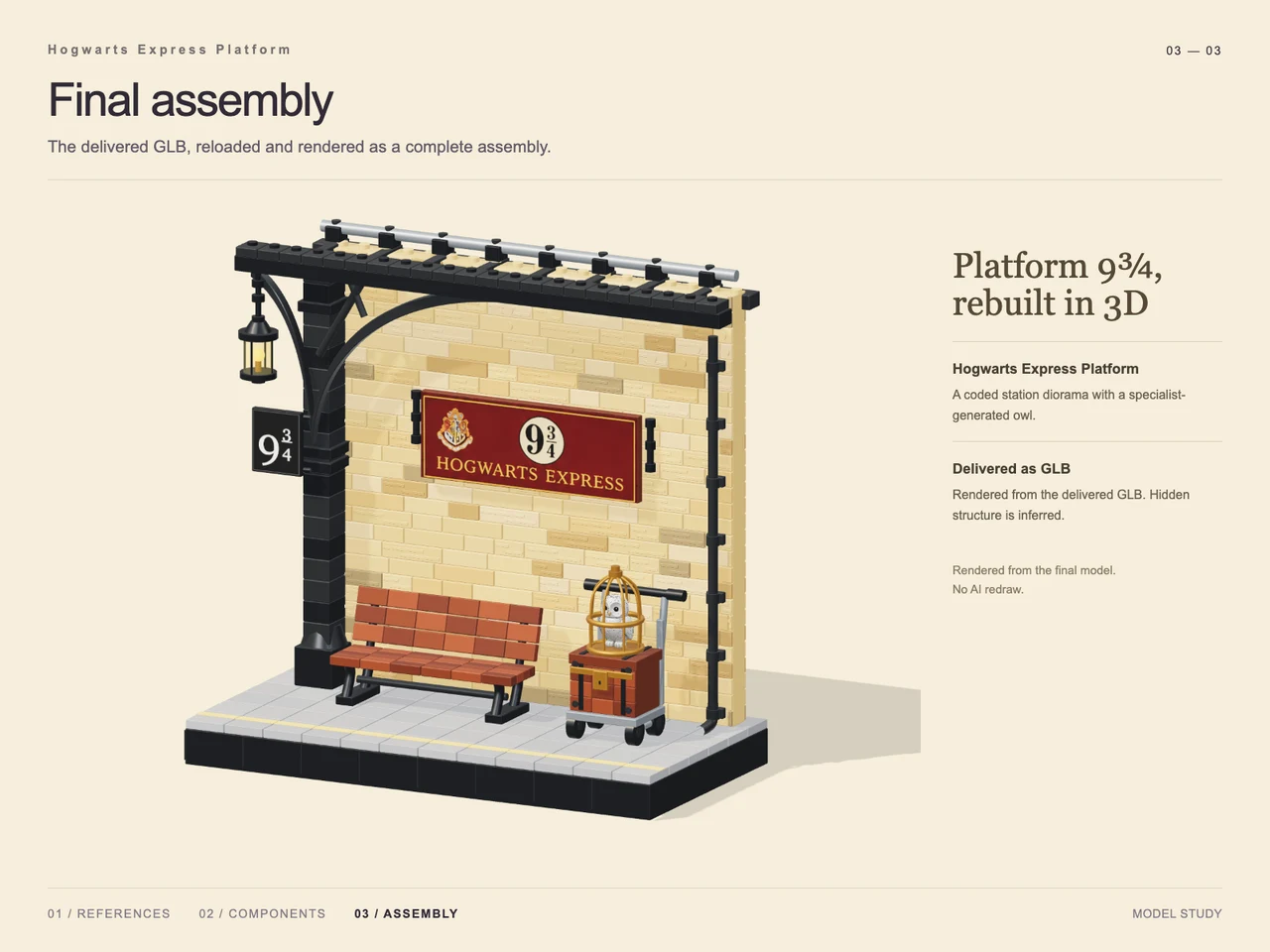
Interactive 3D preview · Build a Platform 9¾ LEGO Scene with GPT-6 Astra and V2FunDrag to rotate · Scroll to zoom
Take a Closer Look
-
 01 / Input
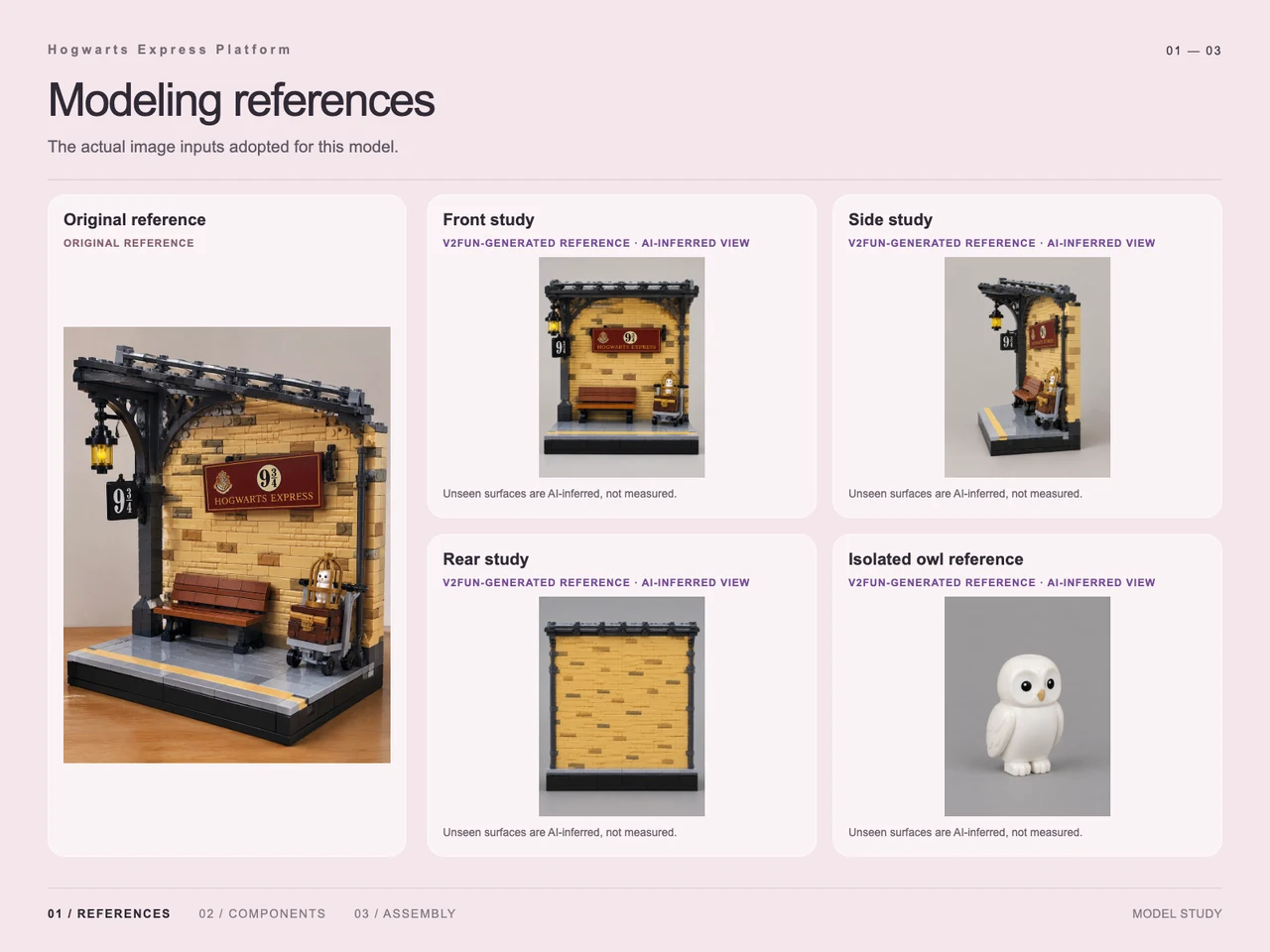
Input · Build a Platform 9¾ LEGO Scene with GPT-6 Astra and V2Fun
-
 02 / Process
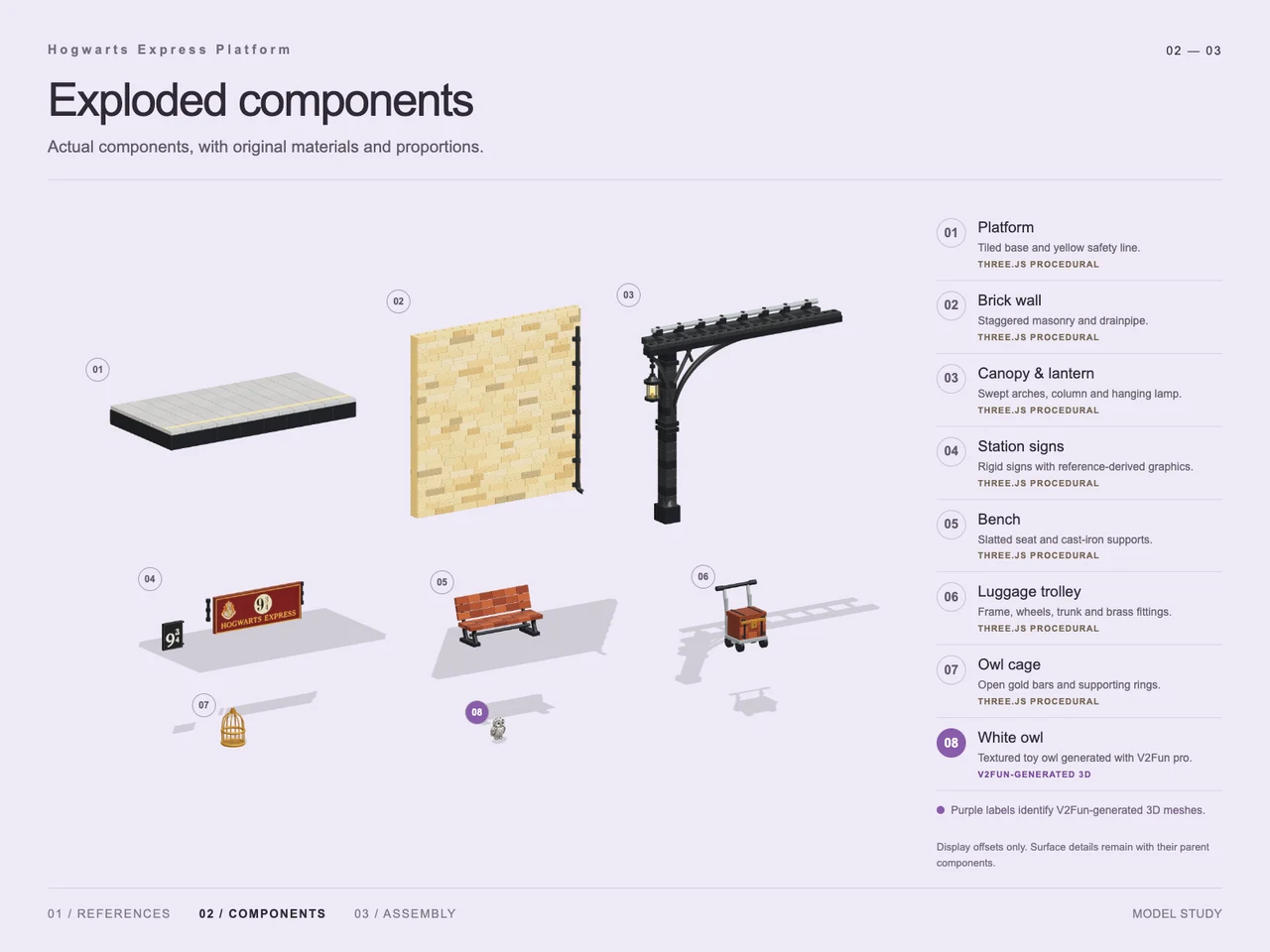
Process · Build a Platform 9¾ LEGO Scene with GPT-6 Astra and V2Fun
-
03 / Final
Final · Build a Platform 9¾ LEGO Scene with GPT-6 Astra and V2Fun
Overview
This experiment recreates a Platform 9¾ LEGO-style scene using GPT-6 Astra as the planner and 3D agent, with V2Fun handling complex 3D asset generation. Instead of treating the reference as one text-to-3D task, the workflow breaks the scene into separate components and assembles them into a structured final asset.
Tools Used
- GPT-6 Astra: reference understanding, task planning, scene decomposition, spatial reasoning, and final assembly.
- V2Fun: generation of complex individual 3D components.
- Three.js / procedural code: simple, regular, or repeated geometry where direct code is more efficient.
- Visual reference: defines the target appearance and component relationships.
- GLB: final 3D output format.
Step 1 — Analyze the Reference
GPT-6 Astra first studies the complete Platform 9¾ scene and identifies its major visual elements. Front, side, rear, and isolated reference studies help clarify the structure before modeling begins.
Step 2 — Decompose the Scene
The scene is divided into independent assets: the platform, brick wall, canopy and pillars, Platform 9¾ sign, bench, luggage trolley, lamp, and smaller decorative props. This converts one complex generation task into several well-defined 3D tasks.
Step 3 — Generate Complex Components with V2Fun
Complex components are generated separately with V2Fun. This avoids using large amounts of procedural geometry code to approximate irregular or visually detailed assets. In the demonstrated V2Fun workflow, major components can return within tens of seconds; the total end-to-end workflow time was not benchmarked.
Step 4 — Assemble with GPT-6 Astra
After generation, GPT-6 Astra determines the scale, rotation, position, and spatial relationships of the individual assets. It reconstructs the scene by placing the wall on the platform, aligning the canopy and pillars, positioning the sign and bench, and arranging the smaller props.
Step 5 — Add Procedural Details
Not every element needs a foundation-model call. Simple and regular structures can be created or refined with Three.js or procedural code. The agent chooses whether each part should be generated, coded, reused, or assembled.
Step 6 — Final Assembly
The separate assets are combined into the final Platform 9¾ LEGO-style scene. The workflow preserves explicit component relationships instead of producing only a single opaque mesh.
Workflow
Reference → Understand → Decompose → Generate → Assemble → Refine → Export
Prompt
A fully assembled LEGO brick, with the whole brick building piece designed for the Three-Quarters Station in 9 from Harry Potter. You need walls and a three-quarter sign for 9, and you can have benches under the wall (like at a train station). Building block style.
Result
Final output: hogwarts-platform.glb
File size: 44.02 MB
Complex component generation: within tens of seconds in the demonstrated V2Fun workflow
Total workflow time: not benchmarked
This workflow shows how GPT-6 Astra can act as a 3D agent: it focuses on understanding, planning, and construction, while V2Fun focuses on complex geometry generation.
Frequently Asked Questions
Can GPT-6 Astra create a 3D scene from a reference image?
GPT-6 Astra can analyze a visual reference, identify components, plan their relationships, and coordinate the construction of a 3D scene. In this workflow, V2Fun generates complex 3D components while GPT-6 Astra handles planning and assembly.
What does V2Fun do in this GPT-6 Astra workflow?
V2Fun generates complex individual 3D assets from visual references, allowing GPT-6 Astra to spend more of its reasoning on decomposition, spatial relationships, and final assembly.
Why split the Platform 9¾ scene into separate components?
Breaking the scene into the wall, platform, sign, bench, structural frame, trolley, and props makes complex generation easier to control and lets each asset be positioned and refined independently.
Does this workflow use Three.js?
Yes. Three.js or procedural code can be used for simple, regular, or repeated geometry, while V2Fun is used for components where direct AI 3D generation is more efficient.
How long does the workflow take?
The technical workflow states that major V2Fun-generated components can return within tens of seconds. A reliable total end-to-end time was not measured, so no total benchmark is claimed.
Explore More
-
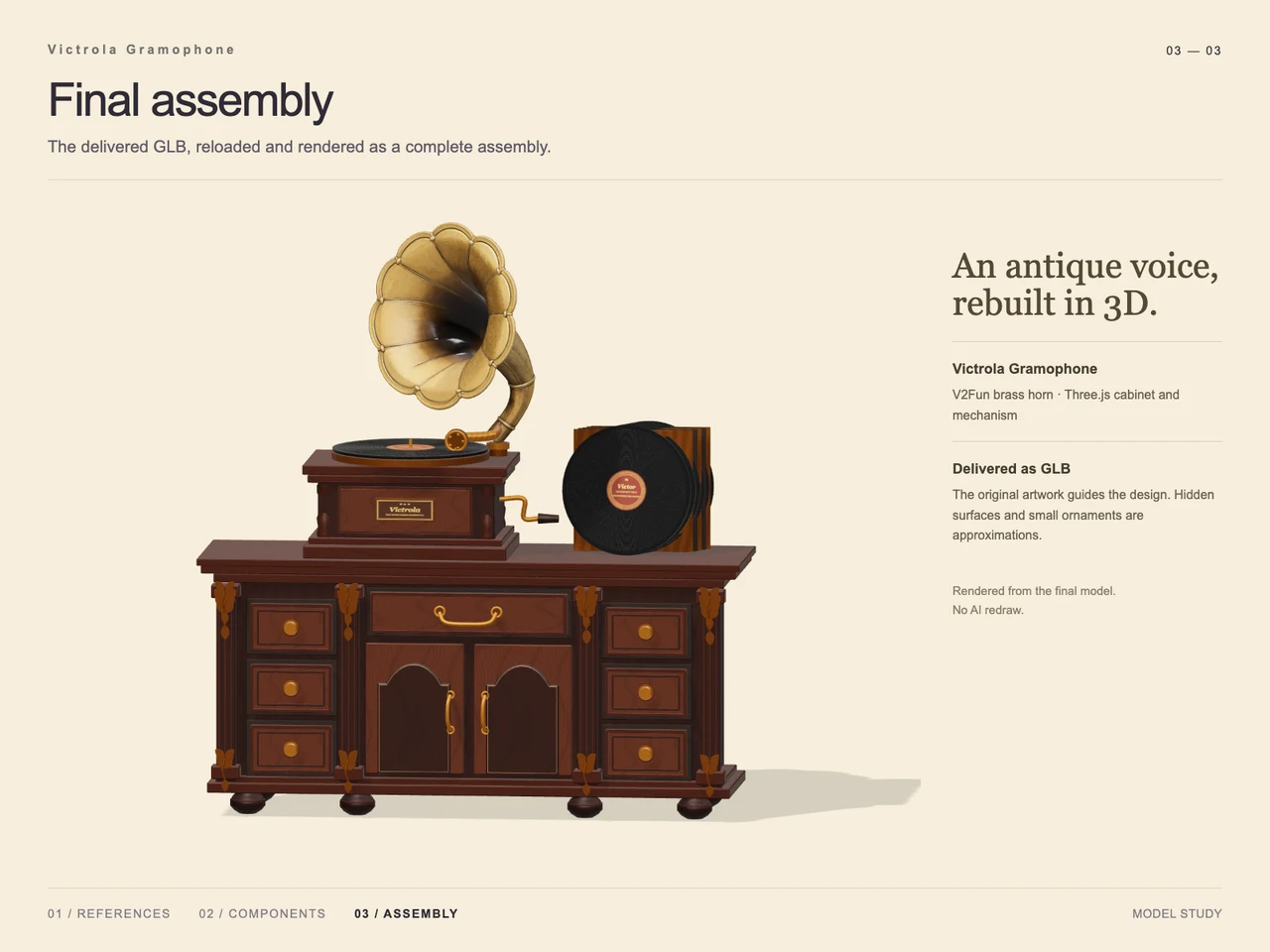
GPT-6 Astra x V2Fun - From Code Generation to Model Collaboration | V2Fun
See how GPT-6 Astra and V2Fun combine agent reasoning, code generation, and AI 3D foundation models to build complex, structured 3D assets.
View page → -
V2Fun - AI 3D Model Generator
Create 3D models from text prompts or images with V2Fun's AI 3D model generator. Generate characters, props, game assets, and 3D-printable models faster.
View page → -
V2Fun - Multi-View to 3D Model AI
Generate accurate 3D models from multiple reference images with V2Fun's multi-view to 3D model AI. Create structured assets with better shape consistency and detail.
View page → -
AI-Driven Automatic 3D Scene Generation: Breaking Barriers with V2Fun.ai | V2Fun
Discover how V2Fun enables AI-driven 3D scene generation with text/image inputs, high-fidelity textures, editing, animation, and export for games, videos, and virtual streaming.
View page →