Build a Pan Tricycle Chef with GPT-6 Astra and V2Fun
See how GPT-6 Astra and V2Fun turn a chef-on-a-frying-pan-tricycle concept into separated character and mechanical components, a calibrated assembly, and a delivered GLB model.
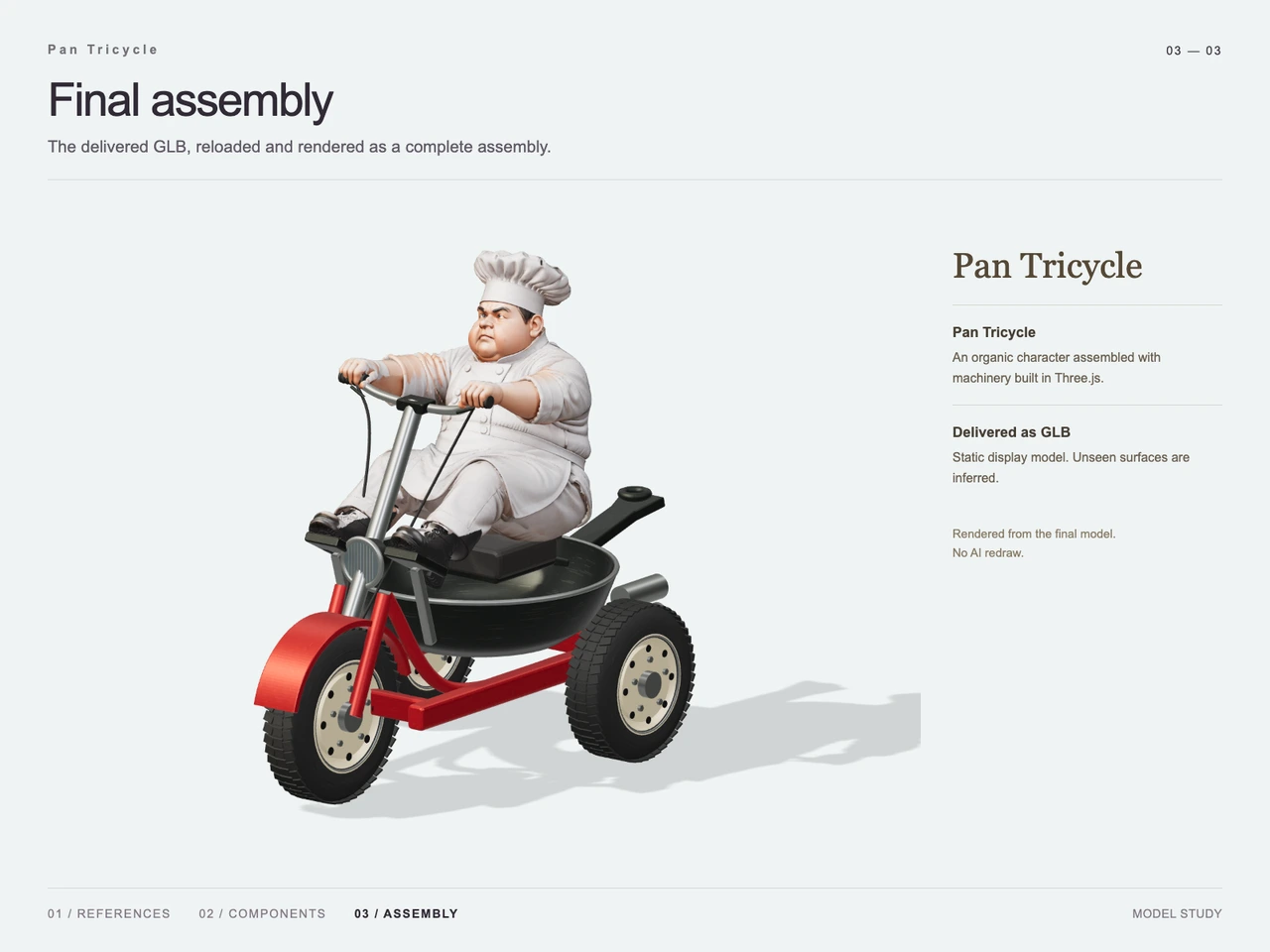
Interactive 3D preview · Build a Pan Tricycle Chef with GPT-6 Astra and V2FunDrag to rotate · Scroll to zoom
Take a Closer Look
-
 01 / Input
Input · Build a Pan Tricycle Chef with GPT-6 Astra and V2Fun
-
 02 / Process
Process · Build a Pan Tricycle Chef with GPT-6 Astra and V2Fun
-
03 / Final
Final · Build a Pan Tricycle Chef with GPT-6 Astra and V2Fun
Overview
This case turns a whimsical character-and-vehicle reference into a complete 3D asset: a round-faced chef seated on a tricycle whose body resembles a black frying pan. The visual evidence shows three stages—modeling references, an exploded component study, and the final assembled model.
The workflow uses GPT-6 Astra to interpret the reference, plan the component hierarchy, and coordinate assembly. V2Fun supplies the detailed chef mesh, while regular mechanical parts are represented procedurally. This division follows the broader GPT-6 Astra and V2Fun model-collaboration workflow, in which organic forms and structured geometry are handled according to their different modeling needs.
Tools Used
- GPT-6 Astra: reference interpretation, component planning, spatial reasoning, and assembly calibration.
- V2Fun: generation of the textured chef character shown in the exploded study. Learn more about the platform's AI 3D model generator.
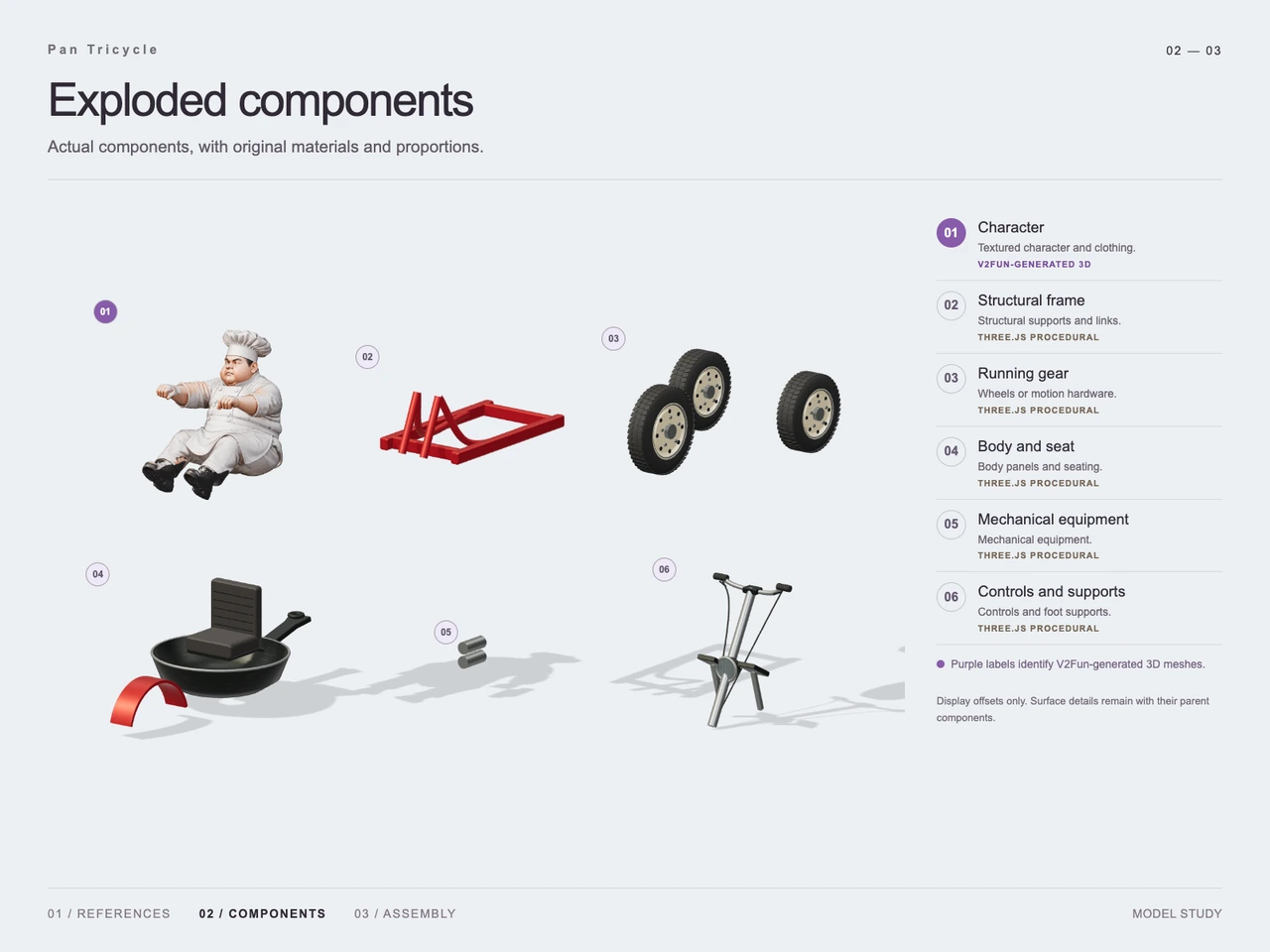
- Three.js / procedural construction: the structural frame, running gear, pan-shaped body and seat, mechanical equipment, controls, and supports identified in the process image.
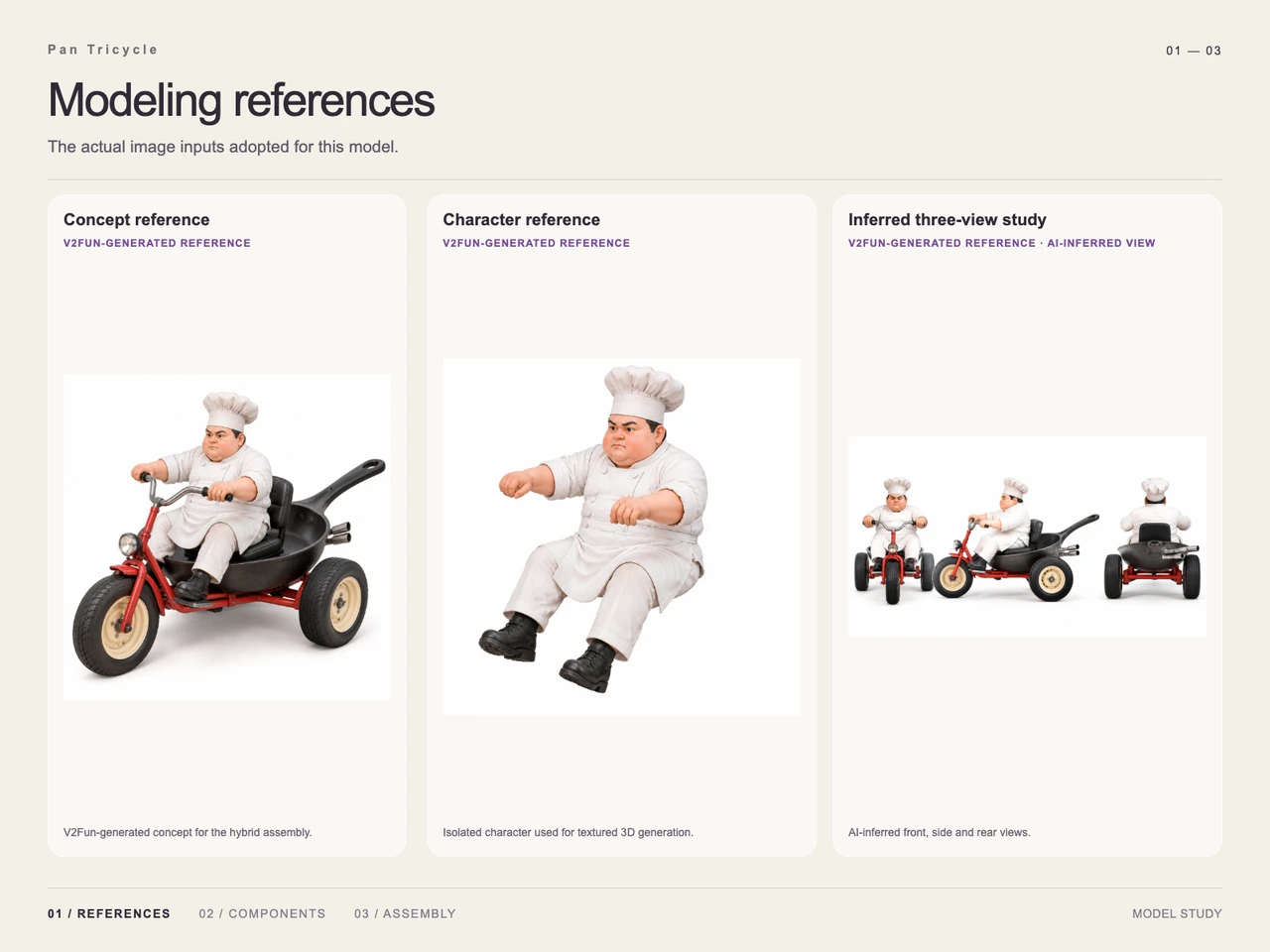
- Visual references: a complete concept image, an isolated character reference, and an AI-inferred front, side, and rear study. The single-view and multi-view input guide explains why additional angles can reduce uncertainty around hidden forms.
- GLB: the supplied final delivery format; see the GLB and 3D export format guide for general format-selection context.
Step 1 — Interpret the Design Intent
GPT-6 Astra identifies two interdependent subjects: the chef and the frying-pan tricycle. The reference establishes the chef's serious expression, white uniform, apron, padded seat, handlebar grip, and foot placement. It also defines the vehicle's shallow pan body, rearward pan handle, red tubular frame, cream wheel hubs, three-wheel layout, and paired short exhaust pipes.
Step 2 — Prepare Reference Views
The modeling study retains the complete concept, isolates the chef, and adds an AI-inferred three-view study of the combined design. These inferred views provide working guidance for the front, side, and rear relationships, but they are interpretations rather than independently photographed evidence.
Step 3 — Decompose the Asset
The exploded study separates the model into six functional groups: character, structural frame, running gear, body and seat, mechanical equipment, and controls and supports. The chef is explicitly labeled as V2Fun-generated 3D, while the other groups are labeled as Three.js procedural components.
Step 4 — Generate the Character
V2Fun generates the isolated textured chef, preserving the visible facial volume, chef's hat, clothing layers, folds, seated pose, boots, and forward-reaching arms. Separating the character allows the organic form to be handled independently from the vehicle's regular mechanical construction.
Step 5 — Build the Mechanical Components
The vehicle is constructed from clearly bounded procedural forms. The exploded view shows a red frame, three wheels, a shallow black pan body with seat and rear handle, short cylindrical equipment, and a handlebar-and-support assembly. These elements correspond to the prompt's emphasis on cylinders, discs, rectangular plates, straight rods, and a limited number of curved tubes.
Step 6 — Calibrate Contact and Assembly
On the agent side, the generated character and procedural vehicle parts are brought together by adjusting scale, rotation, and position. The final render shows the chef seated over the pan body, both hands aligned with the handlebars, and both feet placed near the external supports. The frame, wheels, seat, rear handle, and small mechanical parts are combined into one visually coherent assembly.
Workflow
Concept reference → Isolate character → Infer supporting views → Decompose components → Generate character with V2Fun → Build regular parts procedurally → Calibrate contacts → Assemble → Export GLB
Prompt
Create a complete standalone asset featuring one round-faced, heavyset chef seriously driving a frying-pan-shaped tricycle. He wears a puffy chef's hat, white chef's uniform, and apron. The vehicle has a shallow black frying-pan body, a rearward pan handle forming a tail beam, an independent padded seat, one steering wheel at the front, two wheels at the rear, a fully visible tubular frame, and two short cylindrical exhaust pipes. The chef grips curved handlebars with both hands and rests his feet on external foot supports. Contrast black cast iron, cream-colored wheel hubs, and red brackets.
Combine realistic proportions with mild exaggeration in a collectible-model style. Give the chef an expressive face and natural clothing folds. Construct the machinery from clear cylinders, discs, rectangular plates, straight rods, and a few regular curved tubes, with legible part boundaries and plausible connections. Preserve the contact relationships among the character, seat, handlebars, and foot supports. Show the complete subject centered in a slightly elevated front three-quarter view against a white background, with soft studio lighting, contact shadows, clear focus, and refined material appearance. Exclude text, numbers, logos, watermarks, complex scenery, motion blur, collages, and exploded-part presentation.
Result
The delivered asset is 76-v2-final.glb, a model/gltf-binary file containing 51,757,192 bytes. The supplied final render shows the GLB reloaded as a complete static display assembly, with the chef, pan body, red frame, three wheels, controls, seat, and rear mechanical details visible. Surfaces not established by the references were inferred during modeling, and no animation, topology, UV, dimensional, printability, or runtime-performance claims are made for this case.
Frequently Asked Questions
What was created in this GPT-6 Astra and V2Fun case?
The case produced a complete static 3D assembly of a chef riding a frying-pan-shaped tricycle, delivered as the GLB file `76-v2-final.glb`.
Which part was generated with V2Fun?
The exploded process image explicitly labels the textured chef character and clothing as V2Fun-generated 3D.
Which components were built procedurally?
The process image labels the structural frame, running gear, body and seat, mechanical equipment, and controls and supports as Three.js procedural components.
How were the character and vehicle aligned?
The workflow calibrated scale, rotation, and position so the seated chef's hands met the handlebars and the feet aligned with the external supports while the surrounding vehicle components formed a coherent assembly.
Were multiple reference angles available?
The evidence includes a complete concept, an isolated character reference, and an AI-inferred front, side, and rear study. The inferred views were working interpretations, not independent source photographs.
Is the resulting model proven ready for animation, games, or 3D printing?
No. The evidence supports a reloaded static GLB display model, but it does not prove rigging, topology or UV quality, engine performance, exact dimensions, or printability.
Explore More
-
GPT-6 Astra x V2Fun - From Code Generation to Model Collaboration | V2Fun
See how GPT-6 Astra and V2Fun combine agent reasoning, code generation, and AI 3D foundation models to build complex, structured 3D assets.
View page → -
V2Fun - AI 3D Model Generator
Create 3D models from text prompts or images with V2Fun's AI 3D model generator. Generate characters, props, game assets, and 3D-printable models faster.
View page → -
AI 3D Model Generator Input Guide: Single vs. Multi-View | V2Fun
Learn how to prepare photos, multi-view references, and sketches for an AI 3D Model Generator, then inspect geometry and textures before export.
View page → -
AI 3D Model Generator Export Guide: FBX, GLB, OBJ, or USDZ? | V2Fun
Use an AI 3D Model Generator with the right export format. Compare FBX, GLB, OBJ, and USDZ for Blender, game engines, animation, web, and AR.
View page →