Create an Ox Traveler and Cart with GPT-6 Astra and V2Fun
Follow a zodiac ox character from visual references to a static 3D assembly, combining V2Fun-generated character and cargo meshes with a procedural wooden cart and wheels.
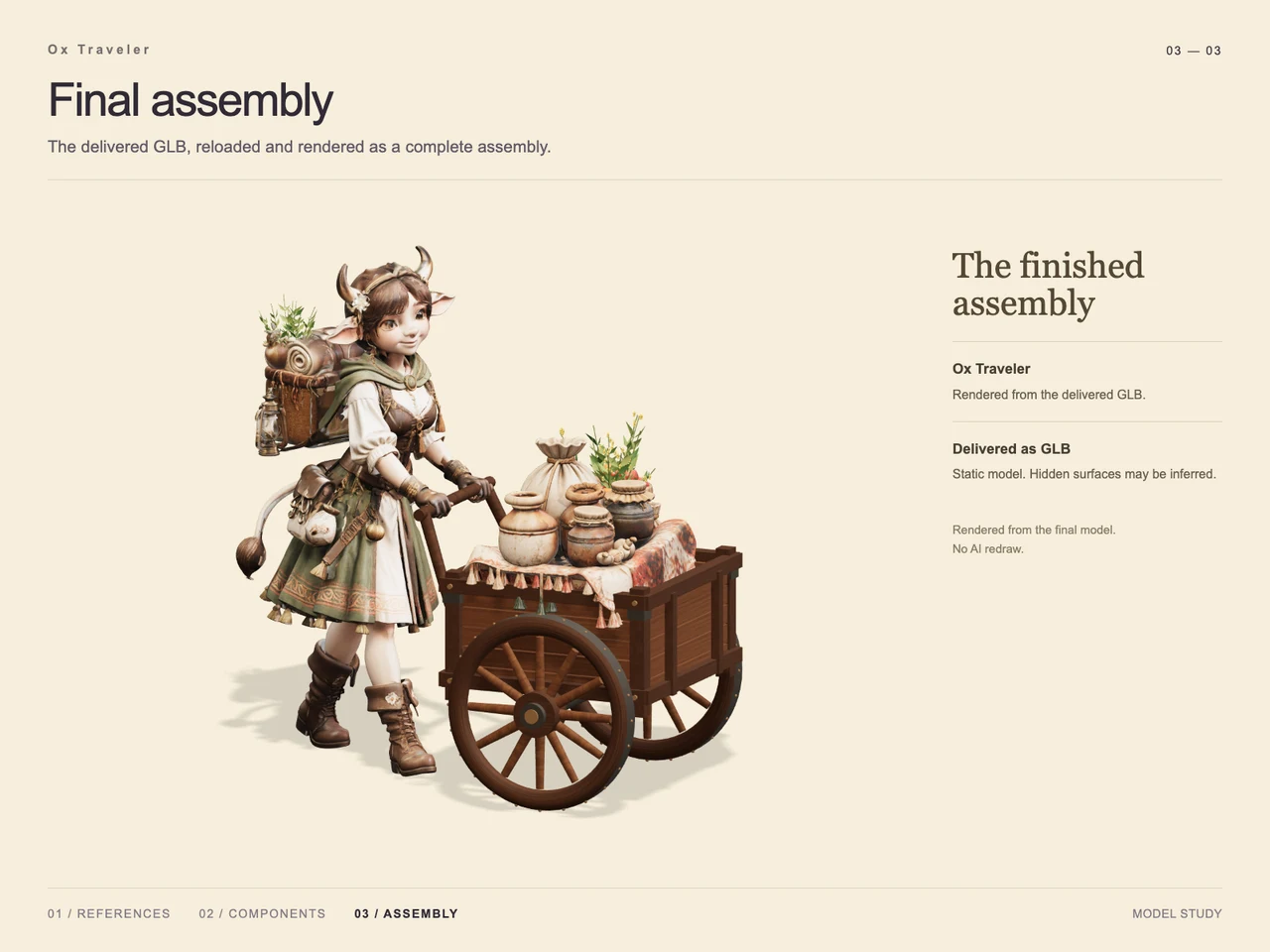
Interactive 3D preview · Create an Ox Traveler and Cart with GPT-6 Astra and V2FunDrag to rotate · Scroll to zoom
Take a Closer Look
-
 01 / Input
Input · Create an Ox Traveler and Cart with GPT-6 Astra and V2Fun
-
 02 / Process
Process · Create an Ox Traveler and Cart with GPT-6 Astra and V2Fun
-
03 / Final
Final · Create an Ox Traveler and Cart with GPT-6 Astra and V2Fun
Overview
Ox Traveler turns an anthropomorphic Chinese zodiac ox brief into a full-body fantasy character pushing a wooden market cart. Curved horns, broad animal ears, a tufted tail, layered clothing, boots, and a loaded backpack establish the traveler's identity. The cart extends the accessory-rich design with pottery, a tied sack, patterned fabric, and greenery.
The case combines two modeling approaches: V2Fun generates the complex character and cargo meshes, while Three.js supplies the cart structure, paired wheels, and selected plant details. The technical notes assign GPT-6 Astra the task of understanding the character, pushing pose, and accessory relationships. This division connects to the broader GPT-6 Astra and V2Fun collaboration workflow.
Tools Used
- GPT-6 Astra: interpretation of the zodiac ox design, cart interaction, and accessory relationships.
- V2Fun: generated reference imagery and the character and market-goods 3D meshes.
- Three.js: procedural cart frame, handles, fittings, paired wooden wheels, backpack herbs, and cargo wildflowers.
- GLB: the supplied final delivery format.
Step 1 — Establish the Character Reference
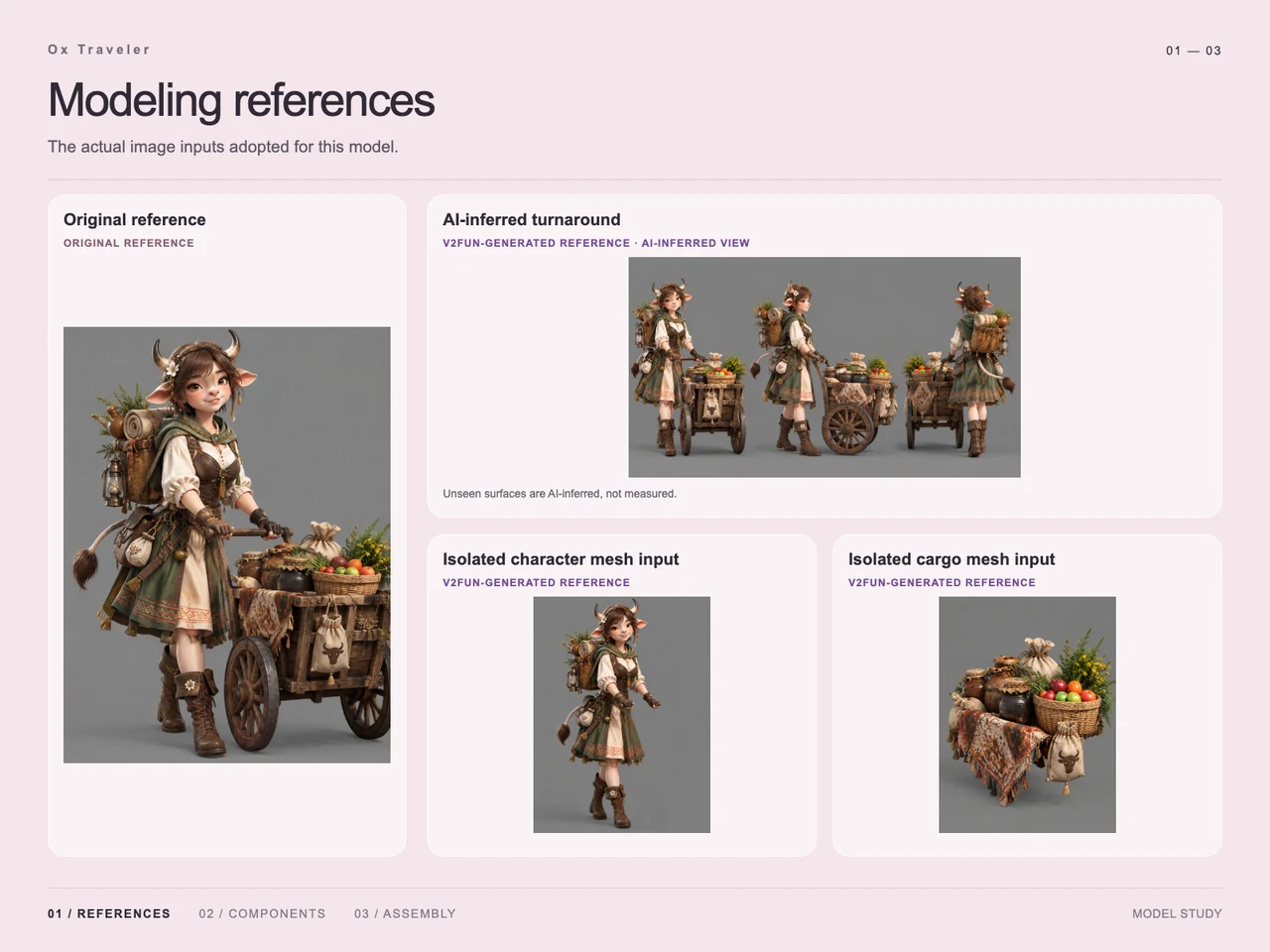
The input board shows an original reference alongside a V2Fun-generated turnaround and isolated character and cargo references. The original image defines a horned traveler holding a cart handle, with a substantial backpack and densely arranged market goods.
The turnaround supplies proposed front, side, and rear appearances. Its unseen surfaces are explicitly identified as AI-inferred rather than measured. The generated studies relate to AI image generation for 3D references; the board does not establish that a particular multiview modeling mode was used.
Step 2 — Separate the Character, Cargo, and Cart
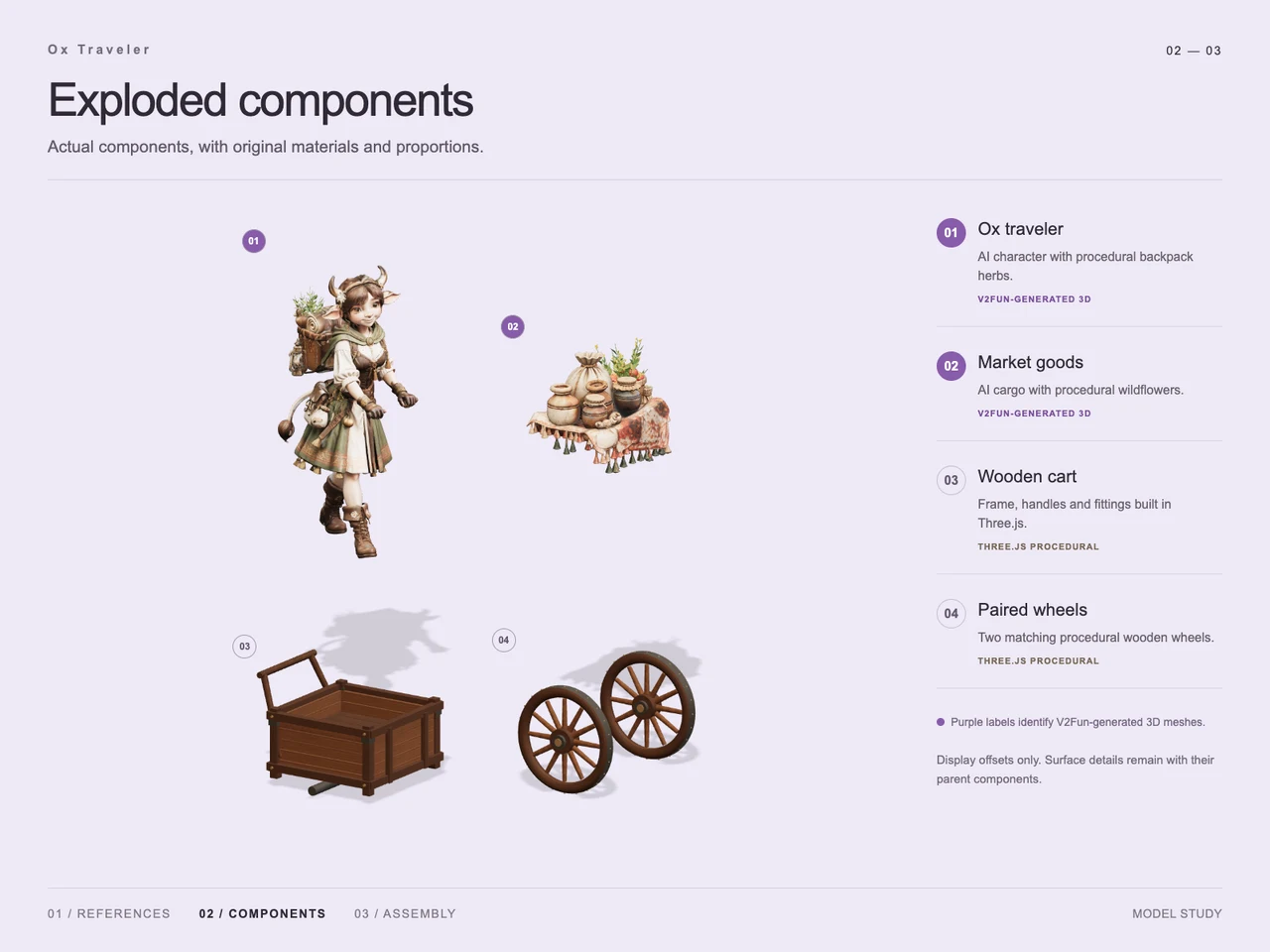
The process board presents four component groups: the ox traveler, market goods, wooden cart, and paired wheels. The isolated character reference removes the cart while retaining the traveler's outfit and backpack. The cargo reference separates the decorative load from the wheeled structure.
This separation makes the intended modeling inputs easier to read where hands, handles, fabric, and goods overlap in the original composition. For related preparation principles, see the single-image and multiview input guide.
Step 3 — Combine Generated Meshes with Procedural Parts
The exploded view identifies the traveler and market-goods groups as V2Fun-generated 3D meshes. These groups carry the irregular forms of the face, clothing, backpack, vessels, sack, and draped fabric. They illustrate the role of V2Fun's AI 3D model generator within this case.
The wooden cart frame, handles, and fittings are labeled as Three.js procedural work, as are the two matching spoked wheels. The component notes also identify procedural herbs on the backpack and wildflowers in the cargo. The exploded positions are presentation offsets; they do not establish that every visible accessory is an independently editable object.
Step 4 — Assemble and Present the Delivered Model
The final board brings the traveler, loaded cart, and wheels together against a plain warm background. The hands meet the handle area, the goods sit above the cart body, and the wheels flank the wooden structure. The character's horns, layered green-and-cream outfit, backpack, and tail remain prominent.
The board identifies this image as a render of the delivered GLB after reloading, with no AI redraw. It documents a static assembly, with hidden surfaces potentially inferred.
Workflow
Original reference → AI-inferred turnaround and isolated inputs → Character and cargo generation → Procedural cart, wheels, and plant details → Assembly → GLB delivery and reloaded render.
Prompt
English translation of the design brief: “Anthropomorphic Chinese zodiac ox, 3D render style, full-body view, with plenty of carried items, a plain background, and a pushcart.”
The source also includes a request to make the font bolder and brighter. This is a presentation note; the evidence does not establish a separate typography revision.
Result
The supplied output is ox-traveler.glb, sized at 108,008,888 bytes, with MIME type model/gltf-binary.
The final render preserves the core traveler-and-cart concept while interpreting the details: the market load emphasizes pottery, a sack, greenery, and draped cloth, with a different arrangement from the original reference. The case demonstrates a visible division between generated organic detail and procedural cart construction. No case-specific generation time or token measurements were supplied.
Frequently Asked Questions
What makes this character an anthropomorphic zodiac ox?
The design combines ox-like horns, broad ears, and a tufted tail with a humanoid body, layered clothing, boots, a backpack, and a cart-pushing pose.
Which Ox Traveler components were generated with V2Fun?
The process board identifies the traveler and market-goods meshes as V2Fun-generated 3D. The input board also labels the turnaround and isolated character and cargo images as V2Fun-generated references.
What was built procedurally in Three.js?
The cart frame, handles, fittings, and paired wooden wheels are labeled as procedural Three.js work. The component descriptions also identify procedural backpack herbs and cargo wildflowers.
Are the turnaround views measured references?
No. The turnaround is labeled as AI-inferred, including surfaces unseen in the original reference. It provides a proposed interpretation of the character from additional angles.
What does the final GLB evidence establish?
The supplied metadata identifies ox-traveler.glb as a 108,008,888-byte model/gltf-binary file. The final board presents a reloaded render of the static traveler-and-cart assembly. It does not document rigging, animation, or measured performance.
Explore More
-
GPT-6 Astra x V2Fun - From Code Generation to Model Collaboration | V2Fun
See how GPT-6 Astra and V2Fun combine agent reasoning, code generation, and AI 3D foundation models to build complex, structured 3D assets.
View page → -
V2Fun - AI Image Generator for 3D Creation
Create concept images, character references, and visual assets with V2Fun's AI image generator. Turn ideas into 3D-ready images for modeling, animation, and game design.
View page → -
AI 3D Model Generator Input Guide: Single vs. Multi-View | V2Fun
Learn how to prepare photos, multi-view references, and sketches for an AI 3D Model Generator, then inspect geometry and textures before export.
View page → -
V2Fun - AI 3D Model Generator
Create 3D models from text prompts or images with V2Fun's AI 3D model generator. Generate characters, props, game assets, and 3D-printable models faster.
View page →