Orthodox Church 3D Modeling with GPT-6 Astra and V2Fun
Explore an Orthodox church exterior study combining a V2Fun-generated golden cupola with procedural Three.js architecture, from modeling references to an assembled GLB.
Interactive 3D preview · Orthodox Church 3D Modeling with GPT-6 Astra and V2FunDrag to rotate · Scroll to zoom
Take a Closer Look
-
 01 / Input
Input · Orthodox Church 3D Modeling with GPT-6 Astra and V2Fun
-
 02 / Process
Process · Orthodox Church 3D Modeling with GPT-6 Astra and V2Fun
-
03 / Final
Final · Orthodox Church 3D Modeling with GPT-6 Astra and V2Fun
Overview
The Golden Cupola case develops an Orthodox church exterior using a combination of AI generation and procedural architecture. The prompt requests a church model against a gray gradient background. The supplied presentation adds the architectural direction: pale masonry, dark roofs, arched windows, gold onion domes, and crosses.
The central modeling decision is specific: generate a new central cupola with V2Fun and assemble it with an existing Three.js church. The technical notes describe GPT-6 Astra handling structural understanding and task decomposition. This division of responsibilities follows the broader GPT-6 Astra and V2Fun 3D agent workflow. No case-specific token savings or generation times are supplied.
Tools Used
- GPT-6 Astra: structural understanding and task planning, as described in the technical notes.
- V2Fun: generated modeling references and the central golden cupola mesh, as identified in the presentation.
- Three.js and procedural code: the church architecture and retained accessories identified in the exploded view.
- GLB: the supplied final asset format.
Step 1 — Establish the Modeling References
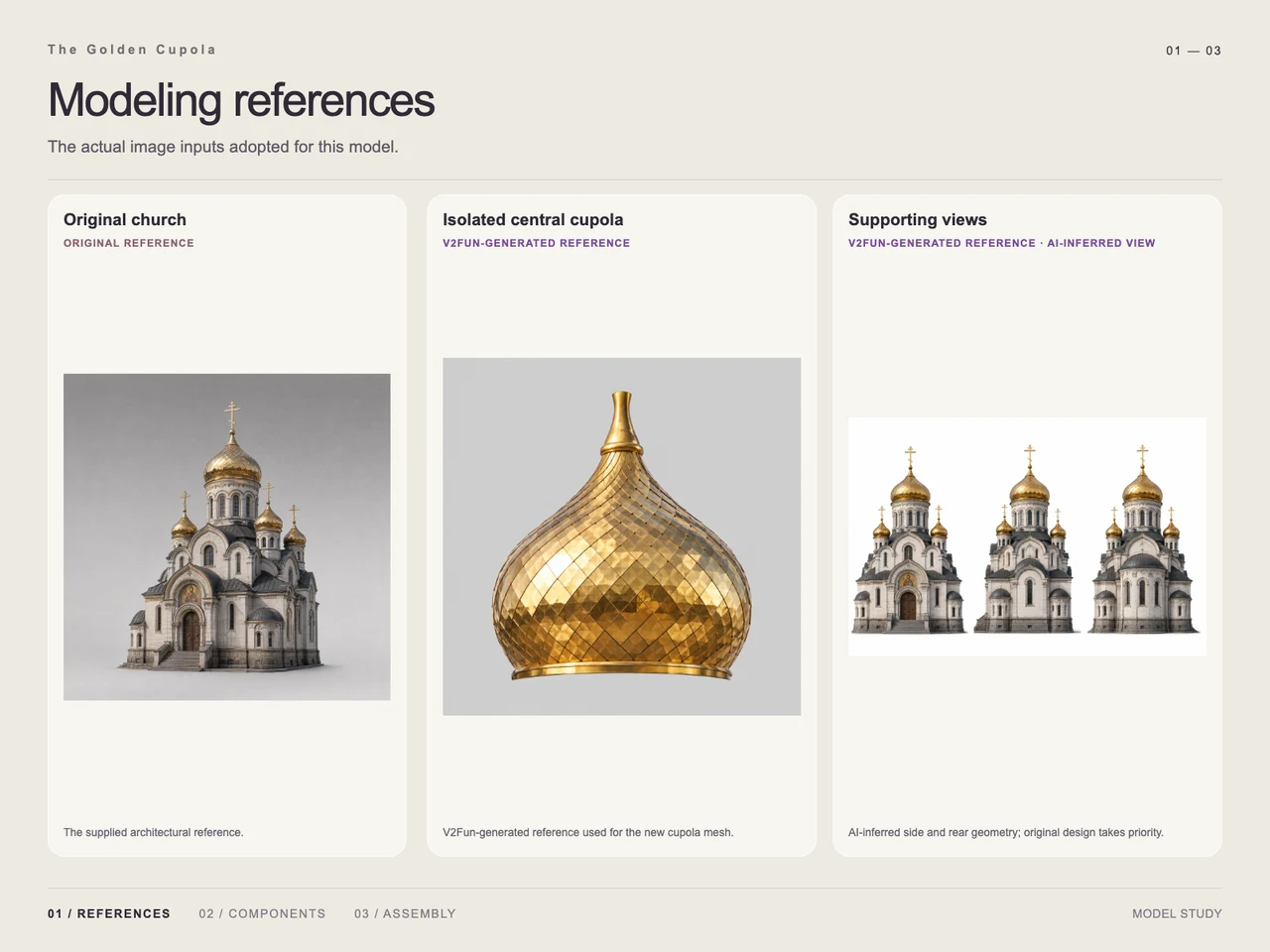
The input board pairs the original church reference with an isolated golden cupola and supporting church views. The isolated reference makes the cupola’s rounded silhouette, tapered neck, diamond-patterned surface, and base rim easier to inspect.
The supporting side and rear views are labeled as AI-inferred. They provide design guidance without establishing the unseen architecture as observed fact. The single-image and multi-view input guide provides related guidance on preparing references and handling hidden surfaces.
Step 2 — Separate the Architectural Components
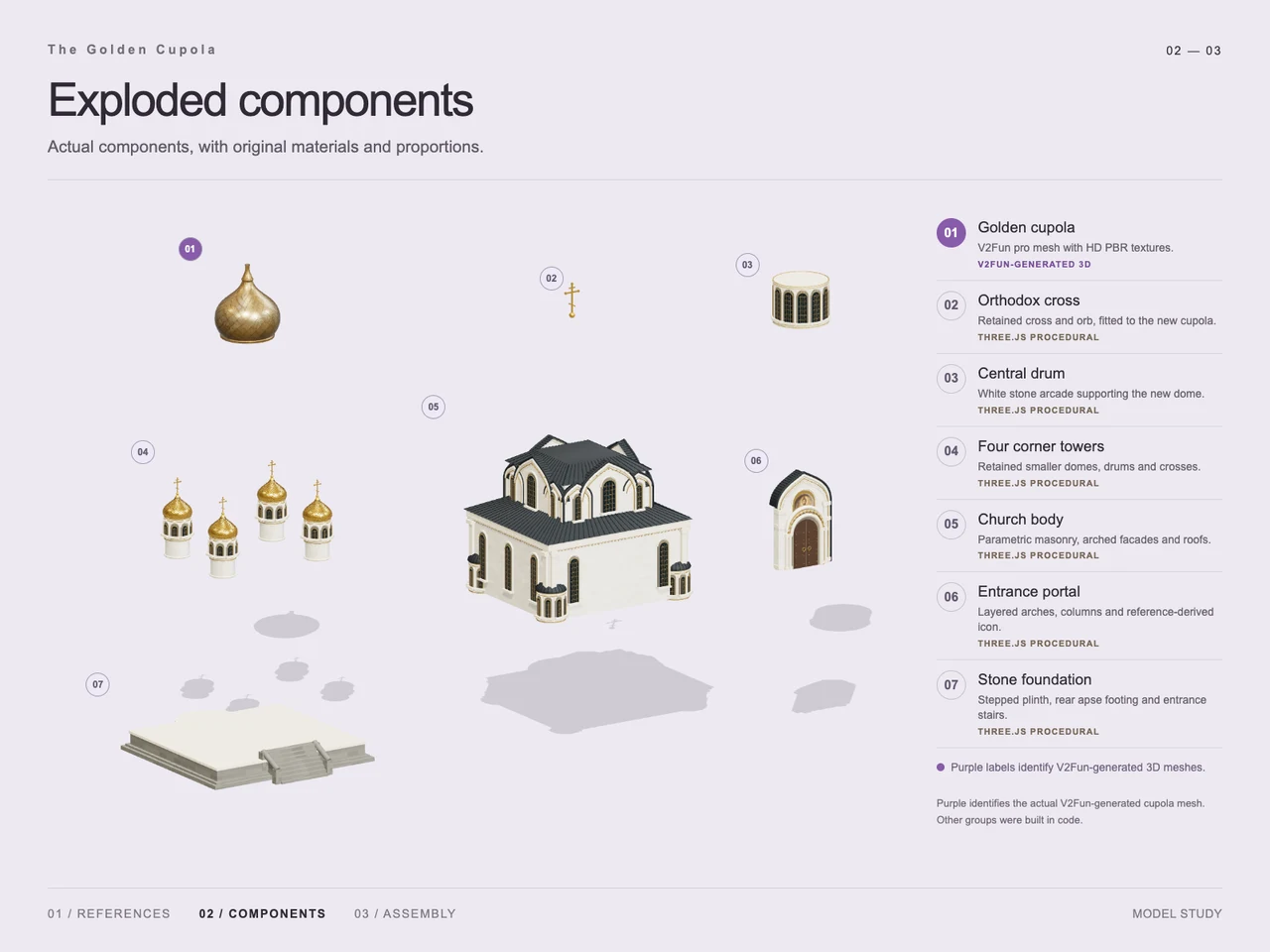
The exploded presentation identifies seven groups:
- Golden cupola: the V2Fun-generated central dome.
- Orthodox cross: the retained cross and orb fitted to the new cupola.
- Central drum: a pale stone arcade supporting the dome.
- Four corner towers: smaller domes, drums, and crosses retained in the assembly.
- Church body: procedural masonry, arched facades, and roofs.
- Entrance portal: layered arches, columns, and a reference-derived icon.
- Stone foundation: a stepped plinth, rear apse footing, and entrance stairs.
Only the central cupola is marked as V2Fun-generated 3D. The remaining groups are labeled as procedural Three.js work.
Step 3 — Generate the Central Cupola
The isolated cupola reference is identified as the input used for the new mesh. Its gold finish and diagonal surface pattern distinguish it from the pale drum and darker roofs beneath it. This component is the case’s demonstrated use of the V2Fun AI 3D model generator.
The component board describes PBR textures, but it supplies no texture resolution or material-channel inspection results.
Step 4 — Assemble and Present the Church
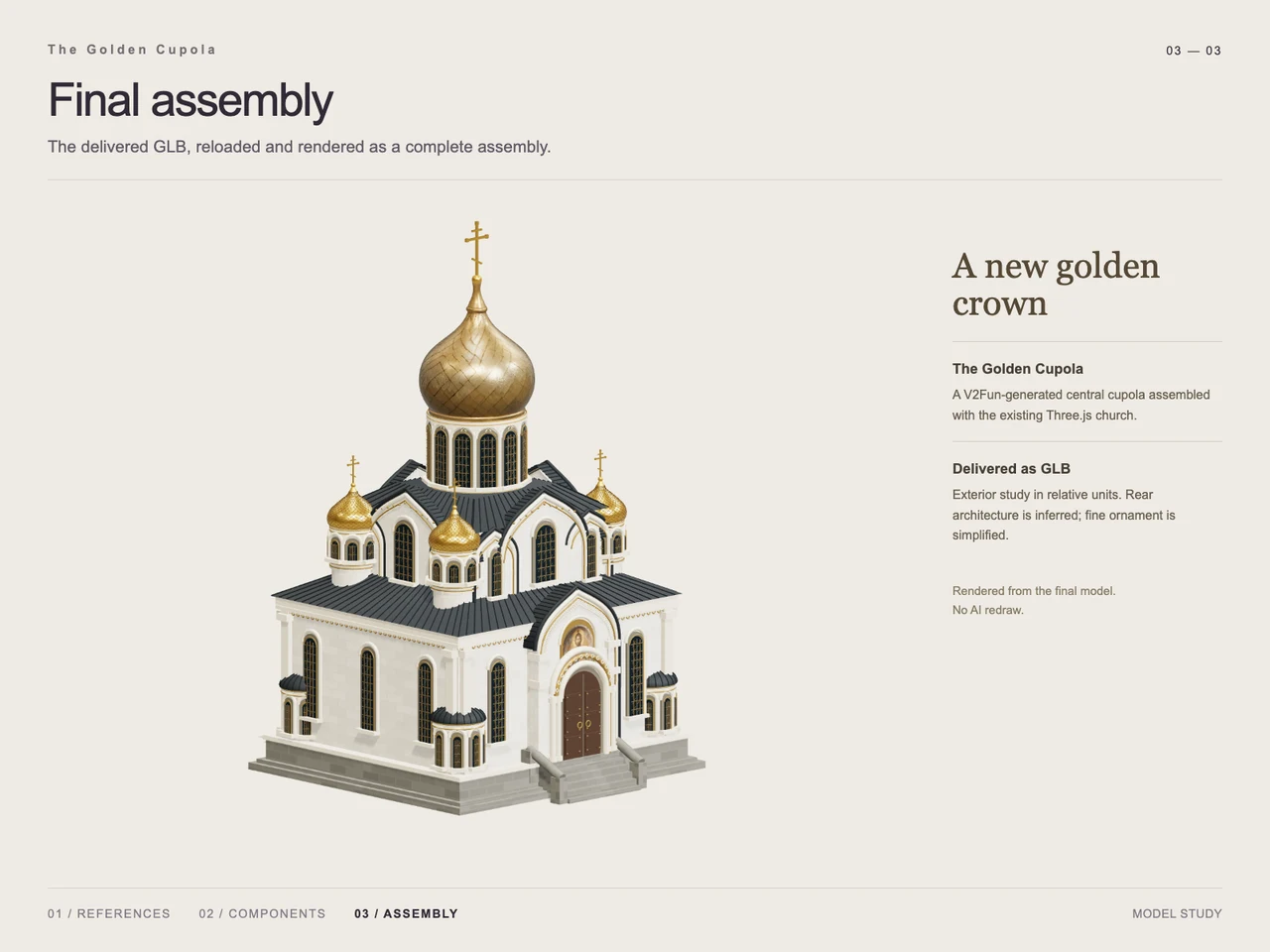
The final view shows the new cupola seated above the central windowed drum, with the retained cross at its peak. Smaller golden domes surround the upper church body, while the arched entrance and stairs establish the front of the building.
The presentation states that the delivered GLB was reloaded and rendered as a complete assembly. It describes the result as an exterior study in relative units, with inferred rear architecture and simplified fine ornament.
Workflow
Church reference → Isolated cupola and supporting views → Component decomposition → V2Fun cupola generation → Assembly with procedural Three.js architecture → GLB export and documented reload render.
Prompt
“Display an Orthodox church model against a gray gradient background.”
This is an English translation of the supplied prompt. The final presentation uses a warm neutral background rather than visibly reproducing the requested gray gradient.
Result
The final image presents a complete church exterior with a prominent golden central dome, pale walls, dark ribbed roofs, tall arched windows, and a stepped stone base.
- File:
orthodox-church-v2.glb - Supplied size: 98,736,540 bytes, approximately 98.74 MB.
- Supplied MIME type:
model/gltf-binary.
The case documents a generated architectural component integrated into a larger procedural assembly. For context on the delivered format, see the GLB and other 3D export formats guide.
Frequently Asked Questions
Which part of the Orthodox church was generated with V2Fun?
The central golden cupola is the only component identified as V2Fun-generated 3D. The presentation also identifies V2Fun-generated reference imagery.
What did Three.js contribute to the church model?
The exploded view labels the cross, central drum, four corner towers, church body, entrance portal, and stone foundation as procedural Three.js components.
What role does GPT-6 Astra have in this case?
The technical notes describe GPT-6 Astra performing structural understanding and task decomposition, with V2Fun handling complex model generation. The images show that approach applied to a generated cupola and procedural church assembly.
Are the supporting views verified views of the original church?
No. The reference board labels the supporting side and rear views as AI-inferred. The final presentation also states that rear architecture is inferred and fine ornament is simplified.
What file was supplied for the final church?
The supplied metadata lists orthodox-church-v2.glb, with MIME type model/gltf-binary and a size of 98,736,540 bytes. The presentation states that the delivered GLB was reloaded for the final assembly render.
Does this case demonstrate lower token use or faster modeling?
The technical notes describe efficiency as a motivation for separating planning from generation. No token counts, generation times, or comparative measurements are supplied for this church.
Explore More
-
GPT-6 Astra x V2Fun - From Code Generation to Model Collaboration | V2Fun
See how GPT-6 Astra and V2Fun combine agent reasoning, code generation, and AI 3D foundation models to build complex, structured 3D assets.
View page → -
AI 3D Model Generator Input Guide: Single vs. Multi-View | V2Fun
Learn how to prepare photos, multi-view references, and sketches for an AI 3D Model Generator, then inspect geometry and textures before export.
View page → -
V2Fun - AI 3D Model Generator
Create 3D models from text prompts or images with V2Fun's AI 3D model generator. Generate characters, props, game assets, and 3D-printable models faster.
View page → -
AI 3D Model Generator Export Guide: FBX, GLB, OBJ, or USDZ? | V2Fun
Use an AI 3D Model Generator with the right export format. Compare FBX, GLB, OBJ, and USDZ for Blender, game engines, animation, web, and AR.
View page →