Build a Mining Crawler with GPT-6 Astra and V2Fun
See how GPT-6 Astra and V2Fun turn a miner-and-drilling-vehicle concept into a component-based 3D asset, combining generated character detail, procedural machinery, assembly calibration, and GLB delivery.
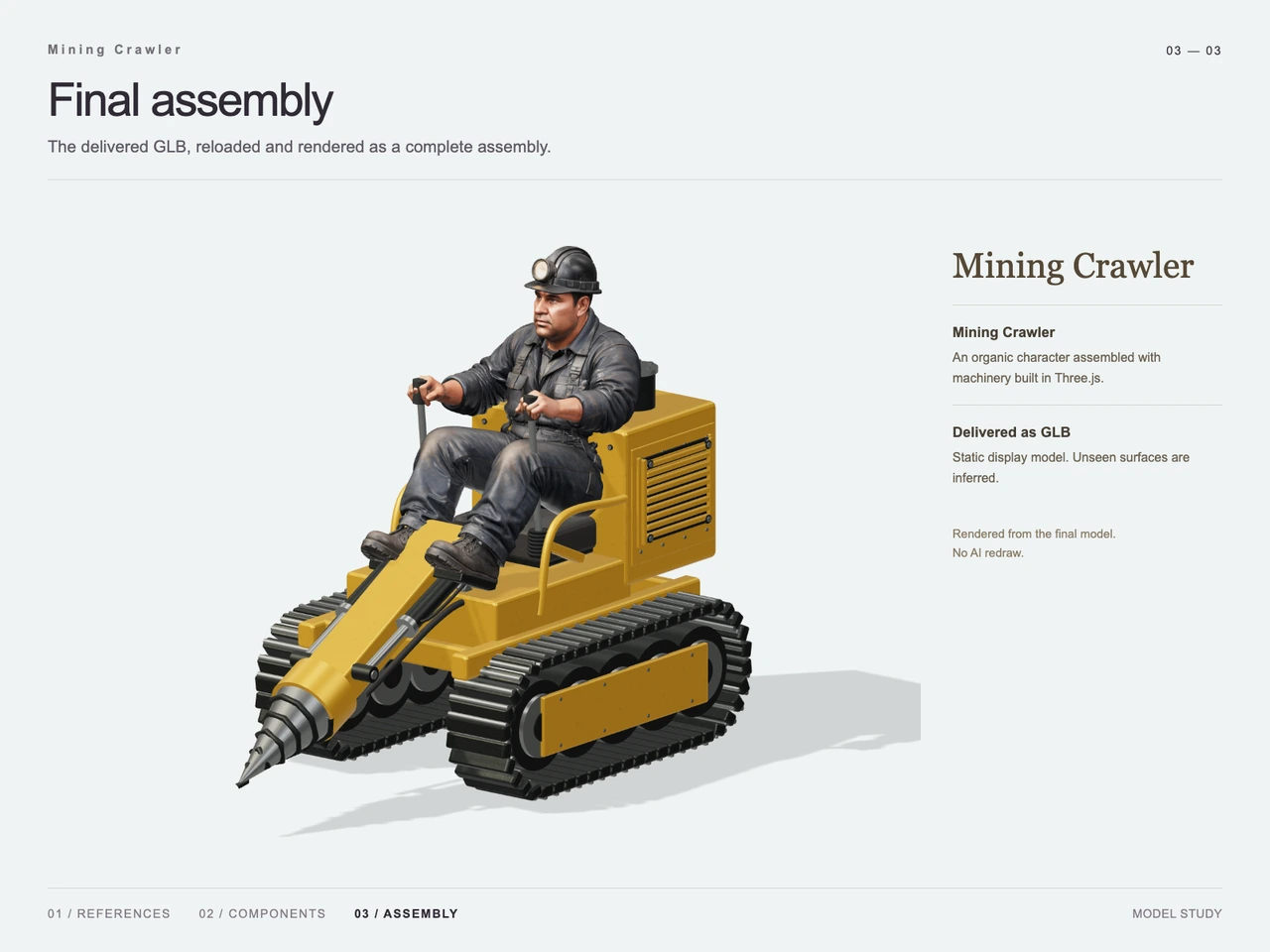
Interactive 3D preview · Build a Mining Crawler with GPT-6 Astra and V2FunDrag to rotate · Scroll to zoom
Take a Closer Look
-
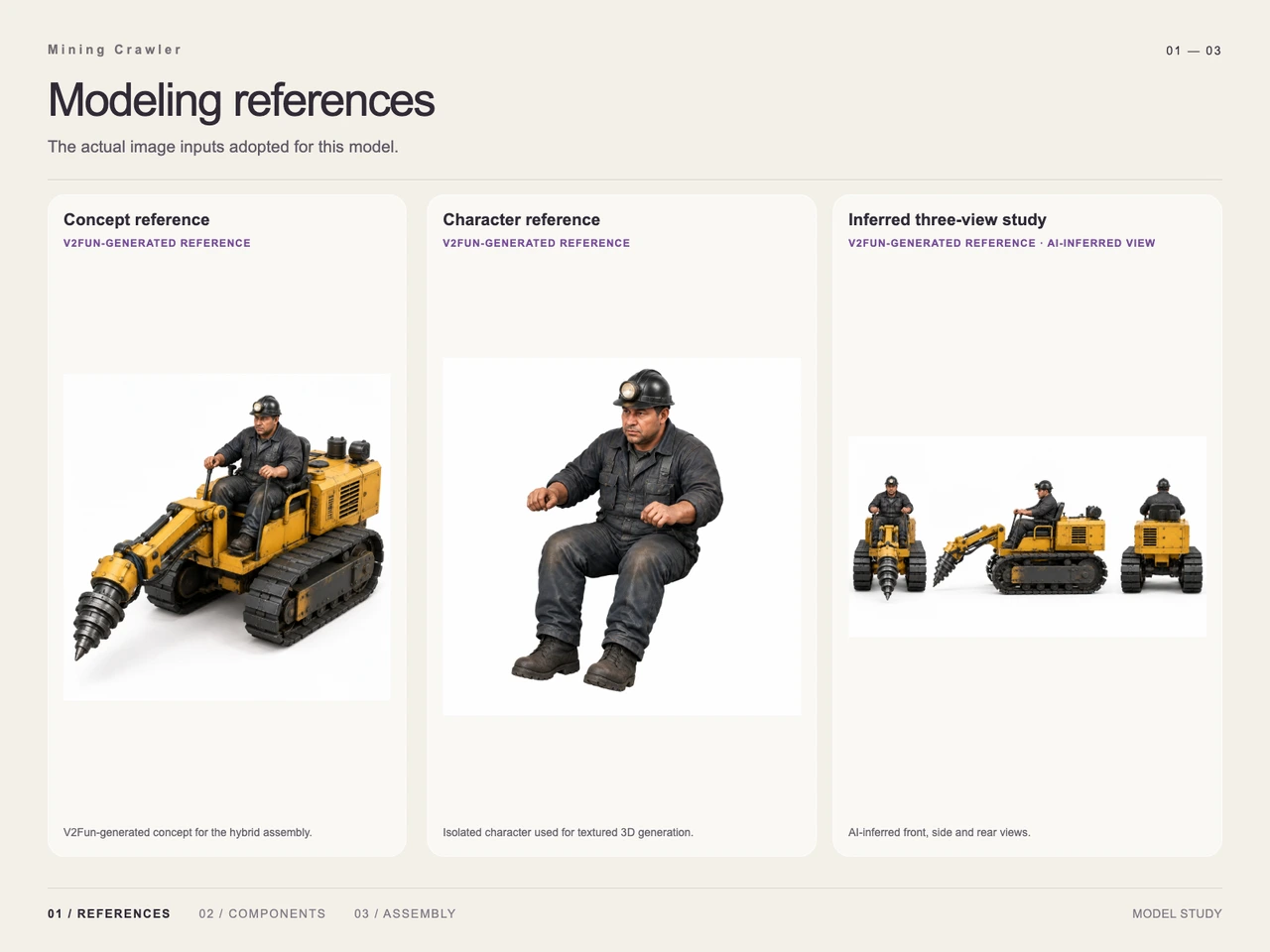 01 / Input
Input · Build a Mining Crawler with GPT-6 Astra and V2Fun
-
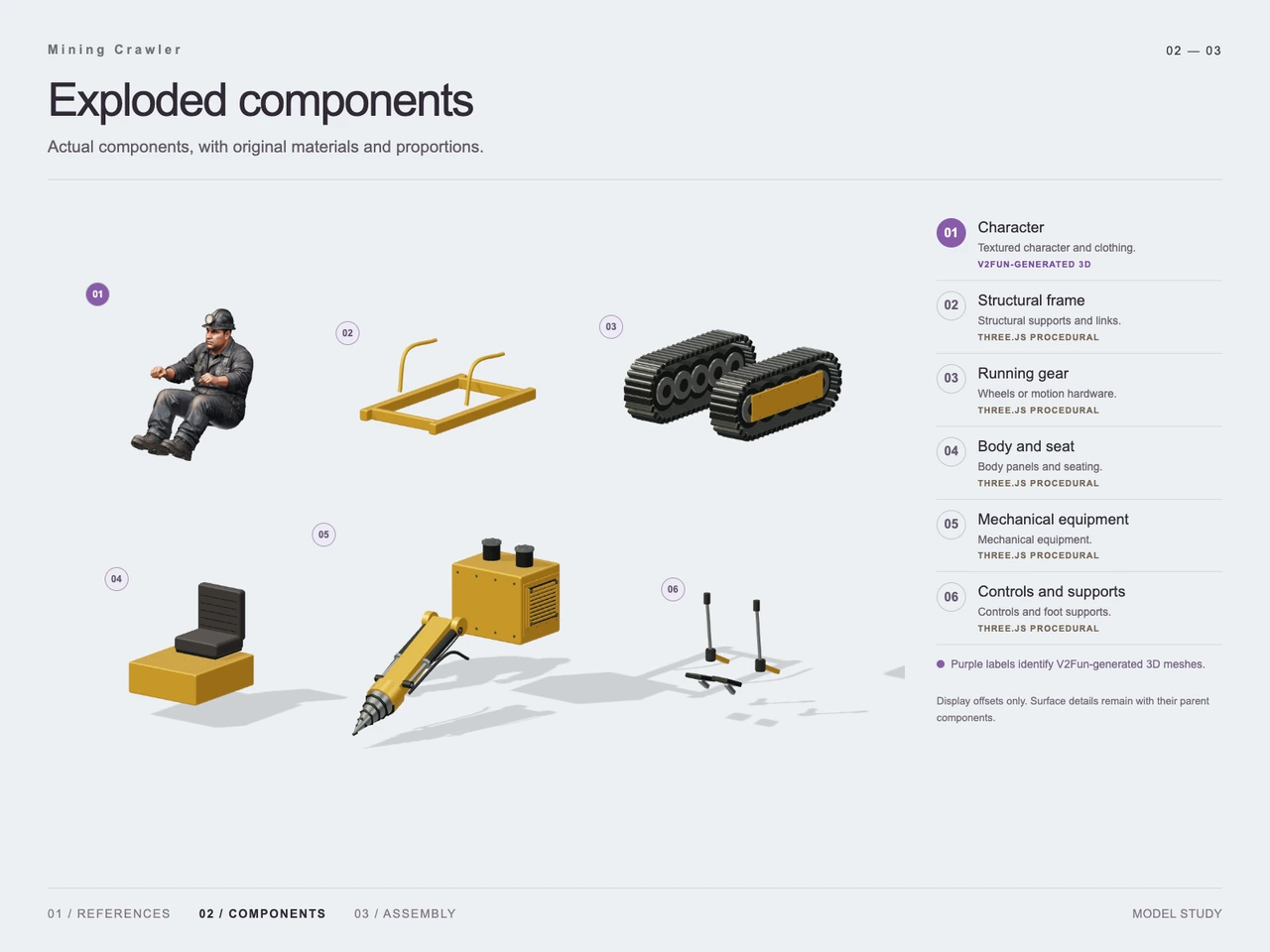 02 / Process
Process · Build a Mining Crawler with GPT-6 Astra and V2Fun
-
03 / Final
Final · Build a Mining Crawler with GPT-6 Astra and V2Fun
Overview
This case turns a concept of a sturdy middle-aged miner operating a compact tracked drilling vehicle into one complete 3D asset. The reference establishes the front three-quarter silhouette, seated operating pose, industrial-yellow body, black tracks, square power housing, and short drill arm.
The evidence shows a hybrid workflow: the miner was generated as a detailed character component, while the structural frame, running gear, body, drilling equipment, controls, and supports were constructed as separate procedural assemblies. GPT-6 Astra then coordinated their placement into the delivered model. This follows the broader GPT-6 Astra and V2Fun model-collaboration workflow.
Tools Used
- GPT-6 Astra: subject analysis, component planning, spatial calibration, and final assembly.
- V2Fun: generation of the textured miner character used in the model. The platform's image-to-3D model generator provides context for this reference-led generation route.
- Three.js / procedural modeling: construction of the regular mechanical components shown in the exploded study.
- Visual references: the complete concept, isolated character, and inferred front, side, and rear studies.
- GLB: the supplied final asset format. The 3D export format guide explains where GLB fits among common handoff formats.
Step 1 — Interpret the Complete Asset
GPT-6 Astra first treats the miner and crawler as one connected subject rather than two unrelated models. Important relationships include the seated pose, both hands meeting the control levers, the boots resting near the front supports, and the drill projecting ahead of the tracks.
Step 2 — Expand the Available Reference Evidence
The concept image supplies a strong front three-quarter view but leaves some surfaces unseen. The study therefore includes inferred front, side, and rear views to guide component planning. These views are reconstruction aids rather than proof of exact hidden geometry. For projects where several source angles are available, the multi-view 3D modeling workflow offers a directly relevant alternative.
Step 3 — Decompose the Miner and Machine
The exploded study separates the asset into six visible groups: the character, structural frame, running gear, body and seat, mechanical equipment, and controls and supports. This division makes the character's organic form and clothing distinct from the vehicle's repeated, regular geometry.
Step 4 — Generate the Character with V2Fun
V2Fun supplies the textured miner component, preserving the recognizable helmet lamp, workwear, facial character, seated posture, and bent limbs visible in the reference. The isolated character is then available for placement against the seat, levers, and foot supports.
Step 5 — Build the Mechanical Groups Procedurally
The evidence labels the remaining groups as Three.js procedural components. These include the frame, paired track modules, seat and power housing, drill assembly, control levers, and supports. Repeated rectangular track plates, rods, boxes, cylinders, stacked drill discs, and regular bends are well suited to this construction method.
Step 6 — Calibrate and Assemble
GPT-6 Astra brings the generated and procedural pieces together, adjusting their relative scale, rotation, and position. The final assembly aligns the tracks on either side of the body, projects the drilling arm from the front, seats the miner above the frame, and restores the hand, seat, control, and foot contact relationships.
Workflow
Concept reference → Infer supporting views → Decompose → Generate character → Build procedural machinery → Calibrate contacts → Assemble → Export GLB
Prompt
Create a complete standalone asset featuring a sturdy middle-aged miner wearing a lamp helmet and heavy canvas work clothes. He sits in an open seat on the rear of a compact tracked drilling vehicle and operates two control levers with both hands. The machine has a square power housing, independent track modules with repeated rectangular tread plates, and a short front mechanical arm ending in a drill made from stacked discs and a cone. Keep the access panels, cooling slots, and cylinders restrained. Use industrial yellow with black rubber.
Combine realistic proportions with lightly exaggerated collectible-model styling. Give the miner an expressive face and natural clothing folds. Construct the machinery from clearly separated cylinders, discs, rectangular plates, straight rods, and a few regular curved tubes, with plausible connections and visible contact between the character, seat, handles, and footrests. Show the complete centered subject from a slightly elevated front three-quarter view on a white background, with soft studio lighting, contact shadows, sharp focus, refined PBR-style materials, and clear margins. Exclude text, numbers, logos, watermarks, complex scenery, motion blur, collages, and exploded views.
Result
The delivered result is a static GLB assembly showing the miner seated on the yellow tracked crawler with the drill, tracks, power housing, seat, and controls combined into a coherent display model. The final presentation is rendered from the assembled model rather than redrawn as a new image.
- File:
78-v2-final.glb - Type:
model/gltf-binary - Size: 49,438,096 bytes (approximately 49.44 MB)
The available evidence demonstrates visual decomposition and final assembly, but it does not establish topology quality, UV quality, polygon count, exact dimensions, printability, animation readiness, engine readiness, or measured generation time.
Frequently Asked Questions
What was created in this GPT-6 Astra and V2Fun case?
The case produced a static GLB asset of a middle-aged miner operating a compact industrial-yellow tracked drilling vehicle with a front-mounted drill.
Which part was generated with V2Fun?
The exploded study identifies the textured miner character and clothing as the V2Fun-generated 3D component.
Which components were built procedurally?
The visual evidence labels the structural frame, running gear, body and seat, mechanical equipment, and controls and supports as Three.js procedural groups.
Why was the asset split into components?
The split separates the miner's organic form from the machine's regular boxes, rods, cylinders, tracks, and drill elements, allowing each type of geometry to be handled with an appropriate method before assembly.
Did the workflow use multiple photographed views?
No such source set is proven. The case shows one complete concept reference plus AI-inferred front, side, and rear studies used to reason about surfaces not visible in the original view.
Is the delivered model proven ready for games, animation, or 3D printing?
No. The evidence confirms a static GLB delivery and rendered assembly, but it does not provide the topology, rigging, scale, wall-thickness, import, or performance tests required for those claims.
Explore More
-
GPT-6 Astra x V2Fun - From Code Generation to Model Collaboration | V2Fun
See how GPT-6 Astra and V2Fun combine agent reasoning, code generation, and AI 3D foundation models to build complex, structured 3D assets.
View page → -
V2Fun - AI 3D Model Generator
Create 3D models from text prompts or images with V2Fun's AI 3D model generator. Generate characters, props, game assets, and 3D-printable models faster.
View page → -
V2Fun - Multi-View to 3D Model AI
Generate accurate 3D models from multiple reference images with V2Fun's multi-view to 3D model AI. Create structured assets with better shape consistency and detail.
View page → -
AI 3D Model Generator Export Guide: FBX, GLB, OBJ, or USDZ? | V2Fun
Use an AI 3D Model Generator with the right export format. Compare FBX, GLB, OBJ, and USDZ for Blender, game engines, animation, web, and AR.
View page →