Build a Mechanic Girl Figurine with GPT-6 Astra and V2Fun
Explore a character assembly that combines V2Fun-generated head and body meshes with procedural accessories: a yellow helmet, tin toy robot, remote control, and tool case.
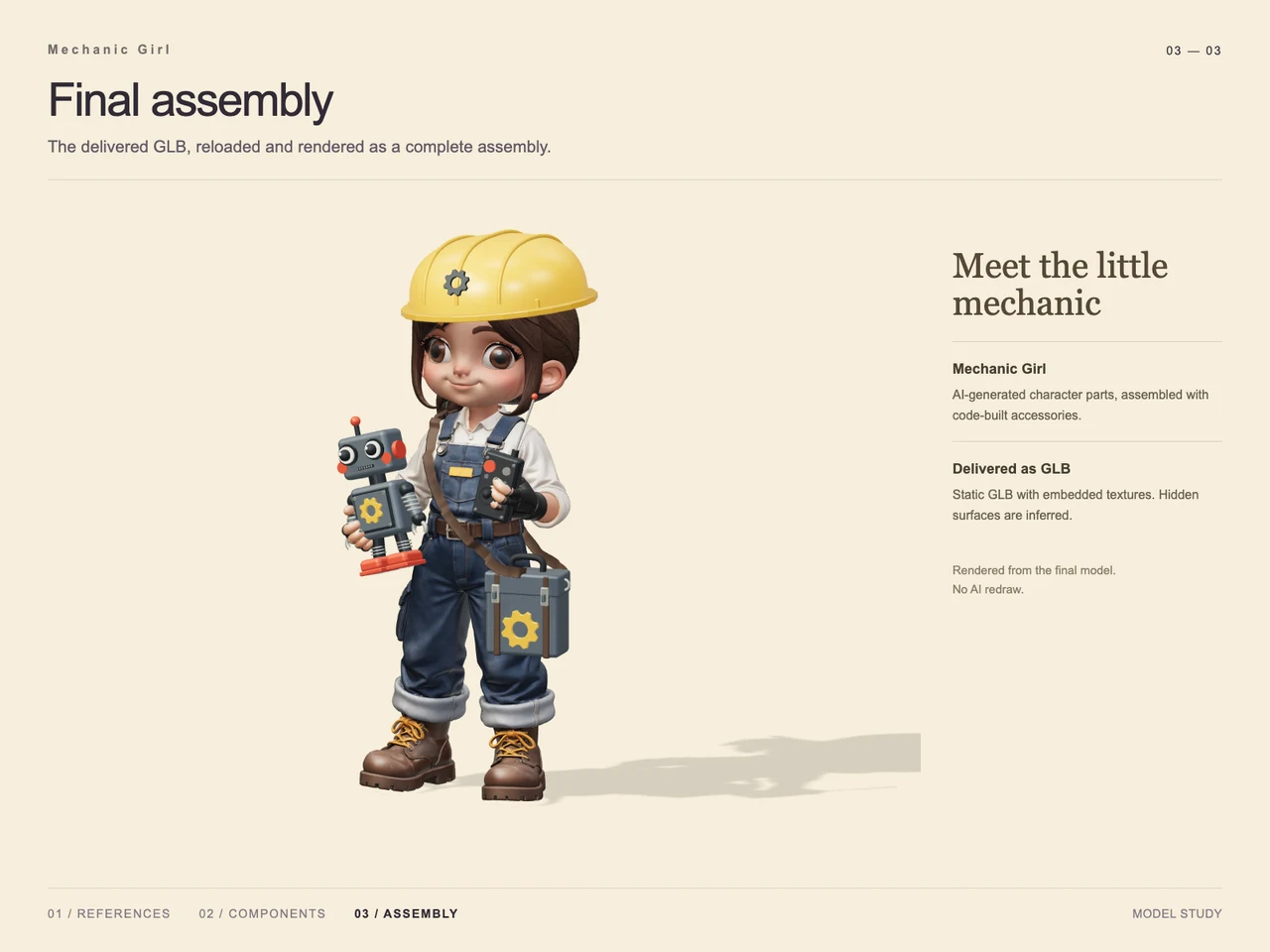
Interactive 3D preview · Build a Mechanic Girl Figurine with GPT-6 Astra and V2FunDrag to rotate · Scroll to zoom
Take a Closer Look
-
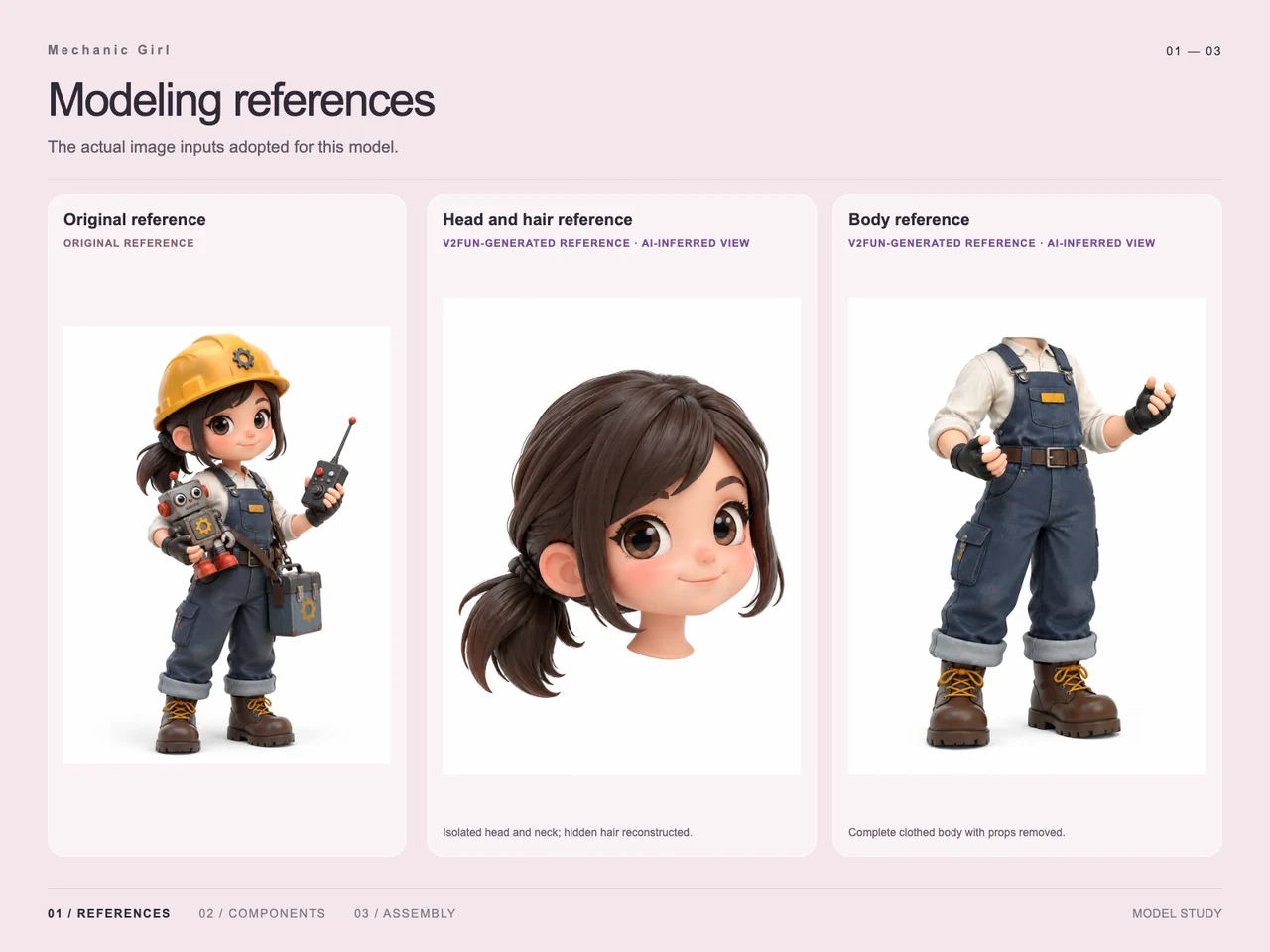 01 / Input
Input · Build a Mechanic Girl Figurine with GPT-6 Astra and V2Fun
-
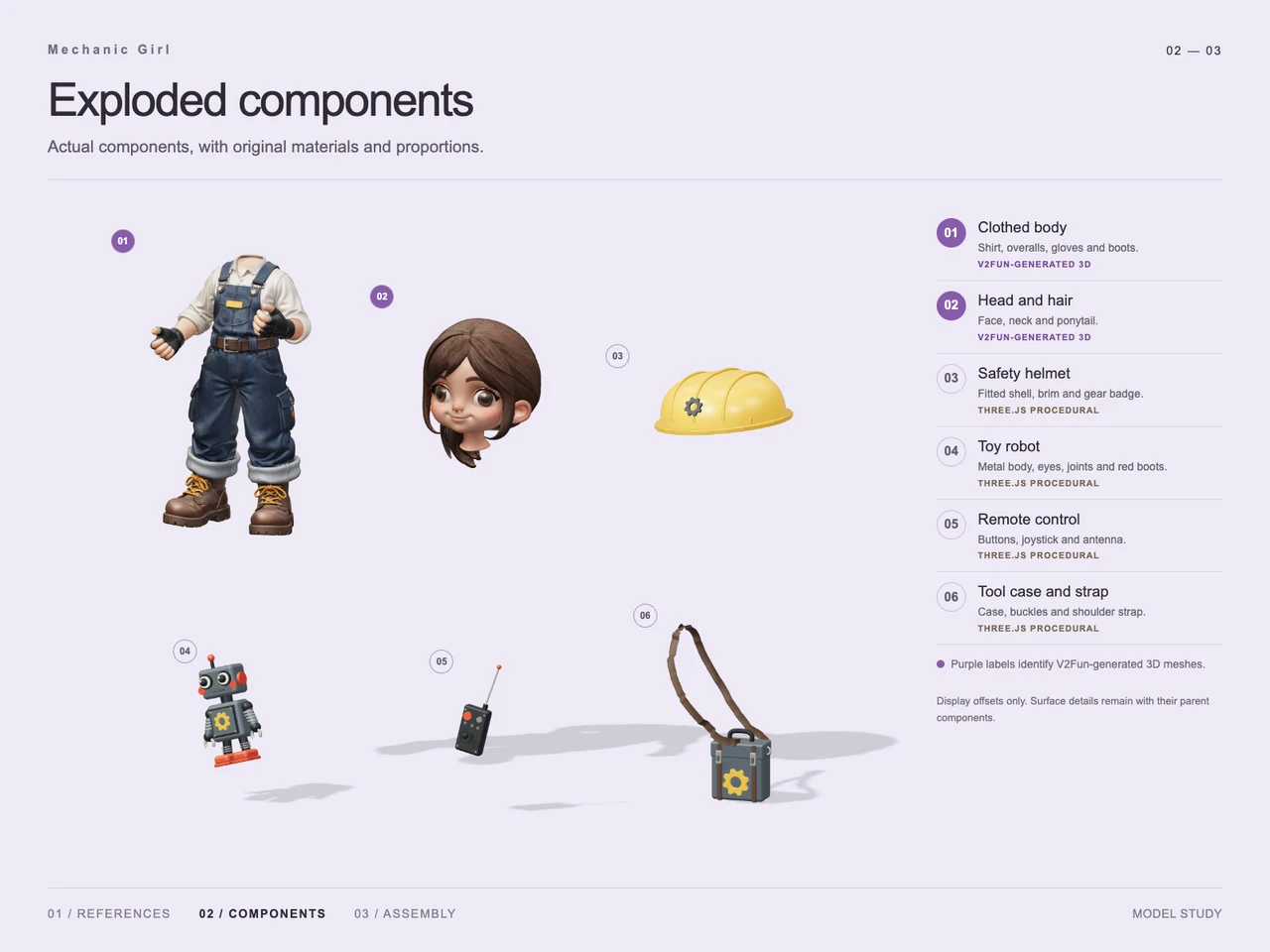 02 / Process
Process · Build a Mechanic Girl Figurine with GPT-6 Astra and V2Fun
-
03 / Final
Final · Build a Mechanic Girl Figurine with GPT-6 Astra and V2Fun
Overview
This case turns a little girl playing with a tin robot into a complete standing 3D figurine. Her yellow work helmet, blue overalls, brown boots, handheld remote, and hanging tool case establish the mechanic theme.
The technical notes describe GPT-6 Astra as the planner for structural understanding and task decomposition, with V2Fun handling complex model generation. The process image makes that division concrete: two generated character components sit alongside four groups of procedural accessories. This follows the broader GPT-6 Astra and V2Fun 3D agent workflow. No case-specific token savings or timing measurements are supplied.
Tools Used
- GPT-6 Astra: structural understanding and task planning, as described in the technical notes.
- V2Fun: generated reference images and the head-and-hair and clothed-body 3D components, as identified in the presentation.
- Three.js: procedural construction of the helmet, toy robot, remote control, and tool case with strap, according to the component labels.
- GLB: the supplied final asset format.
Step 1 — Prepare Isolated Character References
The input presentation shows the original complete character beside two modeling references: an isolated head with hair and neck, and a clothed body with the handheld props removed. Both isolated references are labeled as V2Fun-generated, AI-inferred views.
Removing the helmet exposes a reconstructed hairstyle, while removing the props makes the clothing and hand poses easier to see. These studies supply separate modeling targets; hidden hair and covered surfaces remain interpretations of the original image. The AI 3D model input guide provides related guidance on reducing occlusion and preparing clear references.
Step 2 — Divide the Figurine into Six Component Groups
The exploded process view documents six groups:
- Clothed body, including the shirt, overalls, gloves, and boots.
- Head and hair, including the face, neck, and ponytail.
- Safety helmet with a brim and gear badge.
- Tin toy robot with round eyes, joint details, and red feet.
- Remote control with buttons, a joystick, and an antenna.
- Tool case with buckles and a shoulder strap.
The separated positions are display offsets used to explain the assembly. Surface details remain with their parent components in this presentation.
Step 3 — Generate the Character and Build the Accessories
The process view identifies the clothed body and head-and-hair meshes as V2Fun-generated 3D. The face, hairstyle, clothing folds, and boots carry the character's organic and fabric detail. These parts illustrate the role of the V2Fun AI 3D model generator in the case.
The four accessory groups are labeled as Three.js procedural work. Their visible details include the helmet's raised ridges, the robot's box-shaped torso and gear emblem, the remote's antenna, and the case's handle and hanging strap. Together, these components demonstrate a hybrid construction approach within one character asset.
Step 4 — Assemble and Present the Final Model
The final image shows the head joined to the body, the yellow helmet placed over the hair, the robot held in one hand, and the remote held in the other. A brown strap crosses the torso and supports the tool case at the hip. Both boots meet the ground in a standing pose.
The final presentation identifies this view as a render of the delivered GLB after reloading, with no AI redraw. It describes the asset as static with embedded textures and notes that hidden surfaces are inferred. These are documented presentation details rather than an independent inspection of the file.
Workflow
Original character reference → isolated head and body references → six component groups → V2Fun character generation and Three.js accessory construction → complete assembly → GLB delivery and documented reload render.
Prompt
A fully assembled figurine of a little girl playing with a robot, wearing a small worker's hat. She holds a tin robot in one hand and a remote control in the other, with a repair tool case secured at her waist. All accessories are fully assembled on the standing figure. Use a pure white background, professional studio lighting, and a highly detailed 3D anime figurine display style.
Result
The final presentation preserves the requested standing character and all major accessories. It uses a warm cream backdrop with a cast shadow, while the prompt requested pure white. The yellow helmet, dark overalls, metal-colored robot, and tool case remain clearly distinguishable in the assembled view.
- File:
mechanic-girl.glb - Supplied size: 102,919,560 bytes, approximately 102.92 MB in decimal units.
- Supplied MIME type:
model/gltf-binary. - Documented presentation: a static character assembly with embedded textures.
For context on the delivery format, see the AI 3D export guide to FBX, GLB, OBJ, and USDZ. This case demonstrates the visual assembly of generated character parts and procedural props; it supplies no measured generation time or downstream performance results.
Frequently Asked Questions
Which mechanic girl components were generated with V2Fun?
The process presentation labels the clothed body and the head with hair as V2Fun-generated 3D. The body group includes the shirt, overalls, gloves, and boots.
Which accessories were built with Three.js?
The safety helmet, tin toy robot, remote control, and tool case with strap are labeled as Three.js procedural components in the exploded view.
Why were separate head and body references prepared?
They provide isolated modeling targets for the character parts. The head reference reconstructs hair hidden by the helmet, and the body reference removes the props to expose the clothing and hand poses. Both are labeled as AI-inferred references.
Does the final assembly include every major accessory from the prompt?
Yes. The final image shows the work helmet, a robot in one hand, a remote in the other, and a tool case hanging at the hip. The character stands with all these elements assembled.
What file was delivered, and is animation demonstrated?
The supplied metadata identifies mechanic-girl.glb at 102,919,560 bytes with MIME type model/gltf-binary. The final presentation describes a static GLB with embedded textures; no animation is demonstrated.
Explore More
-
GPT-6 Astra x V2Fun - From Code Generation to Model Collaboration | V2Fun
See how GPT-6 Astra and V2Fun combine agent reasoning, code generation, and AI 3D foundation models to build complex, structured 3D assets.
View page → -
AI 3D Model Generator Input Guide: Single vs. Multi-View | V2Fun
Learn how to prepare photos, multi-view references, and sketches for an AI 3D Model Generator, then inspect geometry and textures before export.
View page → -
V2Fun - AI 3D Model Generator
Create 3D models from text prompts or images with V2Fun's AI 3D model generator. Generate characters, props, game assets, and 3D-printable models faster.
View page → -
AI 3D Model Generator Export Guide: FBX, GLB, OBJ, or USDZ? | V2Fun
Use an AI 3D Model Generator with the right export format. Compare FBX, GLB, OBJ, and USDZ for Blender, game engines, animation, web, and AR.
View page →