Build a Maintenance Worker Scissor Lift with GPT-6 Astra and V2Fun
See how GPT-6 Astra and V2Fun turn a maintenance-worker concept into an assembled 3D scissor lift, combining generated character detail with regular mechanical components and spatial calibration.
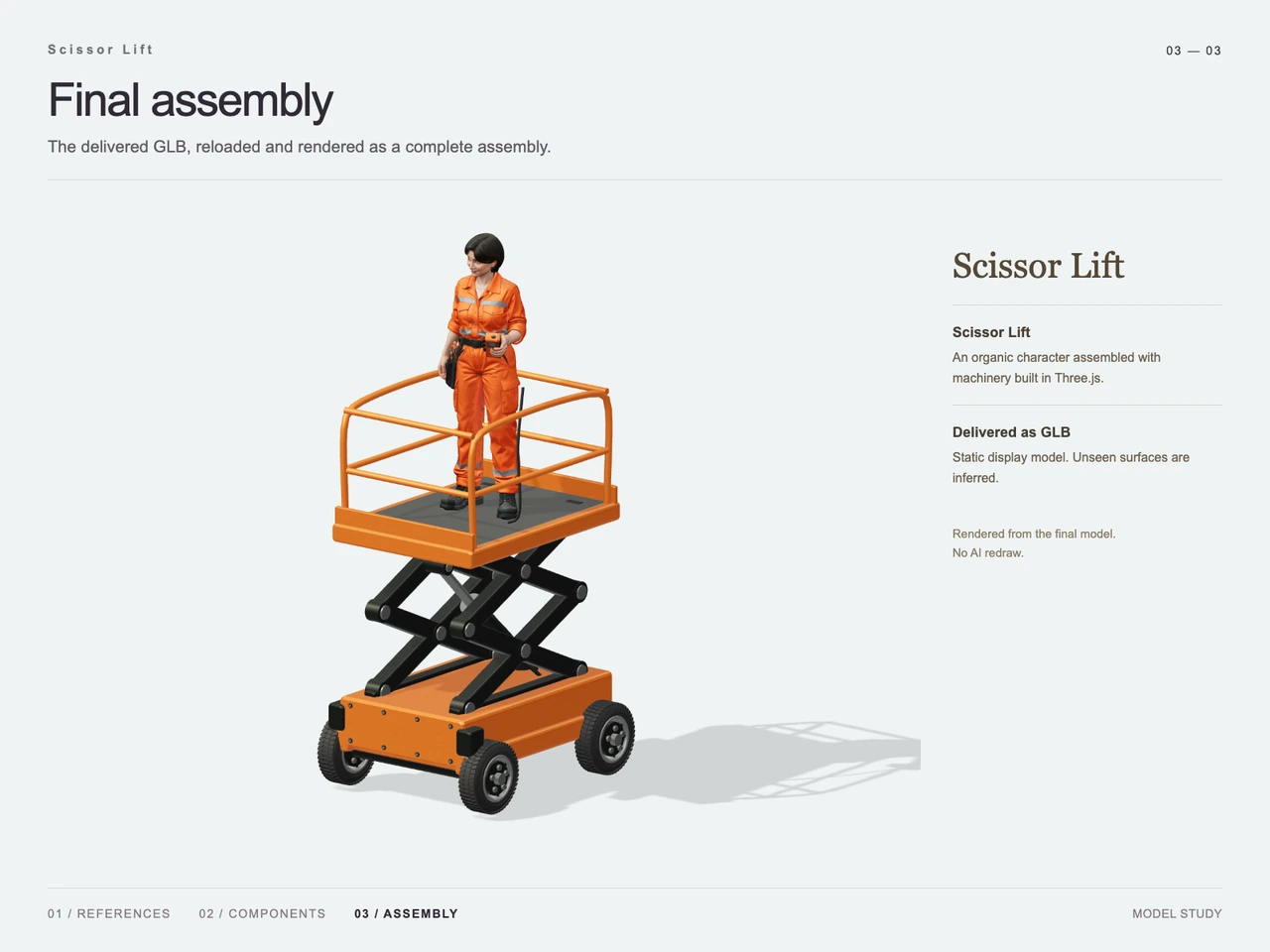
Interactive 3D preview · Build a Maintenance Worker Scissor Lift with GPT-6 Astra and V2FunDrag to rotate · Scroll to zoom
Take a Closer Look
-
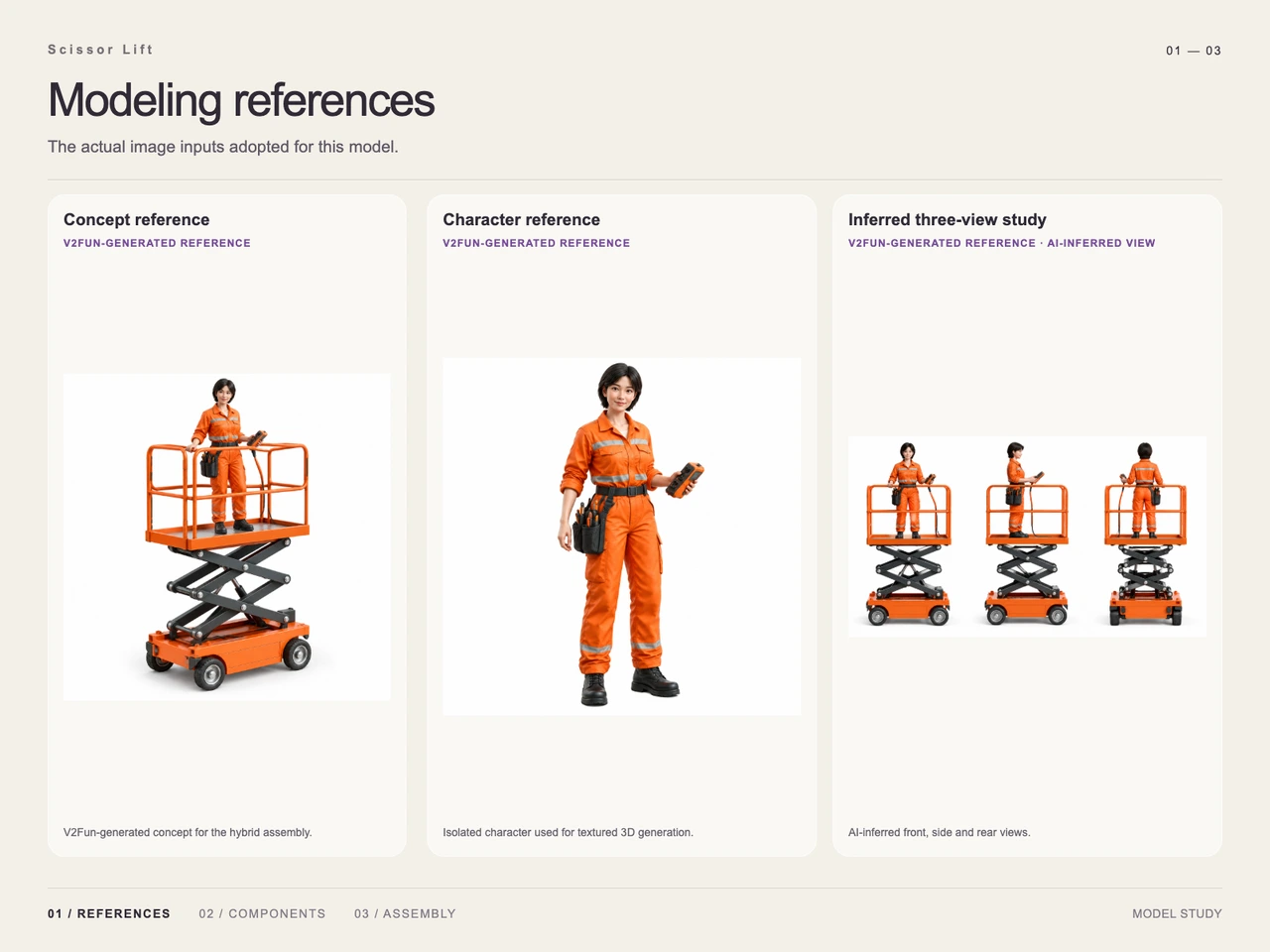 01 / Input
Input · Build a Maintenance Worker Scissor Lift with GPT-6 Astra and V2Fun
-
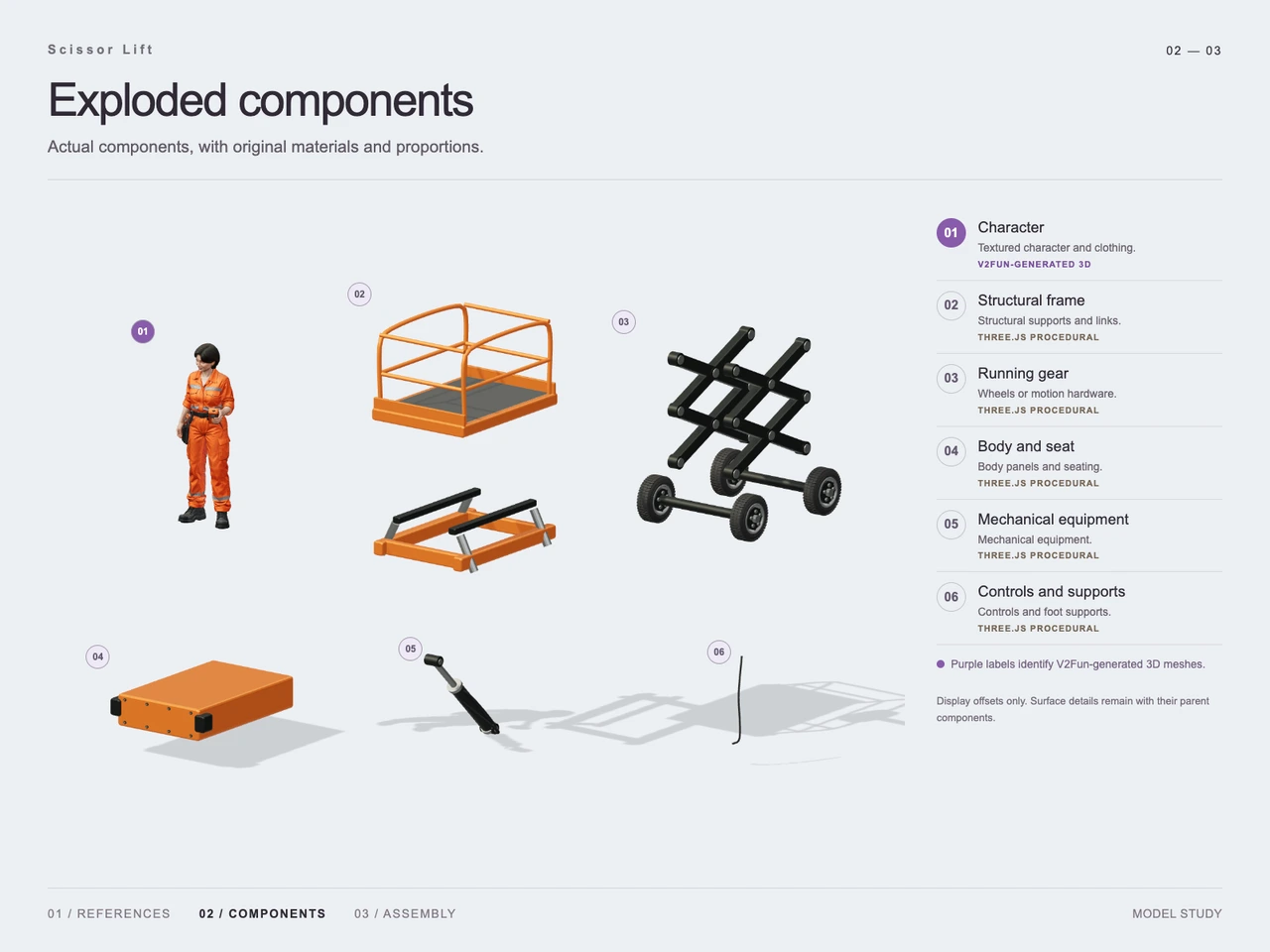 02 / Process
Process · Build a Maintenance Worker Scissor Lift with GPT-6 Astra and V2Fun
-
03 / Final
Final · Build a Maintenance Worker Scissor Lift with GPT-6 Astra and V2Fun
Overview
This case turns a front three-quarter concept of a short-haired adult maintenance worker standing on a compact mobile scissor lift into a complete 3D asset. The reference establishes the orange coveralls, soft tool pouch, handheld control box, tubular guardrails, raised platform, crossed lifting arms, rectangular base, and four-wheel layout.
The process separates the organic character from the lift’s regular mechanical forms. GPT-6 Astra interprets the hierarchy and coordinates assembly, while V2Fun supplies the detailed character mesh. The component study shows the structural frame, running gear, body, platform, controls, and supports as separate construction groups. This division follows the broader GPT-6 Astra and V2Fun collaborative workflow.
Tools Used
- GPT-6 Astra: reference analysis, component planning, spatial reasoning, and assembly calibration.
- V2Fun: generation of the textured maintenance-worker component.
- Three.js / procedural geometry: construction of regular mechanical parts shown in the process evidence, including frames, wheels, panels, and supports.
- Visual references: the concept image, isolated character reference, and inferred front, side, and rear study.
- GLB: the supplied final asset format.
Step 1 — Define the Complete Asset
The prompt specifies one worker and one lift as a self-contained asset. The input board keeps the full silhouette visible against a plain background and provides an isolated character study. It also includes inferred front, side, and rear views to reduce uncertainty around the platform, scissor structure, wheel placement, clothing, and pose. For similar projects, the single-image and multi-view input guide explains why additional angles can clarify hidden forms without proving exact reconstruction.
Step 2 — Decompose the Character and Machine
GPT-6 Astra organizes the subject into six visible groups: the character, upper platform and guardrail structure, scissor frame and running gear, rectangular body, mechanical equipment, and controls or supports. The process board identifies the character as V2Fun-generated and the regular mechanical groups as procedural. This keeps the character’s face, clothing folds, belt, tool pouch, and handheld controller separate from the lift’s repeated bars, pins, plates, and wheels.
Step 3 — Generate the Organic Component
V2Fun is used for the maintenance worker, where facial form, fabric folds, clothing layers, and accessories are less suitable for primitive-only construction. The isolated reference preserves the orange workwear, reflective bands, boots, belt, tool pouch, and control box visible in the design. This is an image-guided component-generation step; the available evidence does not establish topology, UV layout, rigging, or animation readiness. The V2Fun image-to-3D model generator provides background on this type of reference-driven generation.
Step 4 — Build the Regular Lift Components
The lift is reconstructed from clearly bounded forms: rectangular plates for the platform and base, tubular rails around the deck, straight crossed members for the lifting mechanism, cylindrical pivots, and four wheels on two axles. The exploded view indicates that these mechanical groups were handled procedurally. The evidence demonstrates their visible arrangement, but it does not prove engineering dimensions, functional articulation, load capacity, or manufacturing accuracy.
Step 5 — Calibrate Contact and Assembly
The agent brings the generated and procedural components back together, adjusting their visible scale, rotation, and placement. The final render positions the worker inside the guardrails with both feet on the deck, places the scissor pairs between the upper platform and wheeled base, and aligns the controls with the worker’s hand. This step focuses on the pose and contact relationships requested by the prompt rather than claiming a functional simulation.
Step 6 — Render and Export
The assembled result is shown from a slightly elevated front three-quarter view with soft studio lighting and a contact shadow. Orange body panels and rails visually connect the worker’s clothing with the machine, while dark scissor arms and tires keep the lifting structure readable. The delivered file is a binary glTF asset; the GLB export format guide provides relevant format context. No downstream engine, print, rigging, or performance validation is documented for this case.
Workflow
Prompt and concept reference → infer supporting views → separate character and machine → generate the organic character → construct regular mechanical groups → calibrate scale and contacts → assemble → render → export GLB
Prompt
An adult female maintenance worker with short hair wears orange coveralls and a soft tool pouch while standing on the platform of a compact mobile scissor lift. She holds the guardrail with one hand and operates a control box with the other. The machine has a four-wheel rectangular base, two clearly visible pairs of crossed scissor arms with cylindrical pivot pins, a thin rectangular metal platform, and simple tubular guardrails. Show the complete worker, lifting structure, and wheel assembly at a moderate raised height. Treat the person and machine as one self-contained collectible-style asset with realistic proportions, slight stylization, a lively face, natural fabric folds, clear component boundaries, and plausible contact points. Use a slightly elevated front three-quarter view, centered composition, white background, soft studio lighting, contact shadows, clear focus, and refined PBR-style materials. Include no text, numbers, logos, watermarks, complex environment, motion blur, collage, or exploded arrangement.
Result
Final output: 86-v2-final.glb
File type: model/gltf-binary
File size: 48,762,752 bytes (approximately 48.76 MB)
The final evidence shows a complete static assembly containing the worker, guarded platform, crossed lift structure, rectangular base, controls, and four wheels. It demonstrates the intended visual composition and component relationships, but it does not establish topology quality, UV quality, exact dimensions, printability, animation readiness, commercial rights, or measured performance.
Frequently Asked Questions
What was generated with V2Fun in this scissor-lift case?
The process evidence identifies the textured maintenance-worker character and clothing as the V2Fun-generated 3D component. The lift’s regular structural and mechanical groups are labeled as procedural.
How was the mobile scissor lift divided for assembly?
The visible component study separates the asset into the character, upper platform and structural frame, scissor mechanism and running gear, rectangular body, mechanical equipment, and controls or supports.
Why were multiple reference views used?
The input board includes a concept image, an isolated character reference, and inferred front, side, and rear views. These views help clarify the worker’s pose and the lift’s guardrails, platform, crossed arms, base, and wheels, although they do not prove exact hidden geometry.
Does the final model represent an operational scissor lift?
The evidence supports a visually assembled static model with plausible component placement. It does not demonstrate working articulation, engineering dimensions, load capacity, or mechanical simulation.
What file was delivered?
The supplied result is `86-v2-final.glb`, a `model/gltf-binary` file containing 48,762,752 bytes, or approximately 48.76 MB.
Is the asset ready for animation, games, or 3D printing?
That is not established by this case. Rigging, topology, UVs, collision, runtime behavior, physical scale, wall thickness, and downstream import or slicer tests were not provided.
Explore More
-
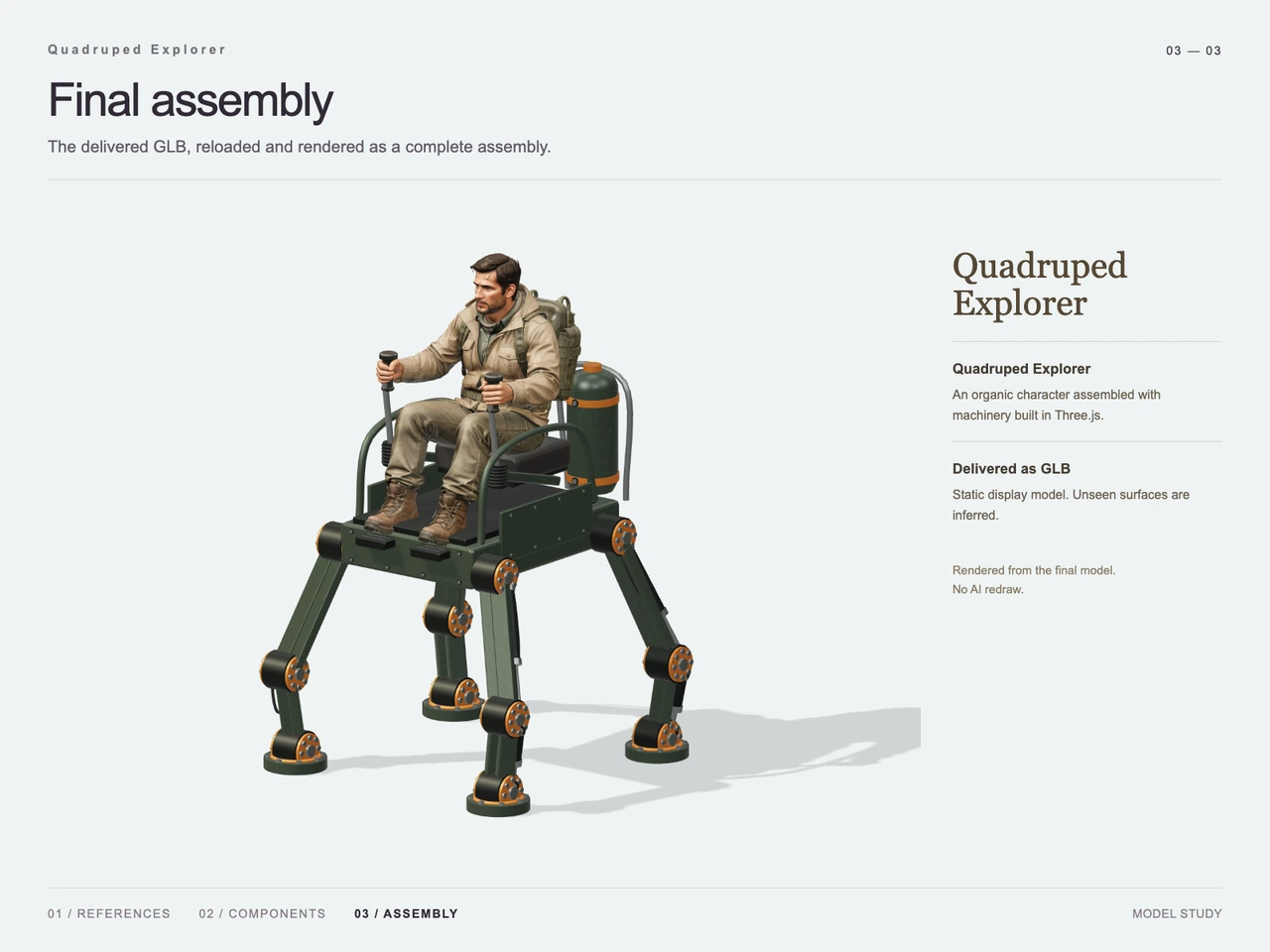
GPT-6 Astra x V2Fun - From Code Generation to Model Collaboration | V2Fun
See how GPT-6 Astra and V2Fun combine agent reasoning, code generation, and AI 3D foundation models to build complex, structured 3D assets.
View page → -
AI 3D Model Generator Input Guide: Single vs. Multi-View | V2Fun
Learn how to prepare photos, multi-view references, and sketches for an AI 3D Model Generator, then inspect geometry and textures before export.
View page → -
V2Fun - AI 3D Model Generator
Create 3D models from text prompts or images with V2Fun's AI 3D model generator. Generate characters, props, game assets, and 3D-printable models faster.
View page → -
AI 3D Model Generator Export Guide: FBX, GLB, OBJ, or USDZ? | V2Fun
Use an AI 3D Model Generator with the right export format. Compare FBX, GLB, OBJ, and USDZ for Blender, game engines, animation, web, and AR.
View page →