Little Kitchen Diorama with GPT-6 Astra and V2Fun
Explore a miniature kitchen built with procedural Three.js components and a V2Fun-generated calico chef, from modeling references to the final GLB assembly.
Interactive 3D preview · Little Kitchen Diorama with GPT-6 Astra and V2FunDrag to rotate · Scroll to zoom
Take a Closer Look
-
 01 / Input
Input · Little Kitchen Diorama with GPT-6 Astra and V2Fun
-
 02 / Process
Process · Little Kitchen Diorama with GPT-6 Astra and V2Fun
-
03 / Final
Final · Little Kitchen Diorama with GPT-6 Astra and V2Fun
Overview
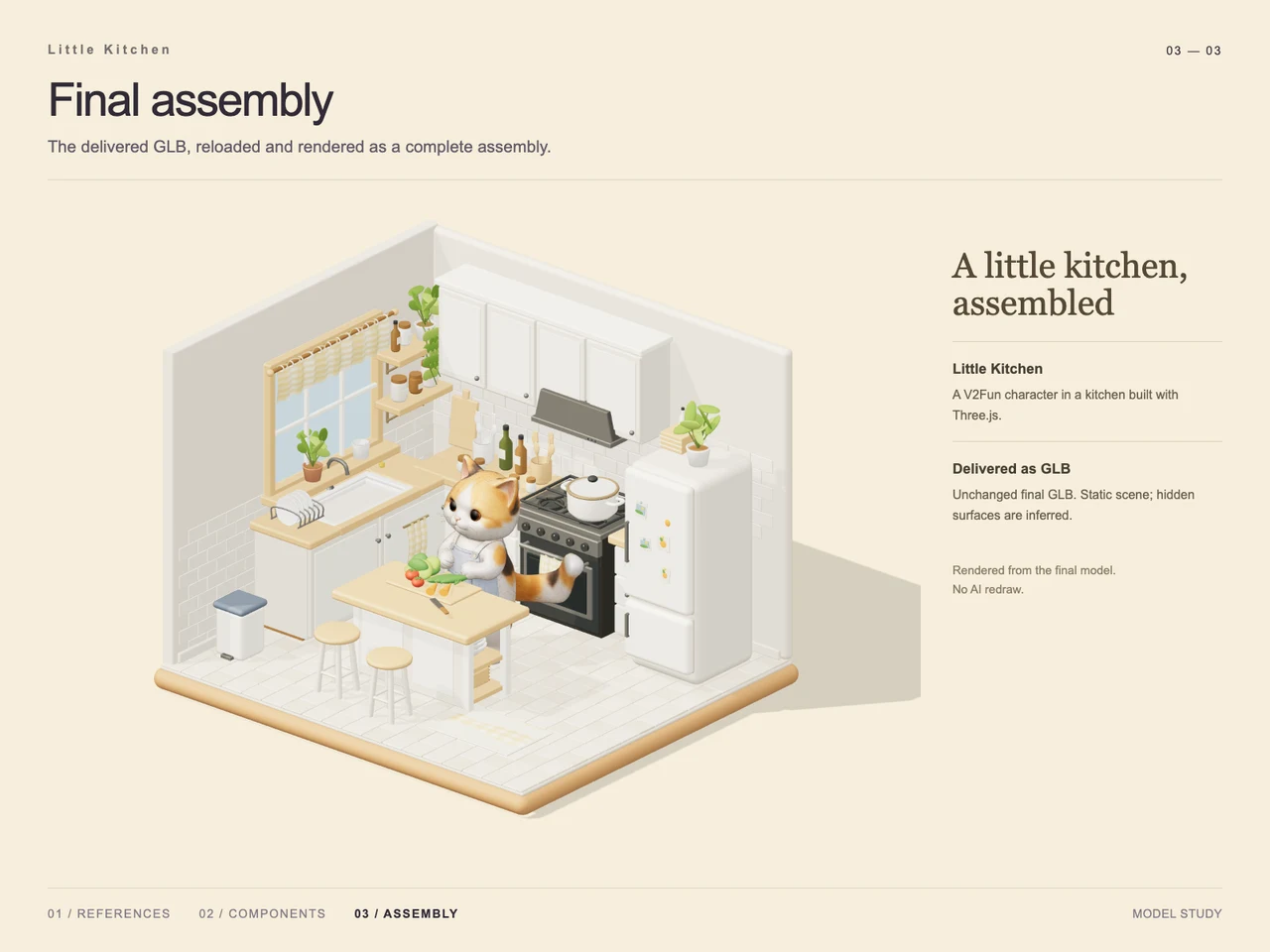
Little Kitchen turns a miniature kitchen reference into a static 3D diorama with cream cabinetry, pale wood worktops, a dark cooking range, a retro refrigerator, and a calico cat behind a preparation island. The raised base and two enclosing walls preserve the reference’s compact, elevated view.
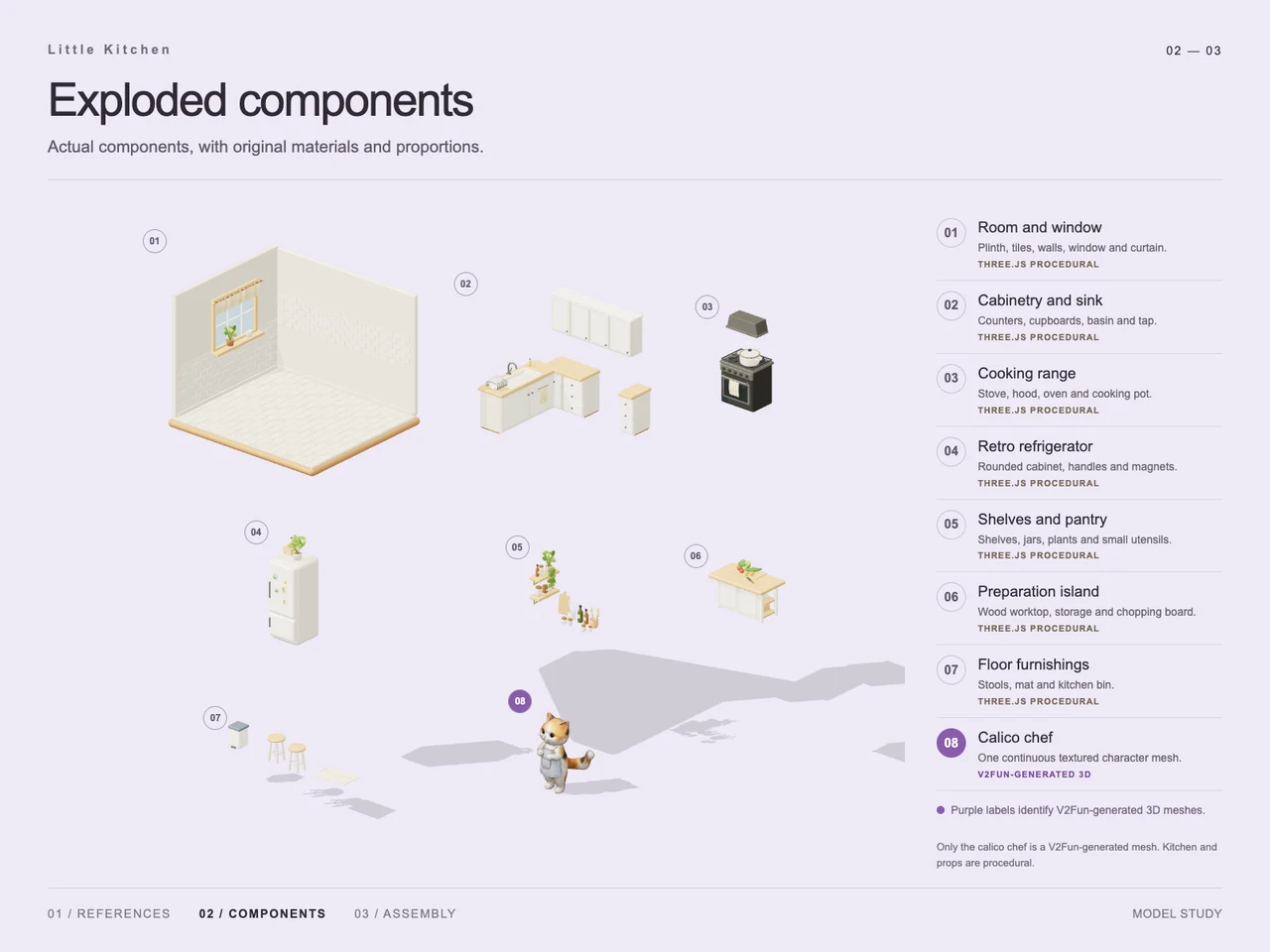
The technical notes describe GPT-6 Astra handling structural understanding and task decomposition. The component study makes the division of work concrete: seven kitchen and furnishing groups are labeled as procedural Three.js work, while the calico chef is the sole V2Fun-generated 3D mesh. This case illustrates the planning-and-generation split discussed in the GPT-6 Astra and V2Fun 3D agent workflow.
Tools Used
- GPT-6 Astra: structural understanding and task planning, as described in the case notes.
- Three.js: procedural construction of the kitchen, room, furniture, and props, as labeled in the component study.
- V2Fun: the generated character reference and calico chef mesh identified in the presentation.
- GLB: the supplied final deliverable format.
Step 1 — Establish the Modeling References
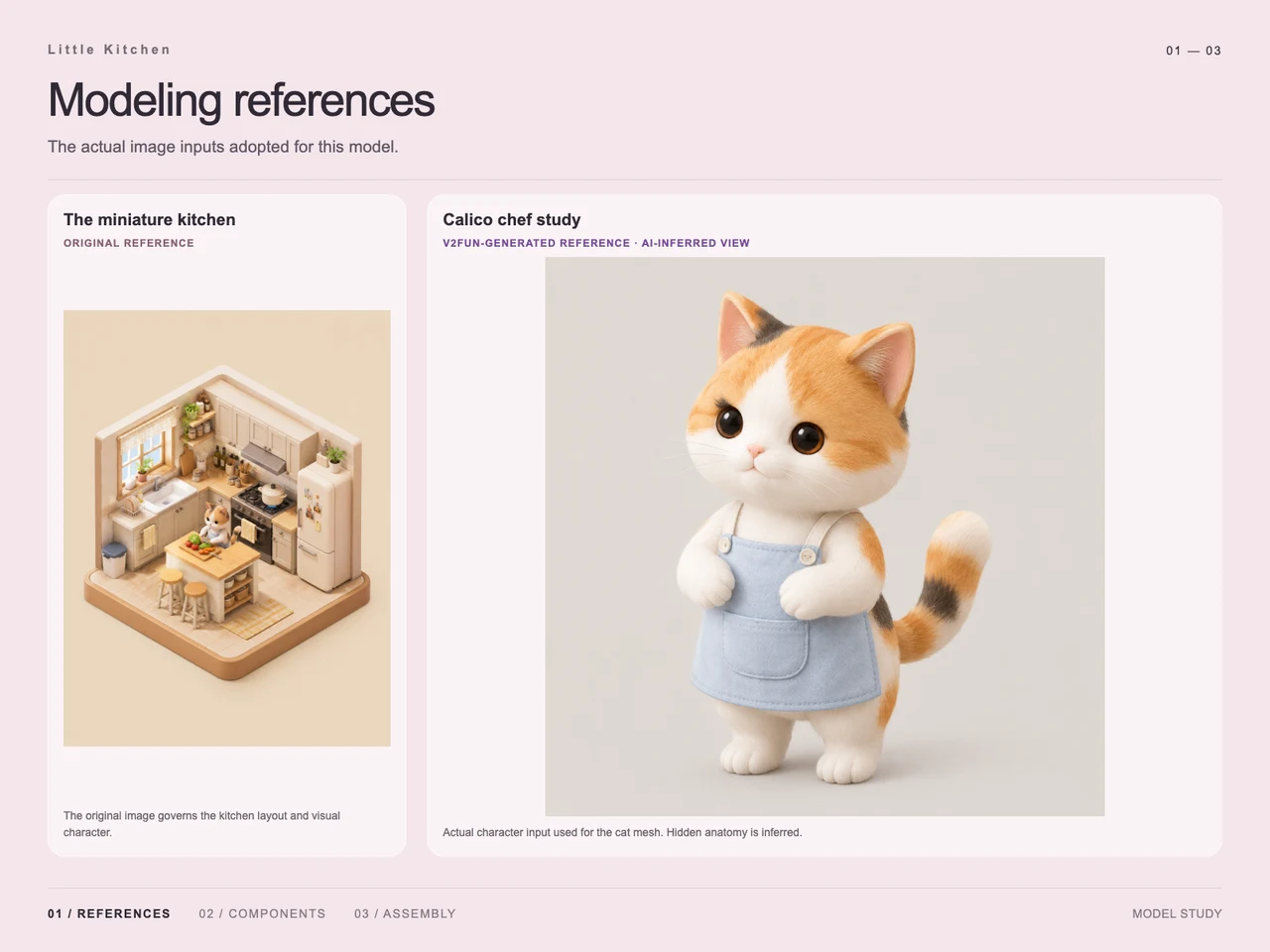
The input board pairs the original miniature kitchen with an isolated calico chef wearing a pale blue apron. The kitchen image governs layout and visual character. The separate cat study is labeled as a V2Fun-generated, AI-inferred reference used for the character mesh.
This separates the room composition from the character’s appearance. V2Fun’s AI image generator for 3D references provides related background on reference preparation. The board explicitly notes that hidden character anatomy is inferred.
Step 2 — Divide the Kitchen into Component Groups
The exploded view documents eight groups:
- Room and window: raised base, floor tiles, walls, window, and curtain.
- Cabinetry and sink: counters, cupboards, basin, and tap.
- Cooking range: stove, hood, oven, and cooking pot.
- Retro refrigerator: rounded cabinet, handles, and magnets.
- Shelves and pantry: shelves, jars, plants, and small utensils.
- Preparation island: wood worktop, storage, and chopping board.
- Floor furnishings: stools, mat, and kitchen bin.
- Calico chef: the generated character mesh.
These are presentation groups; the images do not establish the final file’s object hierarchy.
Step 3 — Combine Procedural Construction with Character Generation
The first seven groups are labeled as Three.js procedural components. The calico chef is presented as one continuous textured character mesh generated with V2Fun. Its rounded head, apron, patches, and curved tail provide the organic focal point within the regular kitchen geometry.
The V2Fun AI 3D model generator is the relevant feature background for this character-generation stage. The case does not document separate AI generation of the appliances or furniture.
Step 4 — Assemble and Present the Final Scene
The final view places the sink beneath the window, upper cabinets above the cooking area, and refrigerator at the right. The island and two stools occupy the foreground, with the cat between the island and stove. Plants, bottles, plates, and vegetables complete the miniature setting.
The final board identifies this image as a render of the delivered GLB after reloading, without an AI redraw. It describes the scene as static and notes that hidden surfaces are inferred.
Workflow
Kitchen reference and character study → component decomposition → procedural kitchen construction and V2Fun character generation → scene assembly → GLB delivery → reload and render.
Prompt
English translation of the supplied design intent:
“Present a clear miniature 2.5D cartoon diorama from a 45° elevated isometric view, using soft, refined textures, realistic PBR materials, and gentle, realistic lighting. Create a small raised diorama base containing the kitchen’s most recognizable elements. Use a solid-color background and a perfectly centered composition in a square 1080 × 1080 layout, with an exceptionally clean, crisp diorama aesthetic. Simply switch to a bolder, brighter font.”
The material, camera, resolution, and typography requests express the intended presentation; they are not technical measurements of the delivered asset.
Result
The supplied output is little-kitchen.glb, sized at 67,320,676 bytes, approximately 67.32 MB. The final image shows a complete kitchen assembly with a generated calico chef and procedural surroundings.
For context on the delivery format, see the AI 3D export guide to FBX, GLB, OBJ, and USDZ. No end-to-end timing or token measurements are supplied for this case.
Frequently Asked Questions
Which part of Little Kitchen was generated with V2Fun?
The component board identifies the calico chef as the sole V2Fun-generated 3D mesh. The input board also identifies its isolated character reference as V2Fun-generated.
What was built procedurally in Three.js?
The room and window, cabinetry and sink, cooking range, refrigerator, shelves and pantry, preparation island, and floor furnishings are all labeled as procedural Three.js work.
What role did GPT-6 Astra play in this case?
The technical notes describe GPT-6 Astra handling structural understanding and task decomposition, separating scene planning from complex model generation.
Does the character study reveal the cat’s complete anatomy?
No. The isolated study supplies the visible character design, but its caption explicitly says hidden anatomy is inferred. The final board similarly notes inferred hidden surfaces.
What is the final deliverable?
The supplied file is little-kitchen.glb at 67,320,676 bytes, approximately 67.32 MB. The final presentation identifies the scene as static and shows a render made after reloading the delivered GLB.
Explore More
-
GPT-6 Astra x V2Fun - From Code Generation to Model Collaboration | V2Fun
See how GPT-6 Astra and V2Fun combine agent reasoning, code generation, and AI 3D foundation models to build complex, structured 3D assets.
View page → -
V2Fun - AI Image Generator for 3D Creation
Create concept images, character references, and visual assets with V2Fun's AI image generator. Turn ideas into 3D-ready images for modeling, animation, and game design.
View page → -
V2Fun - AI 3D Model Generator
Create 3D models from text prompts or images with V2Fun's AI 3D model generator. Generate characters, props, game assets, and 3D-printable models faster.
View page → -
AI 3D Model Generator Export Guide: FBX, GLB, OBJ, or USDZ? | V2Fun
Use an AI 3D Model Generator with the right export format. Compare FBX, GLB, OBJ, and USDZ for Blender, game engines, animation, web, and AR.
View page →