Build a Jet Courier Bike with GPT-6 Astra and V2Fun
See how GPT-6 Astra and V2Fun turn a jet-bike courier concept into a component-planned 3D asset, combining a generated character with procedural mechanical parts and final GLB assembly.
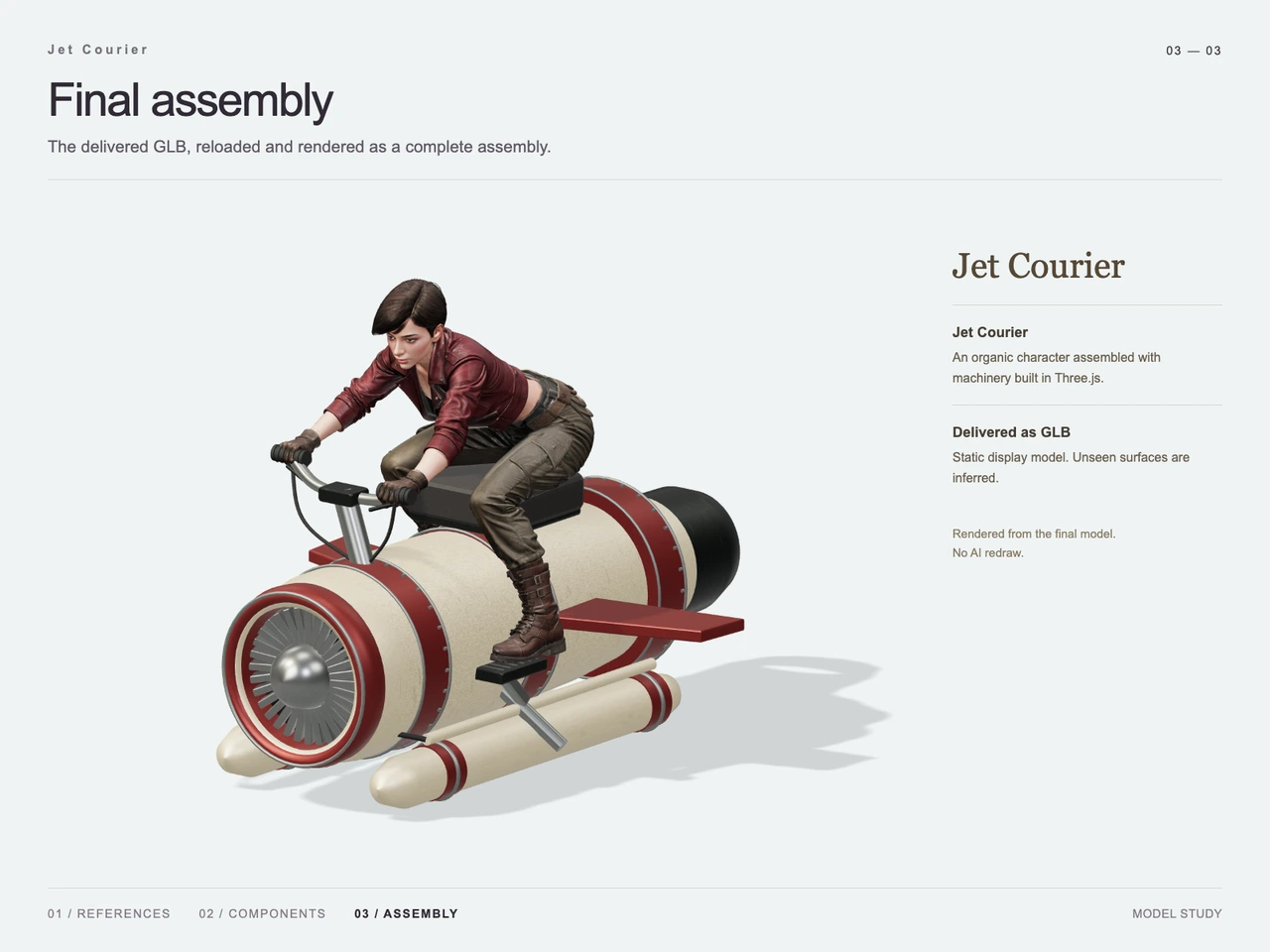
Interactive 3D preview · Build a Jet Courier Bike with GPT-6 Astra and V2FunDrag to rotate · Scroll to zoom
Take a Closer Look
-
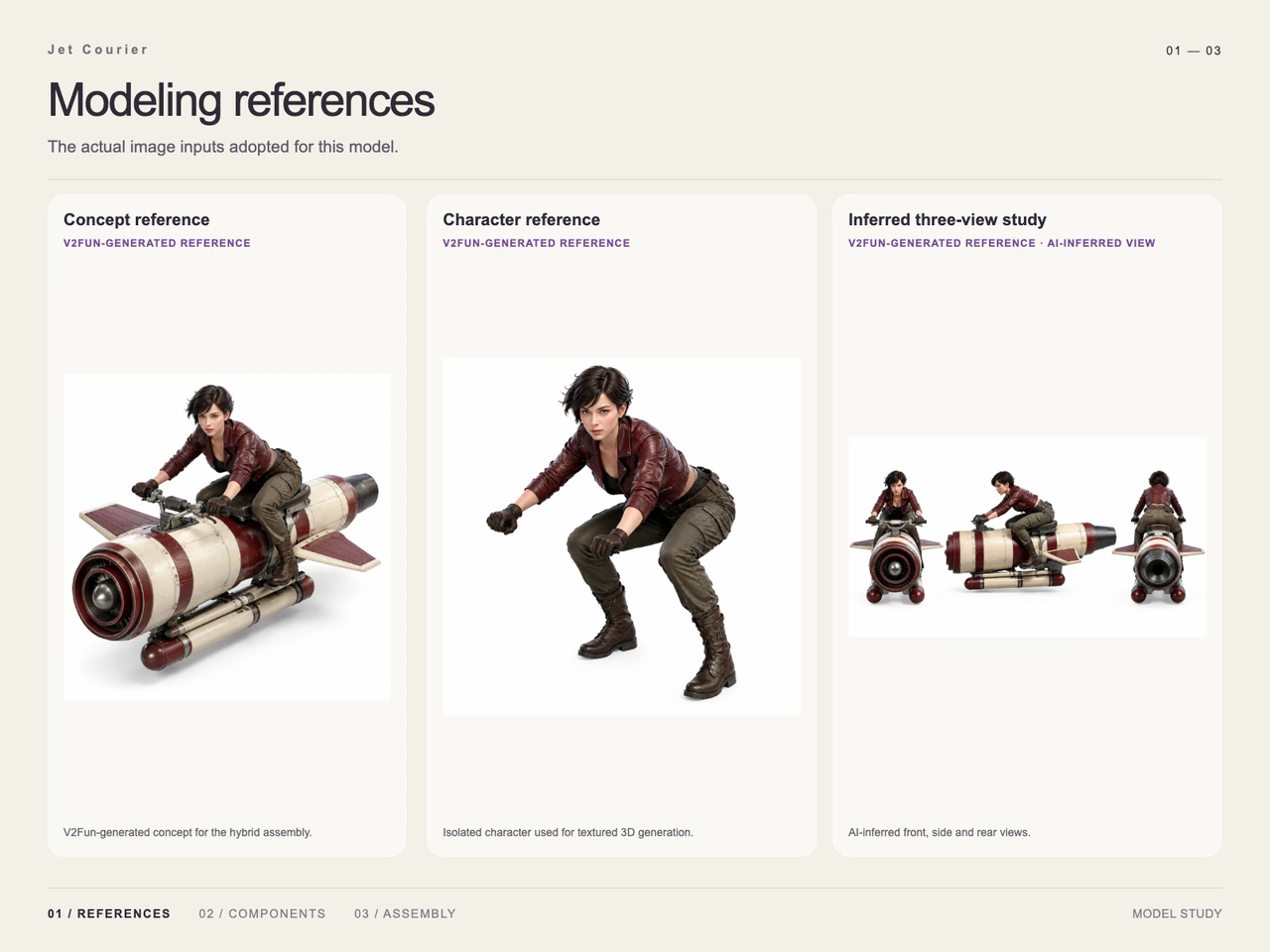 01 / Input
Input · Build a Jet Courier Bike with GPT-6 Astra and V2Fun
-
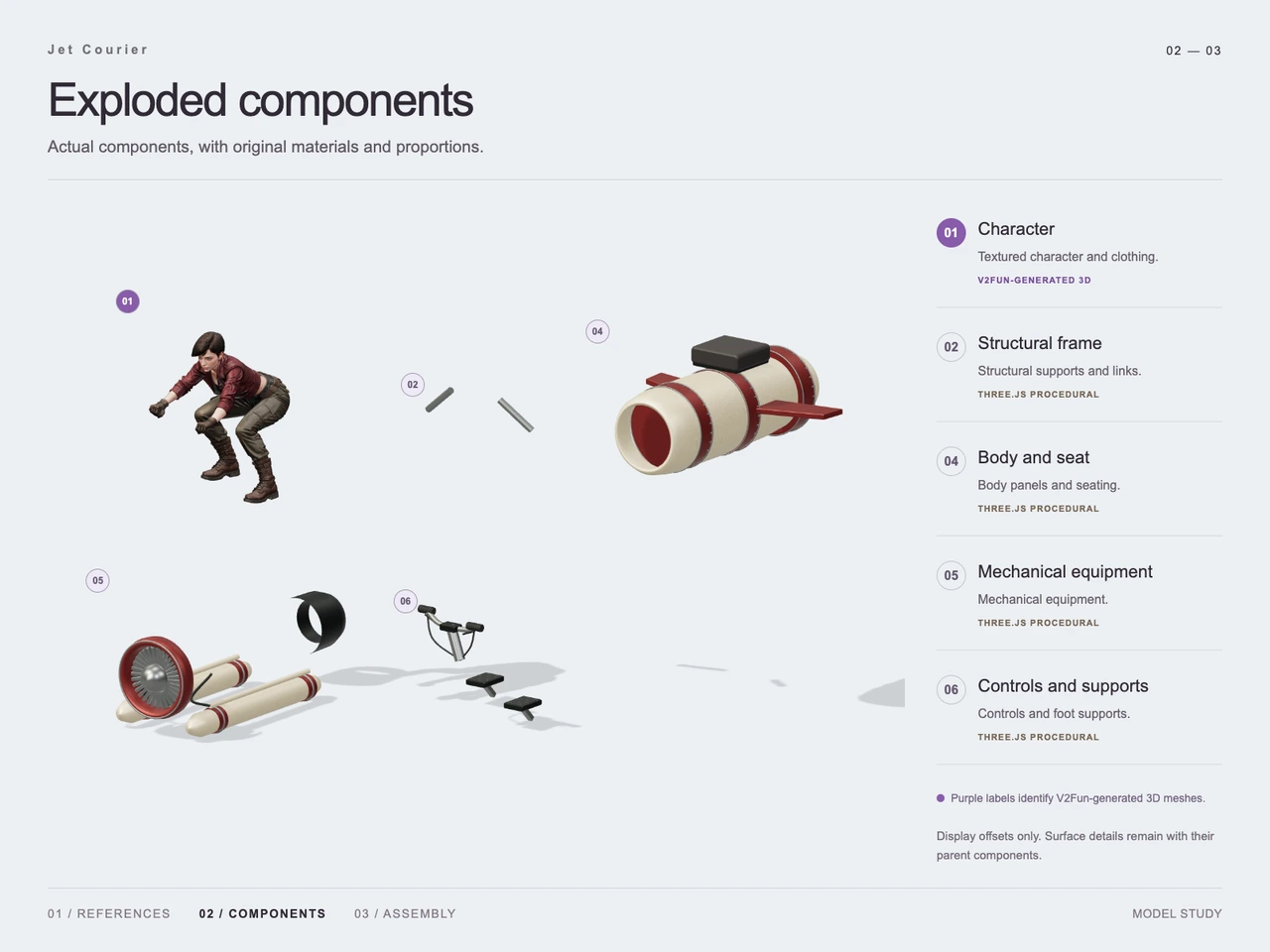 02 / Process
Process · Build a Jet Courier Bike with GPT-6 Astra and V2Fun
-
03 / Final
Final · Build a Jet Courier Bike with GPT-6 Astra and V2Fun
Overview
This case turns a concept of an adult female courier riding a single-cylinder jet bike into one complete 3D asset. The visual target combines an organic character—with short hair, a burgundy leather jacket, cargo trousers, boots, and a forward-leaning riding pose—with a machine built from comparatively regular cylindrical and planar forms.
The evidence shows a hybrid division of work: V2Fun-generated references support the character and overall concept, while the exploded study labels the structural frame, body, mechanical equipment, controls, and supports as procedural Three.js elements. GPT-6 Astra coordinates the component plan and final spatial relationships. This follows the broader GPT-6 Astra and V2Fun model-collaboration workflow.
Tools Used
- GPT-6 Astra: subject analysis, component planning, spatial reasoning, and assembly calibration.
- V2Fun: generation of the textured courier character and concept references.
- Three.js / procedural construction: regular mechanical forms, including the frame, body, propulsion equipment, controls, and supports shown in the component study.
- Visual references: the concept image, isolated character, and AI-inferred front, side, and rear study.
- GLB: the supplied final delivery format.
For related capabilities, see V2Fun’s image-to-3D model generator and multi-view 3D modeling workflow.
Step 1 — Interpret the Character–Machine Brief
The initial reference establishes a single adult courier mounted on one jet bike. Key relationships include both hands at the handlebar, both feet at the side supports, a separate saddle above the body, and visible clearance between the rider and major machine surfaces.
The mechanical silhouette is organized around a large horizontal cylinder with a concentric front intake, a rear nozzle, two short wings, and two parallel lower tubes. The cream and dark-red material blocks provide the principal color direction.
Step 2 — Build Supporting References
The modeling study contains three inputs: the complete concept, an isolated character reference, and an AI-inferred three-view image. These additional views clarify the rider’s crouched posture and offer working evidence for the bike’s front, side, and rear structure. Because the rear and hidden surfaces are inferred, they should be treated as design interpretations rather than measured reconstruction.
Step 3 — Decompose the Asset
The exploded view separates the assembly into five visible groups:
- Character.
- Structural frame.
- Body and seat.
- Mechanical equipment.
- Controls and supports.
This decomposition isolates the irregular human form from the bike’s regular cylinders, discs, plates, rods, and curved supports. It also makes the rider-to-bike contact points explicit during assembly.
Step 4 — Generate the Character with V2Fun
The character is shown as a separately generated, textured 3D component. Her crouched pose, clothing layers, boots, gloves, and human facial form make her less suitable for reconstruction from simple primitives. V2Fun supplies this organic component while preserving the overall visual direction of the reference.
Step 5 — Construct the Mechanical Components
The process image identifies the frame, body and seat, mechanical equipment, and controls as Three.js procedural work. The bike’s regular geometry supports this approach: cylinders establish the central body and lower tubes, discs form the intake assembly, plates define the wings and foot supports, and rods connect the controls and frame.
The evidence demonstrates the visual construction and grouping of these parts, but it does not establish engineering dimensions, mechanical functionality, or manufacturing tolerances.
Step 6 — Calibrate and Assemble
The generated rider and procedural bike parts are brought back together for scale, rotation, and position adjustment. The final assembly aligns the hands with the handlebar, places the rider over the independent saddle, connects the boots to the foot supports, and retains readable separation between the figure and the machine.
The final render shows the assembled asset from a front three-quarter angle with soft lighting and a contact shadow. It also preserves the main cream-and-red body treatment, layered circular intake, rear nozzle, short wings, and parallel lower tubes.
Workflow
Prompt → Concept reference → Character isolation → Inferred multi-view study → Component planning → V2Fun character generation → Procedural bike construction → Assembly calibration → GLB export
For format considerations after generation, consult the FBX, GLB, OBJ, and USDZ export guide.
Prompt
An adult female courier with short hair, wearing a burgundy leather jacket, cargo trousers, and leather boots, leans forward while riding a single-cylinder jet bike. Both hands hold the handlebar, and both feet rest on side foot supports. The vehicle centers on one large horizontal cylindrical body with a layered concentric front intake, a tapered rear nozzle, two short trapezoidal wings, an independently supported saddle, and two parallel pipes beneath the body.
Use cream and dark-red color blocking. Present the character and machine as one complete standalone collectible-style asset, combining realistic proportions with mild exaggeration. Preserve a lively face, natural clothing folds, clear part boundaries, logical connections, contact at the seat, grips, and foot supports, and visible clearance between the rider and body.
Show the complete subject from a slightly elevated front three-quarter view, centered with margin on a white background. Use soft studio lighting, a contact shadow, clear focus, and refined PBR-style materials. Exclude text, numbers, logos, watermarks, complex scenery, motion blur, collages, and exploded views.
Result
The delivered result is 75-v2-final.glb, a model/gltf-binary file containing the assembled jet courier and bike. Supplied file size: 39,914,288 bytes (approximately 38.1 MiB).
The final evidence demonstrates a coherent static assembly and recognizable correspondence with the concept: the courier maintains the intended riding pose, the main contact points are aligned, and the vehicle retains its defining cylindrical layout and color blocking. No claims are made here about topology, UVs, polygon count, animation readiness, engine performance, physical dimensions, or printability because those properties were not verified by the supplied evidence.
Frequently Asked Questions
What was generated with V2Fun in this jet courier case?
The process evidence identifies the textured courier character as a V2Fun-generated 3D component. The concept and inferred reference studies are also labeled as V2Fun-generated references.
Which parts were built procedurally?
The exploded study labels the structural frame, body and seat, mechanical equipment, and controls and supports as Three.js procedural components.
Why use a hybrid workflow for this asset?
The rider contains organic anatomy, clothing, and facial detail, while the bike is largely composed of regular cylinders, discs, plates, rods, and supports. Separating those tasks lets each type of form use a suitable construction method before assembly.
How were the rider and bike aligned?
The final assembly positions the rider above the independent saddle, aligns both hands with the handlebar, and places the boots at the side foot supports while retaining visible separation from the main body.
Was the model created from measured multi-view photography?
No. The supplied study includes an AI-inferred front, side, and rear reference. Hidden geometry should therefore be understood as an interpretation of the concept rather than a measured reconstruction.
What file was delivered?
The supplied output is `75-v2-final.glb`, a binary glTF file of 39,914,288 bytes. The evidence does not verify its topology, UV layout, polygon count, rigging, or readiness for a particular engine or manufacturing process.
Explore More
-
GPT-6 Astra x V2Fun - From Code Generation to Model Collaboration | V2Fun
See how GPT-6 Astra and V2Fun combine agent reasoning, code generation, and AI 3D foundation models to build complex, structured 3D assets.
View page → -
V2Fun - AI 3D Model Generator
Create 3D models from text prompts or images with V2Fun's AI 3D model generator. Generate characters, props, game assets, and 3D-printable models faster.
View page → -
V2Fun - Multi-View to 3D Model AI
Generate accurate 3D models from multiple reference images with V2Fun's multi-view to 3D model AI. Create structured assets with better shape consistency and detail.
View page → -
AI 3D Model Generator Export Guide: FBX, GLB, OBJ, or USDZ? | V2Fun
Use an AI 3D Model Generator with the right export format. Compare FBX, GLB, OBJ, and USDZ for Blender, game engines, animation, web, and AR.
View page →