Harvest Girl and Dog in 3D with GPT-6 Astra and V2Fun
Follow a smiling farm girl, an overhead fruit basket, and a companion dog from isolated references to three generated components and a final GLB assembly.
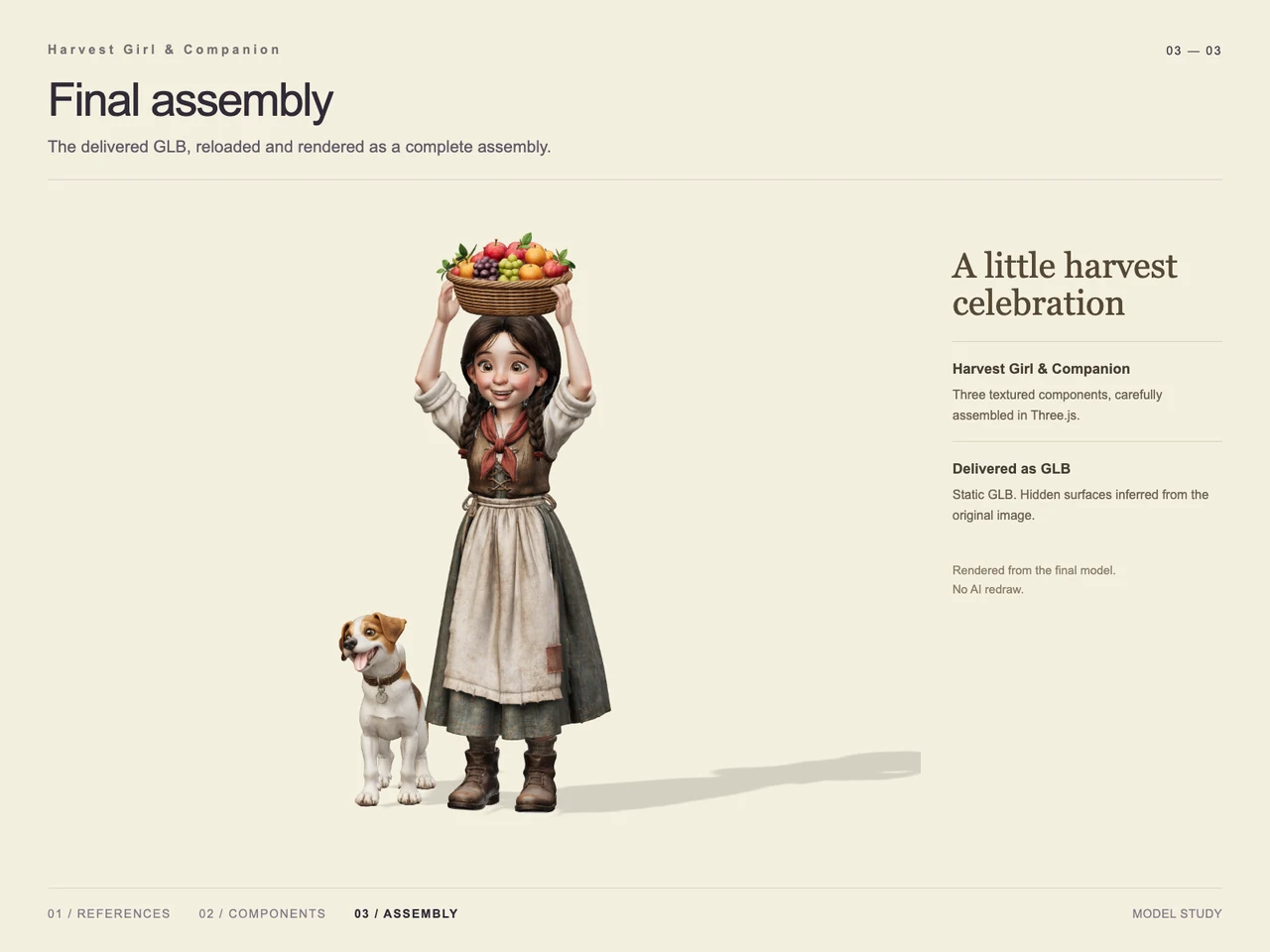
Interactive 3D preview · Harvest Girl and Dog in 3D with GPT-6 Astra and V2FunDrag to rotate · Scroll to zoom
Take a Closer Look
-
 01 / Input
Input · Harvest Girl and Dog in 3D with GPT-6 Astra and V2Fun
-
 02 / Process
Process · Harvest Girl and Dog in 3D with GPT-6 Astra and V2Fun
-
03 / Final
Final · Harvest Girl and Dog in 3D with GPT-6 Astra and V2Fun
Overview
This case turns a cheerful farm girl with a fruit basket and companion dog into a static 3D figurine assembly. The design calls for a standing cartoon character facing the camera, smiling and holding a basket above her head with both hands. Rustic clothing and a small dog at her feet complete the scene.
The case illustrates a division of work: GPT-6 Astra handles interpretation, decomposition, and coordination, while V2Fun generates complex geometry and surfaces. The supplied images document three components: the complete girl, the filled fruit basket, and the dog. Clothing, braids, and facial details remain with the girl rather than appearing as separate assets. The broader approach is described in the GPT-6 Astra and V2Fun model collaboration workflow.
Tools Used
- GPT-6 Astra: scene interpretation, component planning, and generation coordination, as described in the case notes.
- V2Fun: generated component references and the three 3D components identified in the presentation.
- Three.js: assembly of the textured components, documented on the final presentation sheet.
- Visual references: the complete composition and isolated girl, basket, and dog inputs.
- GLB: the supplied final delivery format.
Step 1 — Establish the Pose and Composition
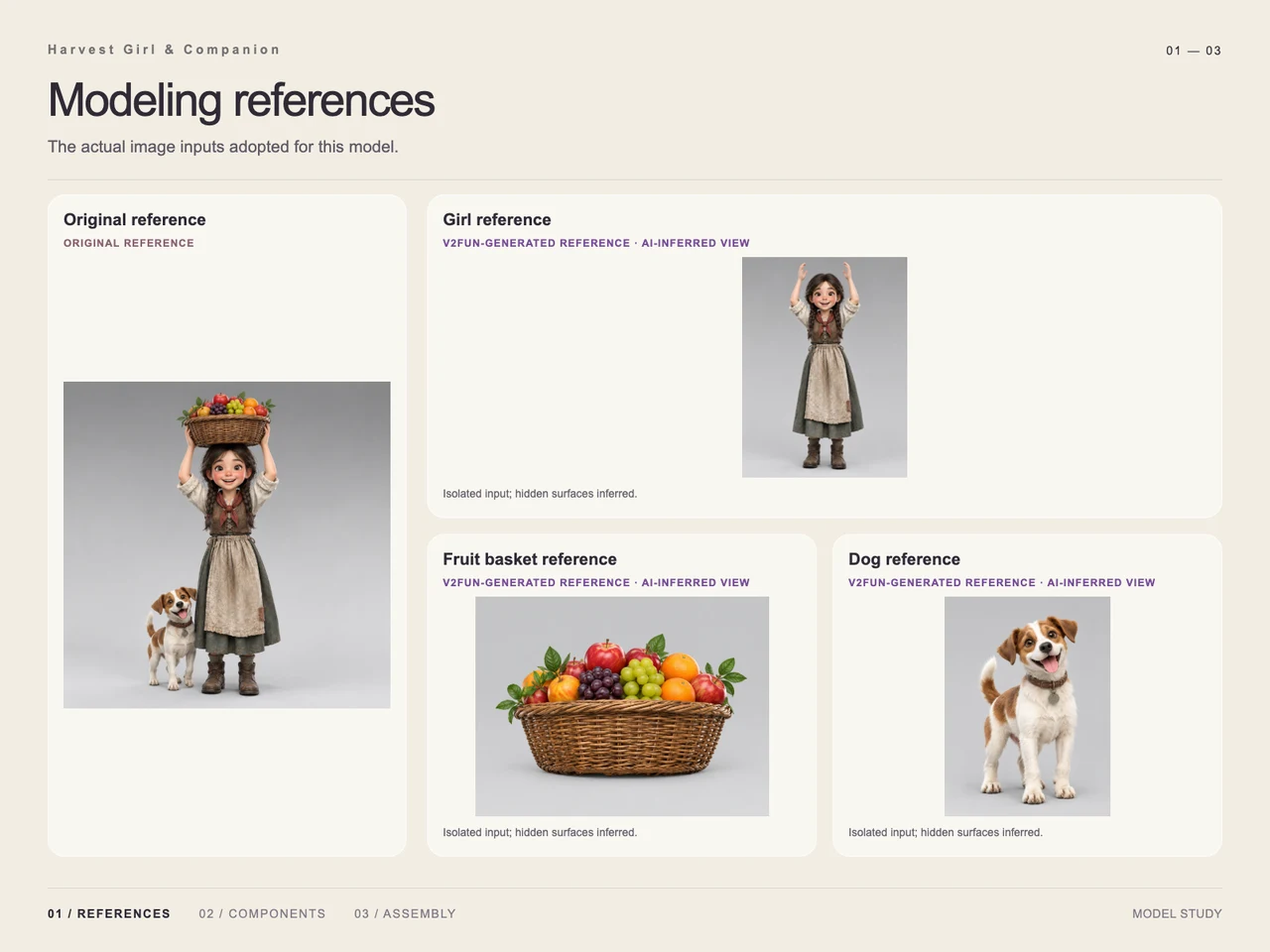
The original reference shows the girl standing upright against a gray gradient, with a woven fruit basket overhead and a brown-and-white dog beside her legs. Her raised arms frame the head and define where the basket must sit. The apron, dark skirt, brown vest, red neck scarf, and boots establish the rural character design.
Step 2 — Prepare Isolated Component References
The reference sheet separates the girl, filled basket, and dog. The girl retains her raised arms while the basket is removed from her reference, making the pose visible for generation and later assembly.
These isolated references are labeled as V2Fun-generated, AI-inferred views. They provide separate modeling inputs, but hidden surfaces remain inferred from the original image. They are not documented front, side, and rear observations. The AI 3D model input guide provides related guidance on reference coverage and overlapping parts.
Step 3 — Generate Three Detailed Components
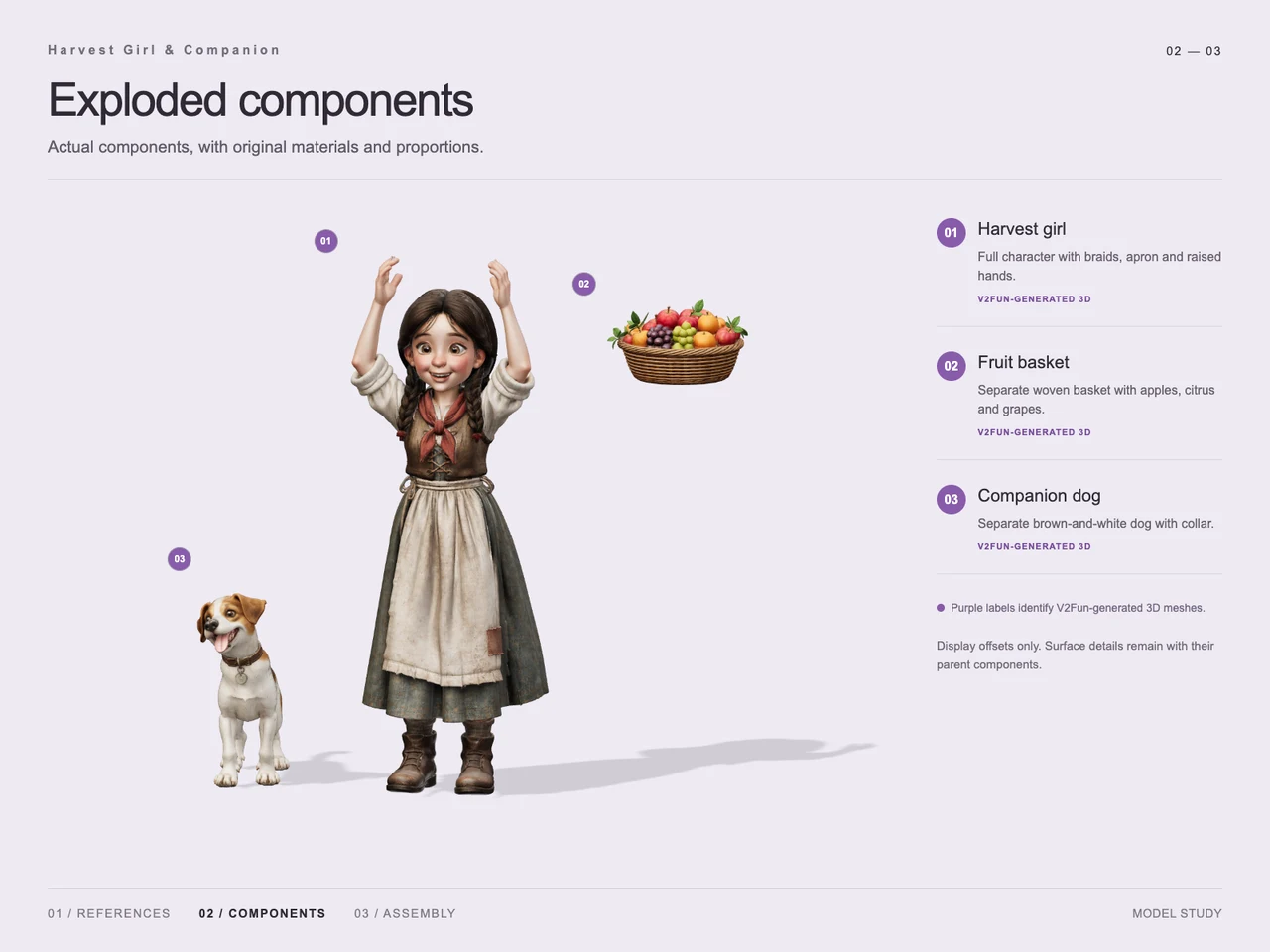
The exploded presentation identifies all three components as V2Fun-generated 3D. The girl includes the smiling face, braids, clothing, and raised hands. The separate basket contains colorful fruit and leaves, while the dog has brown-and-white markings and a collar.
The exploded layout offsets the assets for inspection; it does not depict their final positions. It also keeps surface details with their parent components. This generation stage relates directly to V2Fun's image-to-3D model generator.
Step 4 — Assemble and Present the Result
The final sheet documents assembly in Three.js and identifies the displayed image as a render of the delivered GLB after reloading. The basket is positioned above the girl's head between her raised hands, and the dog stands close to her feet on the viewer's left.
The final presentation uses a warm cream background and a cast ground shadow. It retains the requested subject arrangement while changing the gray backdrop used in the original reference.
Workflow
Complete reference → Identify three components → Prepare isolated references → Generate components with V2Fun → Assemble in Three.js → Export GLB → Reload and render.
Prompt
English translation of the supplied design prompt:
“Against a gradient gray background, show a smiling cartoon farm girl figurine standing and facing the camera. She wears farm clothing and raises both hands above her head to support a basket of fruit. A small dog accompanies her at her feet.”
Result
The documented result is a static assembly of the harvest girl, fruit basket, and companion dog. The final render shows the overhead basket pose, layered rural clothing, cheerful expression, and nearby dog together in one composition.
- File:
harvest-girl.glb - Size: 151,213,580 bytes, approximately 151.21 MB in decimal units
- Type:
model/gltf-binary
The case notes propose that delegating complex surfaces can reduce geometry code and shorten iteration. No token counts or elapsed-time measurements are supplied for this case. For context on the delivered format, see the AI 3D export guide for FBX, GLB, OBJ, and USDZ.
Frequently Asked Questions
Which parts were generated separately for the harvest girl scene?
The presentation identifies three V2Fun-generated components: the complete girl, the filled fruit basket, and the companion dog. The girl's clothing, braids, and facial details remain part of her component.
What did GPT-6 Astra and V2Fun each contribute?
The case notes describe Astra's role as identifying, splitting, and coordinating the scene elements. V2Fun handles complex geometry and surfaces, and the presentation labels all three 3D components as V2Fun-generated.
Were the isolated references observed from multiple angles?
No observed multiview set is documented. The reference sheet labels the isolated girl, basket, and dog images as AI-inferred references, with hidden surfaces inferred from the original image.
How was the overhead basket pose reconstructed?
The girl was shown separately with both arms raised. In the final assembly, the basket sits above her head between her hands, while the dog stands beside her feet. The final sheet documents assembly in Three.js.
What file was delivered, and is animation shown?
The supplied output is harvest-girl.glb, a model/gltf-binary file of 151,213,580 bytes. The final presentation describes a static GLB and a render after reloading; no animation is demonstrated.
Explore More
-
GPT-6 Astra x V2Fun - From Code Generation to Model Collaboration | V2Fun
See how GPT-6 Astra and V2Fun combine agent reasoning, code generation, and AI 3D foundation models to build complex, structured 3D assets.
View page → -
AI 3D Model Generator Input Guide: Single vs. Multi-View | V2Fun
Learn how to prepare photos, multi-view references, and sketches for an AI 3D Model Generator, then inspect geometry and textures before export.
View page → -
V2Fun - AI 3D Model Generator
Create 3D models from text prompts or images with V2Fun's AI 3D model generator. Generate characters, props, game assets, and 3D-printable models faster.
View page → -
AI 3D Model Generator Export Guide: FBX, GLB, OBJ, or USDZ? | V2Fun
Use an AI 3D Model Generator with the right export format. Compare FBX, GLB, OBJ, and USDZ for Blender, game engines, animation, web, and AR.
View page →