Garden Hauler 3D Workflow with GPT-6 Astra and V2Fun
Follow a seated gardener and compact garden vehicle from reference studies through seven component groups to a final GLB assembly, combining V2Fun organic forms with Three.js machinery.
Interactive 3D preview · Garden Hauler 3D Workflow with GPT-6 Astra and V2FunDrag to rotate · Scroll to zoom
Take a Closer Look
-
 01 / Input
Input · Garden Hauler 3D Workflow with GPT-6 Astra and V2Fun
-
 02 / Process
Process · Garden Hauler 3D Workflow with GPT-6 Astra and V2Fun
-
03 / Final
Final · Garden Hauler 3D Workflow with GPT-6 Astra and V2Fun
Overview
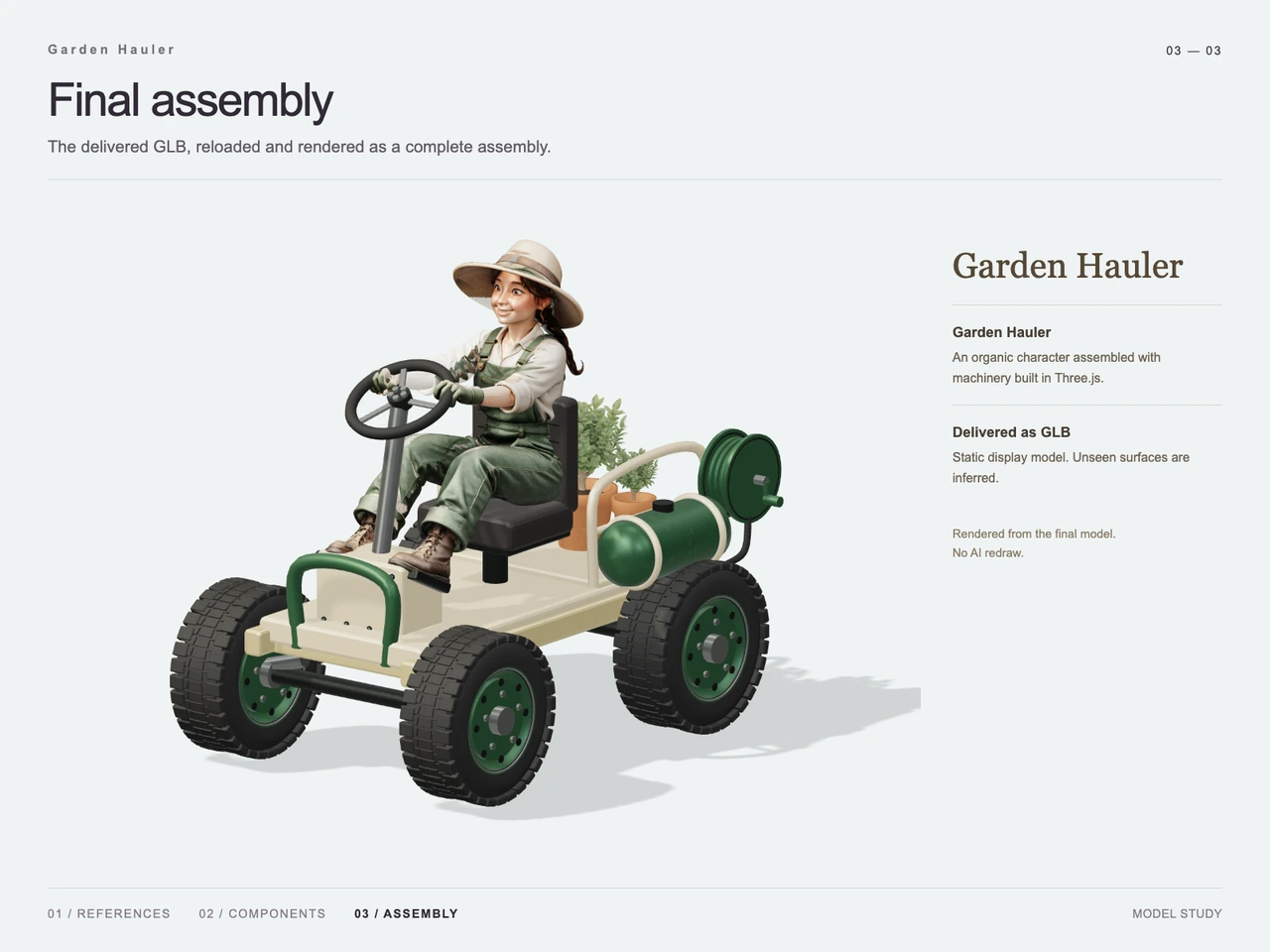
Garden Hauler combines a friendly adult gardener with a compact four-wheel utility vehicle. The design pairs a cream frame and dark green wheel hubs with terracotta pots, foliage, a cylindrical water tank, and a hose reel. Its main assembly challenge is the relationship between the seated character and the machine: the seat, steering wheel, and foot supports must accommodate the driving pose.
The supplied case documents a hybrid approach. GPT-6 Astra handles subject hierarchy, component planning, and assembly calibration; V2Fun supplies the complex organic forms; Three.js supplies the regular vehicle geometry. The broader GPT-6 Astra and V2Fun collaboration workflow explains this division of responsibilities.
Tools Used
- GPT-6 Astra: interpreting the subject, planning components, and coordinating their assembly, as described in the case notes.
- V2Fun: generated references and textured 3D components for the gardener and plants, identified in the reference and component sheets.
- Three.js: procedural construction of the frame, running gear, body and seat, mechanical equipment, and controls.
- GLB: the supplied final asset format.
Step 1 — Establish the Visual References
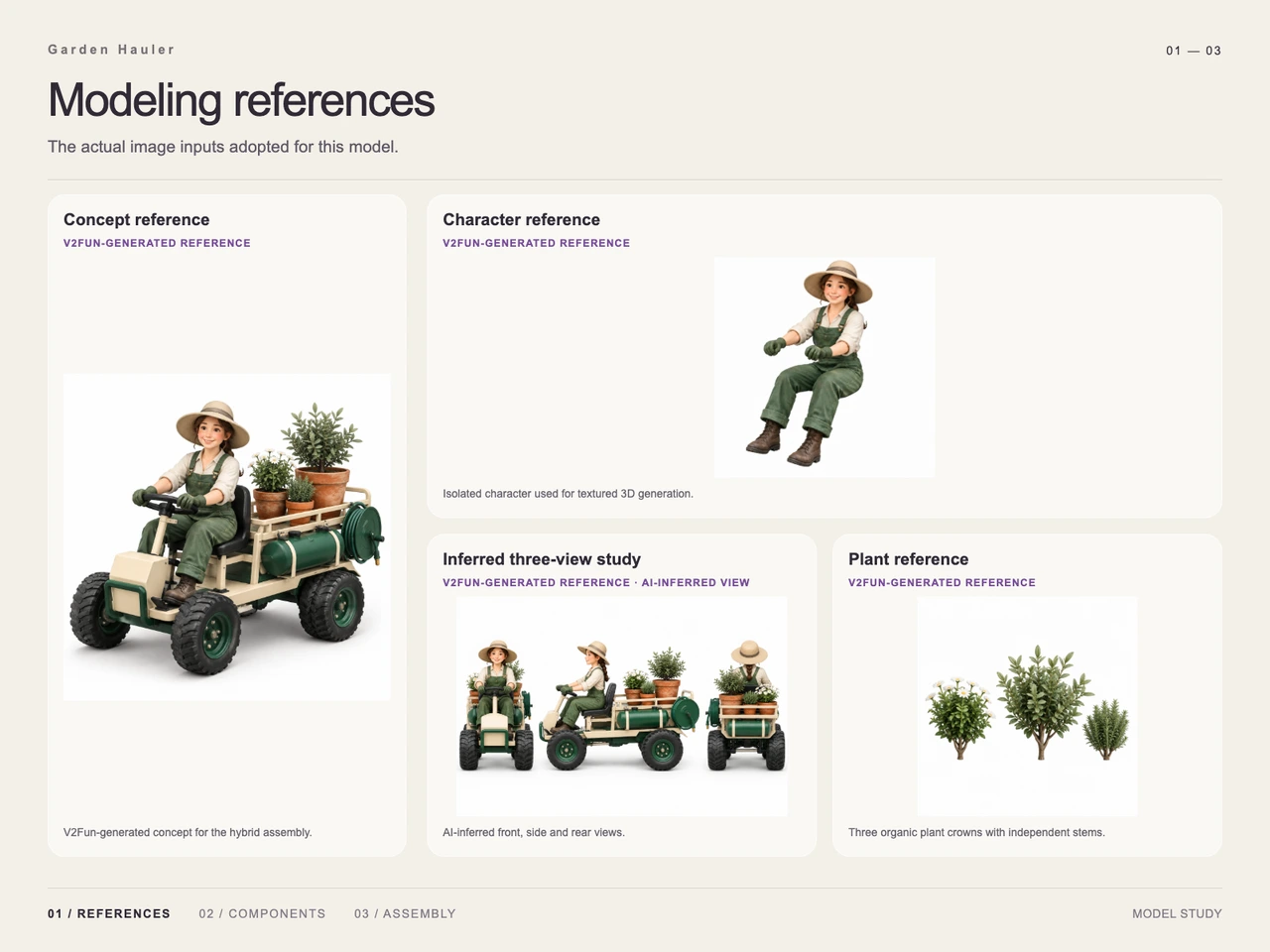
The input sheet contains a complete concept, an isolated seated gardener, a plant reference, and a front, side, and rear study. The character reference separates the hat, clothing, gloves, boots, and seated silhouette from the vehicle. The plant reference shows three distinct foliage forms with independent stems.
These images are labeled as V2Fun-generated references, connecting this stage to AI image generation for 3D creation. The three-view study is explicitly AI-inferred: it provides additional design guidance, while unseen surfaces remain interpretive.
Step 2 — Organize Seven Component Groups
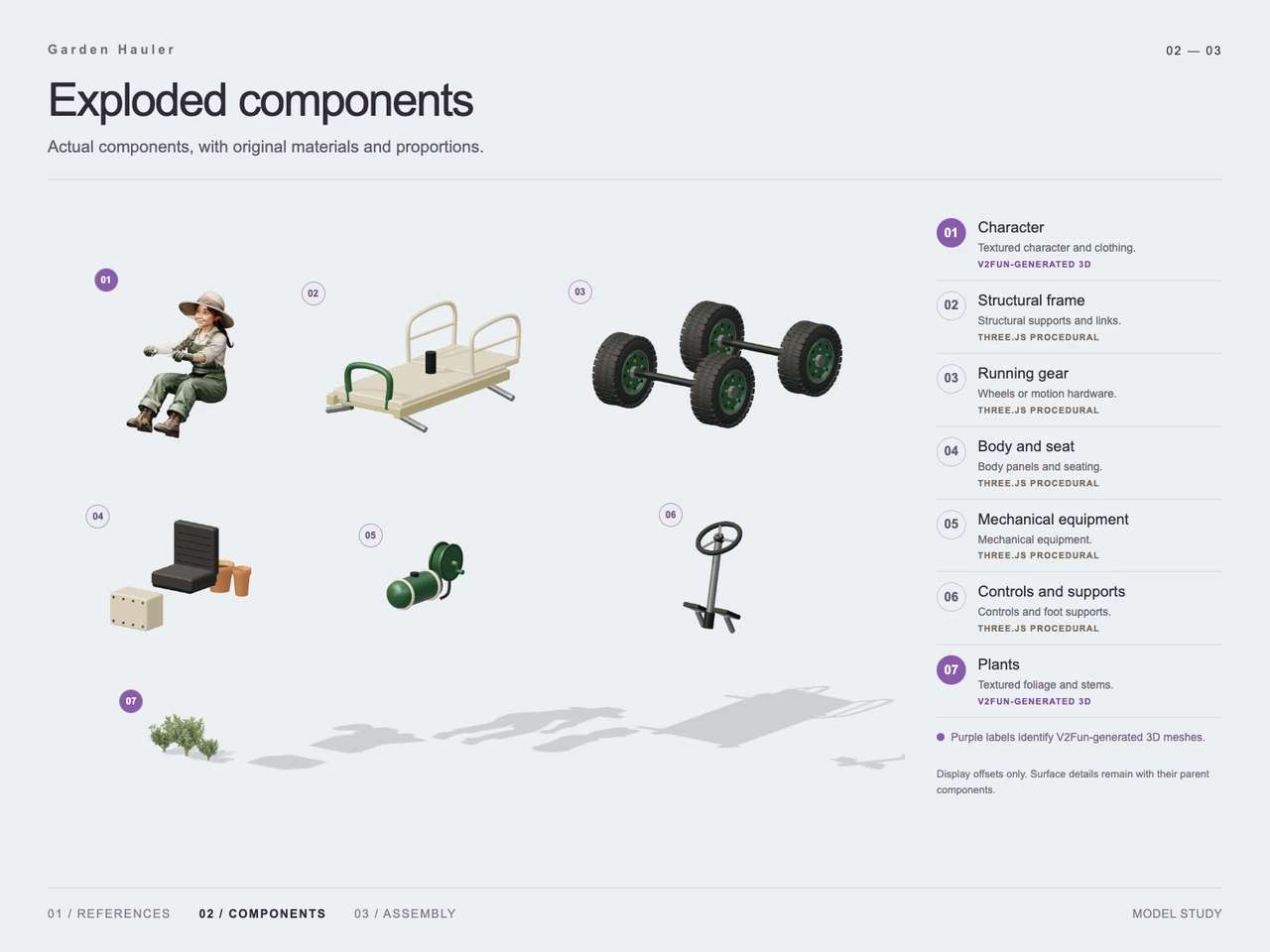
The exploded sheet presents seven groups:
- Character: the gardener, clothing, hat, gloves, and boots.
- Structural frame: the cream platform, rails, and supporting members.
- Running gear: four treaded wheels and connecting axles.
- Body and seat: the front body panel, dark seat, and terracotta pots shown together.
- Mechanical equipment: the cylindrical tank and hose reel.
- Controls and supports: the steering wheel, column, and foot supports.
- Plants: textured foliage and stems.
These are presentation groups, not a verified mesh count. The exploded arrangement uses display offsets to make the parts visible; it does not establish a physical disassembly sequence.
Step 3 — Generate Organic Forms and Build Vehicle Parts
The component sheet identifies the gardener and plants as V2Fun-generated 3D meshes. Their irregular silhouettes, facial features, fabric folds, and foliage distinguish them from the vehicle's regular forms. This is the case's use of V2Fun's AI 3D model generator.
The remaining five groups are labeled Three.js procedural. The visible construction uses rectangular platforms, cylindrical axles and tanks, circular wheels and reel plates, straight supports, and curved rails. This split follows the design's clear distinction between organic subjects and mechanical parts.
Step 4 — Assemble and Present the Model
The final view brings the gardener onto the dark seat, positions the steering assembly in front of her, and places the pots and plants behind her. The water tank and hose reel sit along the vehicle's side. The cream structure and green accents maintain the concept's warm garden theme.
The driving pose remains recognizable, with the gloved hands near the steering rim and the boots above the front support area. The image supports a visual assessment of these relationships, but does not establish exact contact or clearance measurements.
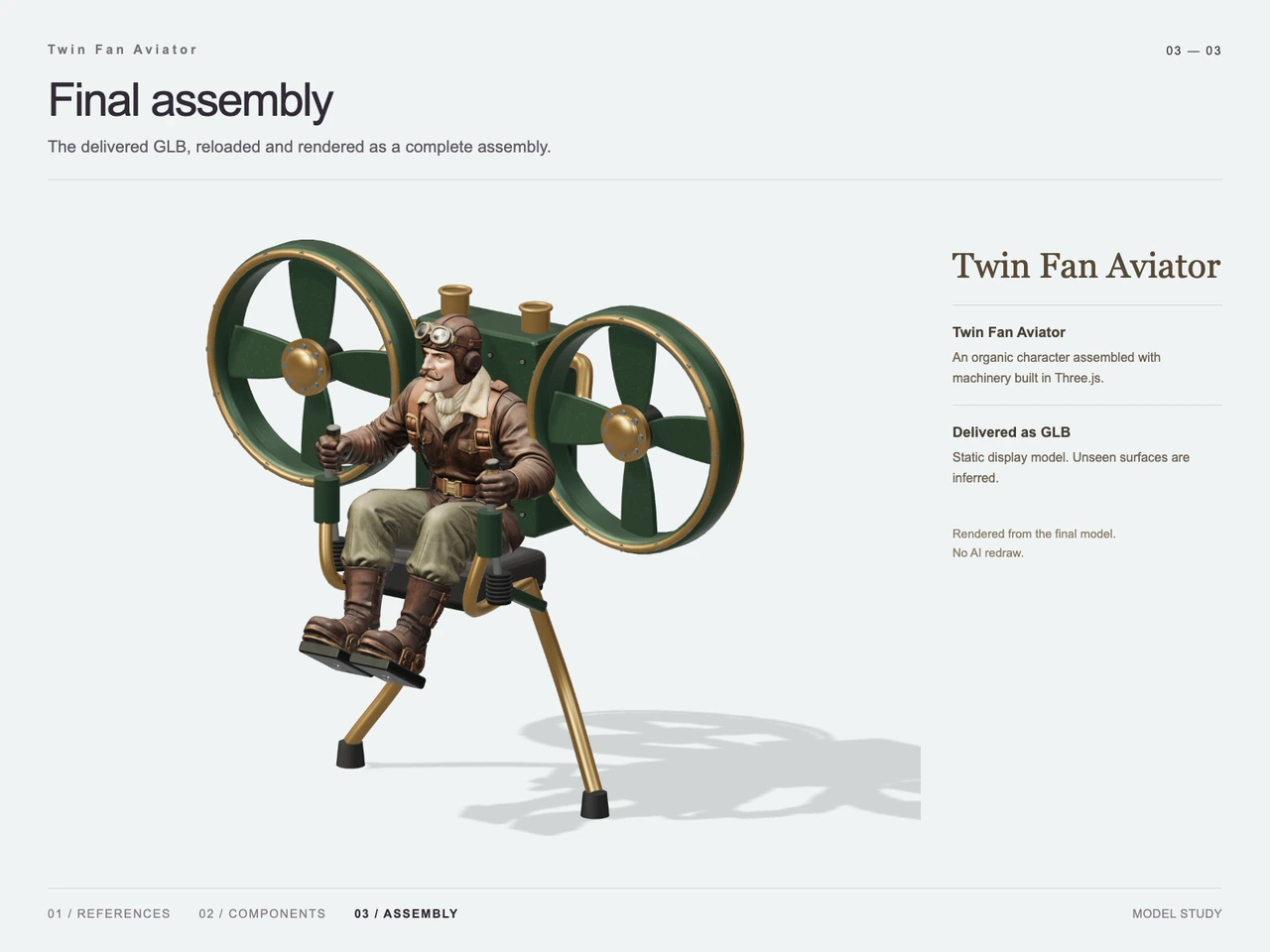
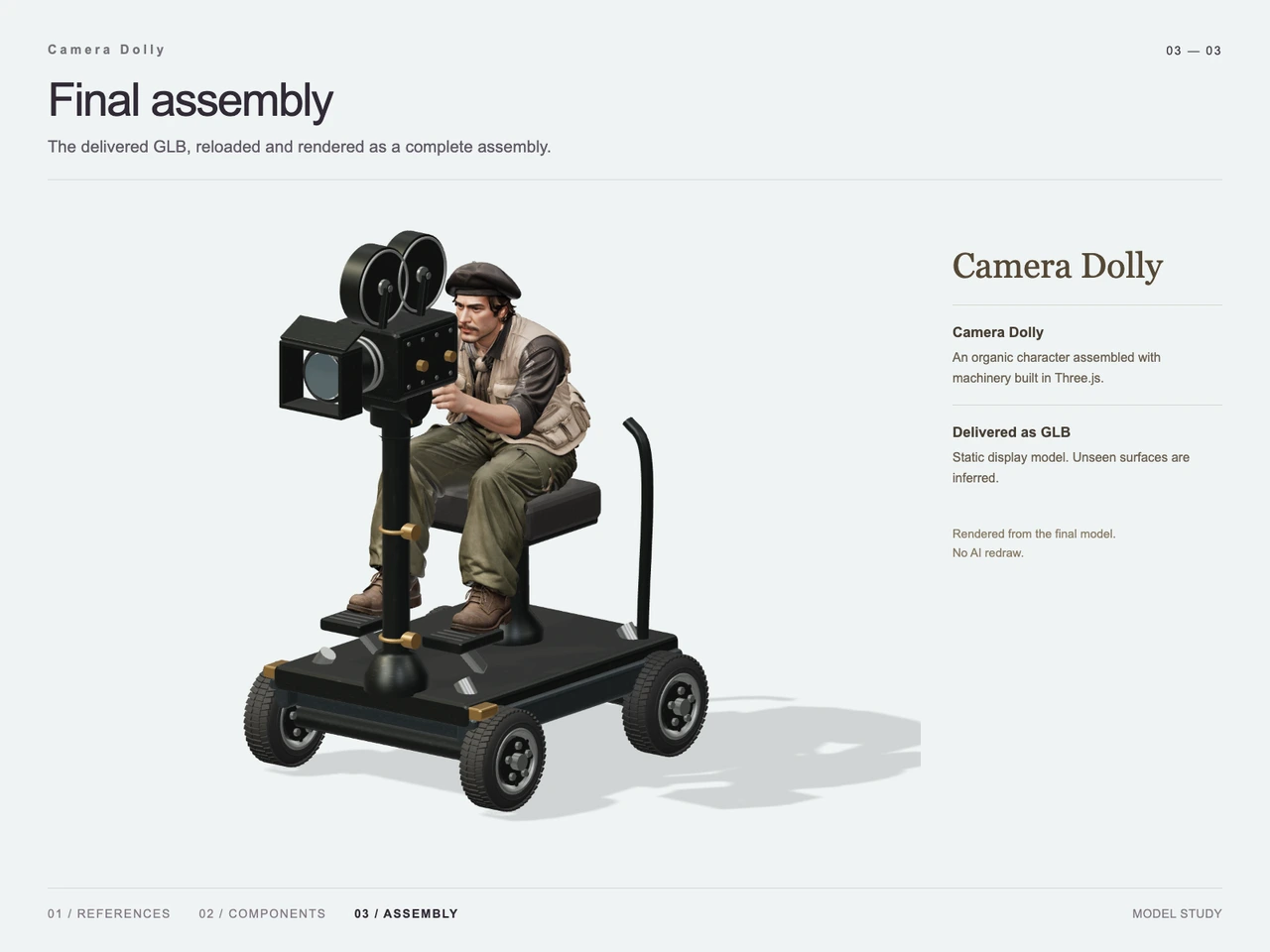
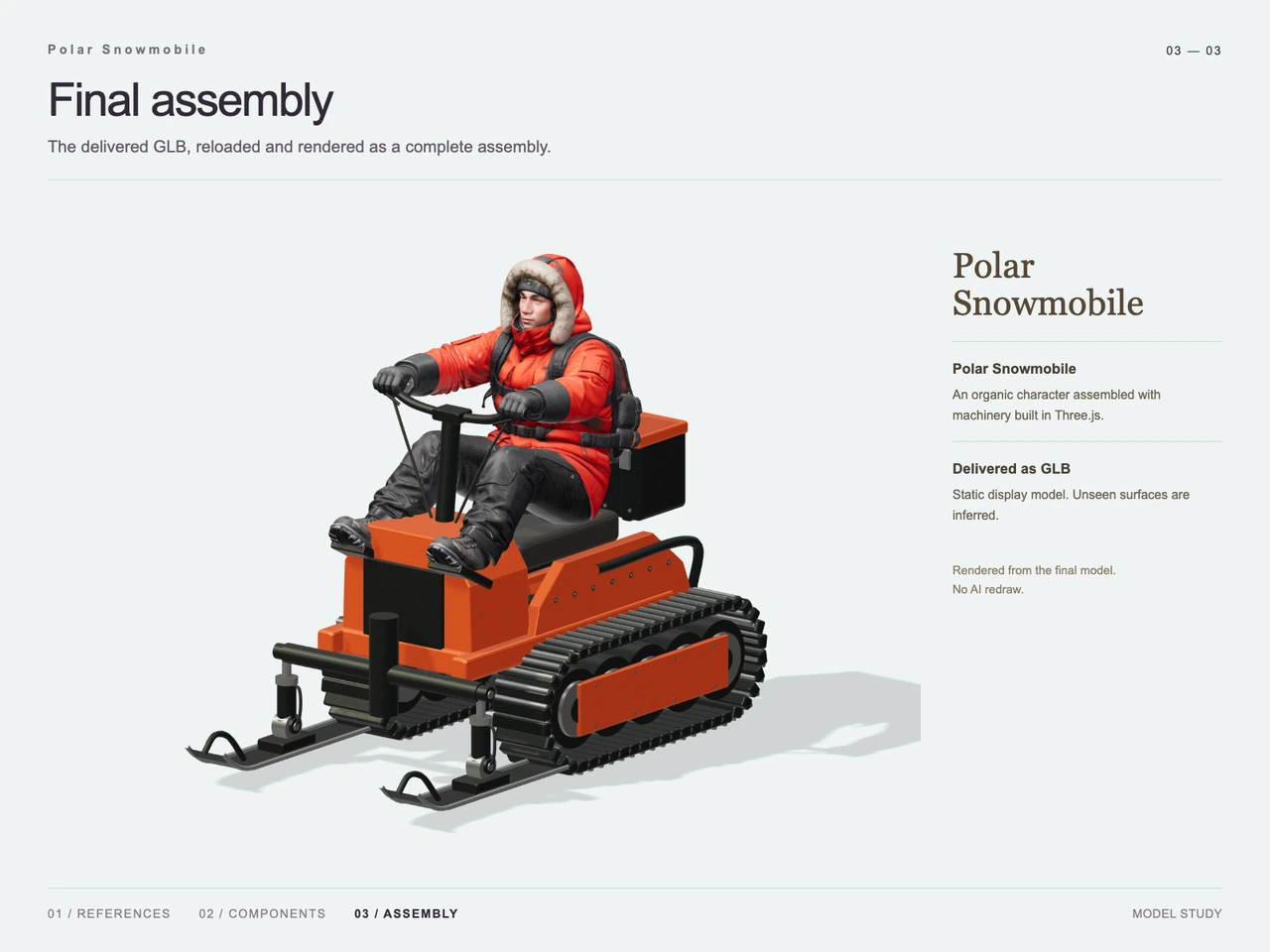
The final sheet describes its image as a render of the delivered GLB after reloading. It identifies the asset as a static display model with inferred unseen surfaces.
Workflow
Design brief → generated concept and isolated references → seven component groups → V2Fun character and plant generation + Three.js vehicle construction → assembly calibration → GLB export → documented reload and final render.
Prompt
English translation of the design brief:
A friendly adult female gardener wearing a wide-brimmed fabric hat, green overalls, and gloves sits at the front of a compact garden hauler with both hands holding the steering wheel. The vehicle has a low rectangular chassis, four chunky tires, and an open rear cargo rack securing three differently sized tapered terracotta pots, each containing a plant with a simple silhouette. A cylindrical water tank and circular hose reel sit along the side. Use a cream-yellow frame and dark green wheel hubs for a warm, relaxed appearance.
Create one complete standalone asset combining one character and one machine, with realistic proportions and mild exaggeration in a collectible-model style. Give the character an expressive face and natural clothing folds. Build the machinery from clear cylinders, discs, rectangular plates, straight rods, and a few regular curved tubes. Keep major part boundaries distinct and connections plausible, preserving contact between the character and the seat, steering grips, and foot supports.
Show the complete subject from a front three-quarter view, slightly above, centered with surrounding margin. Use a white background, soft studio lighting, contact shadows, sharp focus across all parts, and refined PBR materials. Include no text, numbers, logos, watermarks, complex scenery, or motion blur. Produce a single finished reference image, not a collage or exploded view.
Result
The supplied final image shows a complete gardener-and-vehicle display assembly. The character's broad hat, green workwear, and textured clothing contrast with the simpler cream platform, dark seat, treaded wheels, and green watering equipment. Plants remain visible behind the driver, although the character and rails obscure portions of the cargo area.
Delivered file: 88-v2-final.glb.
Supplied size: 105,342,796 bytes, approximately 105.34 MB in decimal units. Supplied MIME type: model/gltf-binary.
For context on the delivery format, see the AI 3D export guide for FBX, GLB, OBJ, and USDZ. This case documents a static visual result; it supplies no measured generation time or token comparison.
Frequently Asked Questions
Which Garden Hauler components were generated with V2Fun?
The exploded component sheet identifies the gardener and the plants as V2Fun-generated textured 3D meshes. It labels the other five groups as Three.js procedural.
What did GPT-6 Astra do in this case?
The case notes assign Astra the interpretation of the subject hierarchy, component planning, and assembly calibration after the complex forms are generated.
How was the garden vehicle divided for modeling?
The presentation separates it into structural frame, running gear, body and seat, mechanical equipment, and controls and supports. Together with the character and plants, these form seven displayed groups.
Were the front, side, and rear references photographs?
No. The reference sheet labels the three-view study as V2Fun-generated and AI-inferred. Those views provide design guidance, and the final sheet states that unseen surfaces are inferred.
Does the final image prove exact hand and foot contact?
It shows the seated driving arrangement, with hands near the steering wheel and boots above the front supports. Exact contact and clearance measurements are not supplied.
What file was delivered, and is the model animated?
The supplied output is 88-v2-final.glb, a model/gltf-binary file of 105,342,796 bytes. The final presentation identifies it as a static display model; animation is not documented.
Explore More
-
GPT-6 Astra x V2Fun - From Code Generation to Model Collaboration | V2Fun
See how GPT-6 Astra and V2Fun combine agent reasoning, code generation, and AI 3D foundation models to build complex, structured 3D assets.
View page → -
V2Fun - AI Image Generator for 3D Creation
Create concept images, character references, and visual assets with V2Fun's AI image generator. Turn ideas into 3D-ready images for modeling, animation, and game design.
View page → -
V2Fun - AI 3D Model Generator
Create 3D models from text prompts or images with V2Fun's AI 3D model generator. Generate characters, props, game assets, and 3D-printable models faster.
View page → -
AI 3D Model Generator Export Guide: FBX, GLB, OBJ, or USDZ? | V2Fun
Use an AI 3D Model Generator with the right export format. Compare FBX, GLB, OBJ, and USDZ for Blender, game engines, animation, web, and AR.
View page →