Create a Garden Couple Figurine with GPT-6 Astra and V2Fun
An embracing chibi couple becomes a garden diorama through two V2Fun-generated components, a procedural Three.js pergola and vines, and a final assembled GLB.
Interactive 3D preview · Create a Garden Couple Figurine with GPT-6 Astra and V2FunDrag to rotate · Scroll to zoom
Take a Closer Look
-
 01 / Input
Input · Create a Garden Couple Figurine with GPT-6 Astra and V2Fun
-
 02 / Process
Process · Create a Garden Couple Figurine with GPT-6 Astra and V2Fun
-
03 / Final
Final · Create a Garden Couple Figurine with GPT-6 Astra and V2Fun
Overview
A Garden Moment turns a reference of an embracing adult chibi couple beneath a white garden pergola into an assembled 3D diorama. The design combines rounded faces and oversized heads with clothing folds, a wood-textured display ring, small plants, and climbing vines.
The case uses a clear division of work: V2Fun generates the paired figurine and garden base, while Three.js supplies the pergola and vines. The technical notes assign visual analysis, component planning, and assembly calibration to GPT-6 Astra. This follows the broader GPT-6 Astra and V2Fun collaboration workflow.
Tools Used
- GPT-6 Astra: interpreting the visual hierarchy, identifying components, and coordinating assembly, as described in the case notes.
- V2Fun: generated reference imagery and two sculptural 3D components—the embracing couple and garden base.
- Three.js: procedural construction of the white pergola and climbing vines.
- Reference images: the complete composition, isolated component studies, and AI-inferred views.
- GLB: the supplied final delivery format.
Step 1 — Establish the Reference and Its Limits
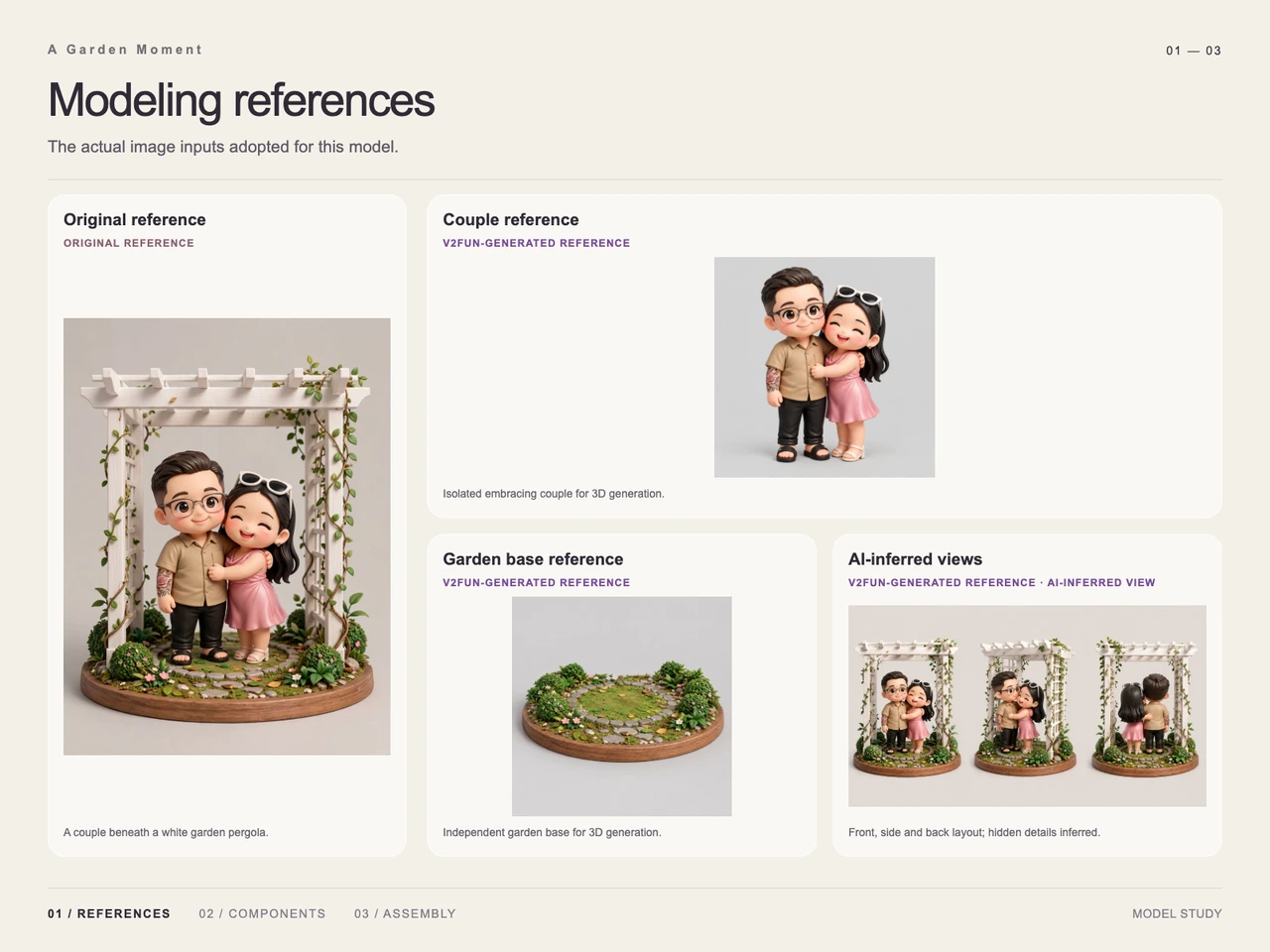
The input board shows the original garden composition alongside isolated references for the couple and base. A separate strip presents front, side, and rear studies labeled as AI-inferred views. These studies suggest hidden forms; they do not document the actual back of a physical figurine.
The isolated couple reference keeps both people together, making their embrace the central relationship to preserve. The base reference exposes the stepping stones and planting otherwise obscured by the figures. For related preparation principles, see the single-image and multi-view input guide.
Step 2 — Generate the Couple and Garden Base
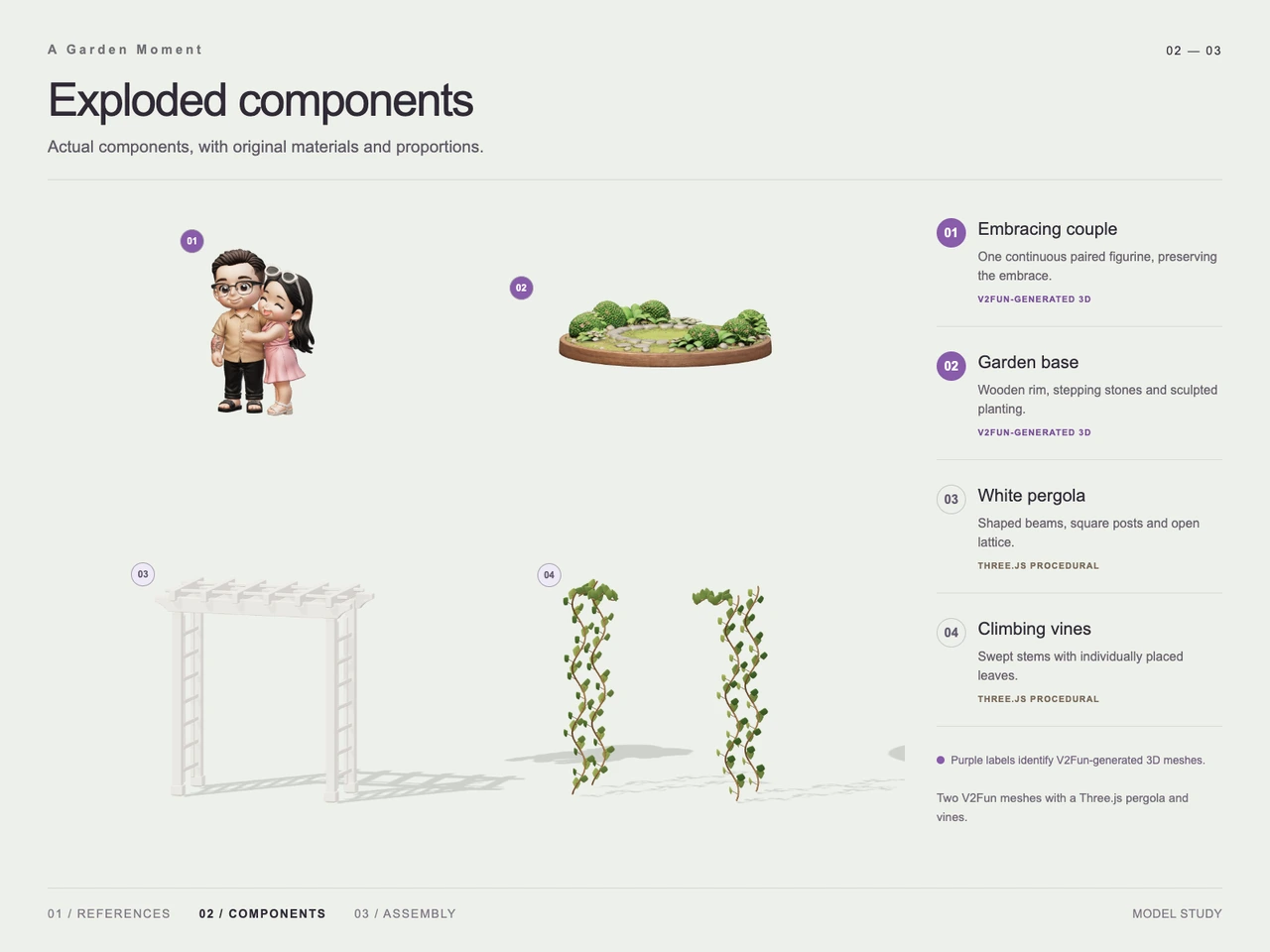
The process board identifies two V2Fun-generated 3D components. The couple is one continuous paired figurine, retaining the close pose rather than splitting the two people into independent character assets. The garden base combines the wooden perimeter, stepping stones, and sculpted planting into a second component.
The visible character details include the man's glasses, khaki shirt, dark trousers, and forearm tattoo, alongside the woman's pink dress, long dark hair, and sunglasses above her forehead. These irregular forms are the part of the workflow handled by the V2Fun AI 3D model generator.
Step 3 — Build the Pergola and Vines
The process board attributes the white pergola to procedural Three.js construction. It shows square posts, open side lattice, shaped beams, and repeated short roof members. The vines are also procedural, described as swept stems with individually placed leaves.
This creates four assembly groups: the paired figurine, garden base, pergola, and vines. Only the first two are identified as V2Fun-generated meshes.
Step 4 — Assemble and Present the Model
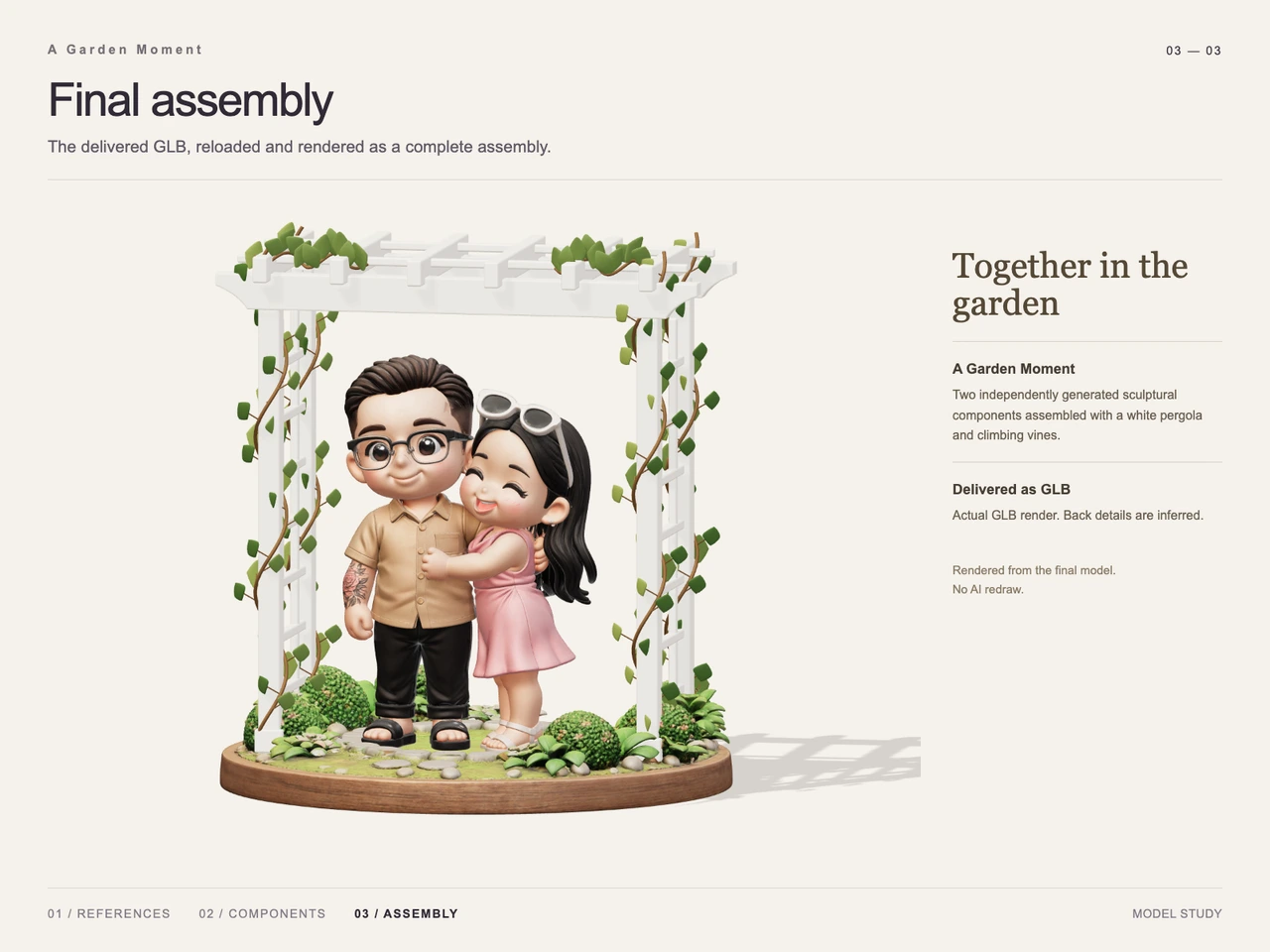
The final image places the couple on the garden path between the white lattice supports. Vines climb both sides and extend across parts of the overhead frame. The full roof and circular base remain visible, preserving the reference's enclosing garden composition.
The final presentation identifies the image as a render of the delivered GLB after reloading, with no AI redraw. It also explicitly notes that back details are inferred. This documents the presented assembly, without establishing unseen geometry or material-map quality.
Workflow
Complete reference → isolated couple and base references → two V2Fun-generated 3D components → procedural Three.js pergola and vines → assembly calibration → GLB export and documented reload render.
Prompt
English translation of the design brief:
Create a warm, resin-style collectible figurine of an adult chibi couple with oversized heads, small bodies, and rounded faces, embracing beneath a white wooden garden pergola. On the left, the smiling man has short, side-parted dark brown hair, thin-framed clear glasses, a khaki short-sleeved shirt, cropped black trousers, black sandals, and a rose tattoo on his forearm. On the right, the woman has long black hair, white-framed sunglasses on her head, small stud earrings, a pink sleeveless dress, and white strappy sandals. She laughs with her eyes closed and cheeks flushed, holding him with both arms while his arm wraps around her shoulders and back.
Use white lattice supports, straight overhead beams, and short rafters to form an open pergola, with green vines climbing the posts. Place the couple on a circular wooden display base with a pebble path, moss, low shrubs, pink and white flowers, scattered leaves, and small stones. Combine smooth clay or resin-style faces with realistic fabric and wood-grain detail. Use soft, warm studio lighting, a slightly elevated front view, the complete pergola roof and base in frame, a clean beige-gray background, a vertical 3:4 composition, and no text or watermark.
Result
The final render retains the embracing pose, contrasting khaki and pink clothing, white garden frame, climbing greenery, and planted circular base. The foliage arrangement and framing vary from the original reference, while the principal subject and scene structure remain recognizable.
- File: garden-couple.glb
- Supplied size: 67,235,212 bytes, approximately 67.24 MB
- Supplied MIME type: model/gltf-binary
- Documented construction: two generated sculptural components plus procedural pergola and vines
The resin description specifies the intended appearance; this case does not establish physical printability. No generation-time or token-use measurements are supplied. For context on the delivery format, consult the AI 3D export guide covering GLB.
Frequently Asked Questions
Were the two people generated as separate characters?
No. The process board identifies the embracing couple as one continuous paired figurine. The garden base is the second independently generated V2Fun component.
Which parts of the garden scene were built with Three.js?
The white pergola and climbing vines are labeled as procedural Three.js components. The pergola includes posts, lattice, and roof members; the vines use swept stems and individually placed leaves.
What did GPT-6 Astra contribute to this case?
The technical notes describe Astra identifying the visual hierarchy, dividing the scene into components, and coordinating assembly calibration. The process images show the resulting component division and completed scene.
Do the rear reference views prove the original figurine's back details?
No. The reference board labels those views as AI-inferred, and the final presentation repeats that back details are inferred.
What file was delivered, and is it verified for resin printing?
The supplied output is garden-couple.glb, with a size of 67,235,212 bytes and MIME type model/gltf-binary. The images document a resin-style digital figurine, but no print-preparation checks or physical print results are supplied.
Explore More
-
GPT-6 Astra x V2Fun - From Code Generation to Model Collaboration | V2Fun
See how GPT-6 Astra and V2Fun combine agent reasoning, code generation, and AI 3D foundation models to build complex, structured 3D assets.
View page → -
AI 3D Model Generator Input Guide: Single vs. Multi-View | V2Fun
Learn how to prepare photos, multi-view references, and sketches for an AI 3D Model Generator, then inspect geometry and textures before export.
View page → -
V2Fun - AI 3D Model Generator
Create 3D models from text prompts or images with V2Fun's AI 3D model generator. Generate characters, props, game assets, and 3D-printable models faster.
View page → -
AI 3D Model Generator Export Guide: FBX, GLB, OBJ, or USDZ? | V2Fun
Use an AI 3D Model Generator with the right export format. Compare FBX, GLB, OBJ, and USDZ for Blender, game engines, animation, web, and AR.
View page →