Build a Floating Fantasy Sanctum with GPT-6 Astra and V2Fun
See how GPT-6 Astra decomposes a stylized floating-island reference, combines a V2Fun-generated rock island with procedural ruins and vegetation, and assembles the complete scene as a GLB.
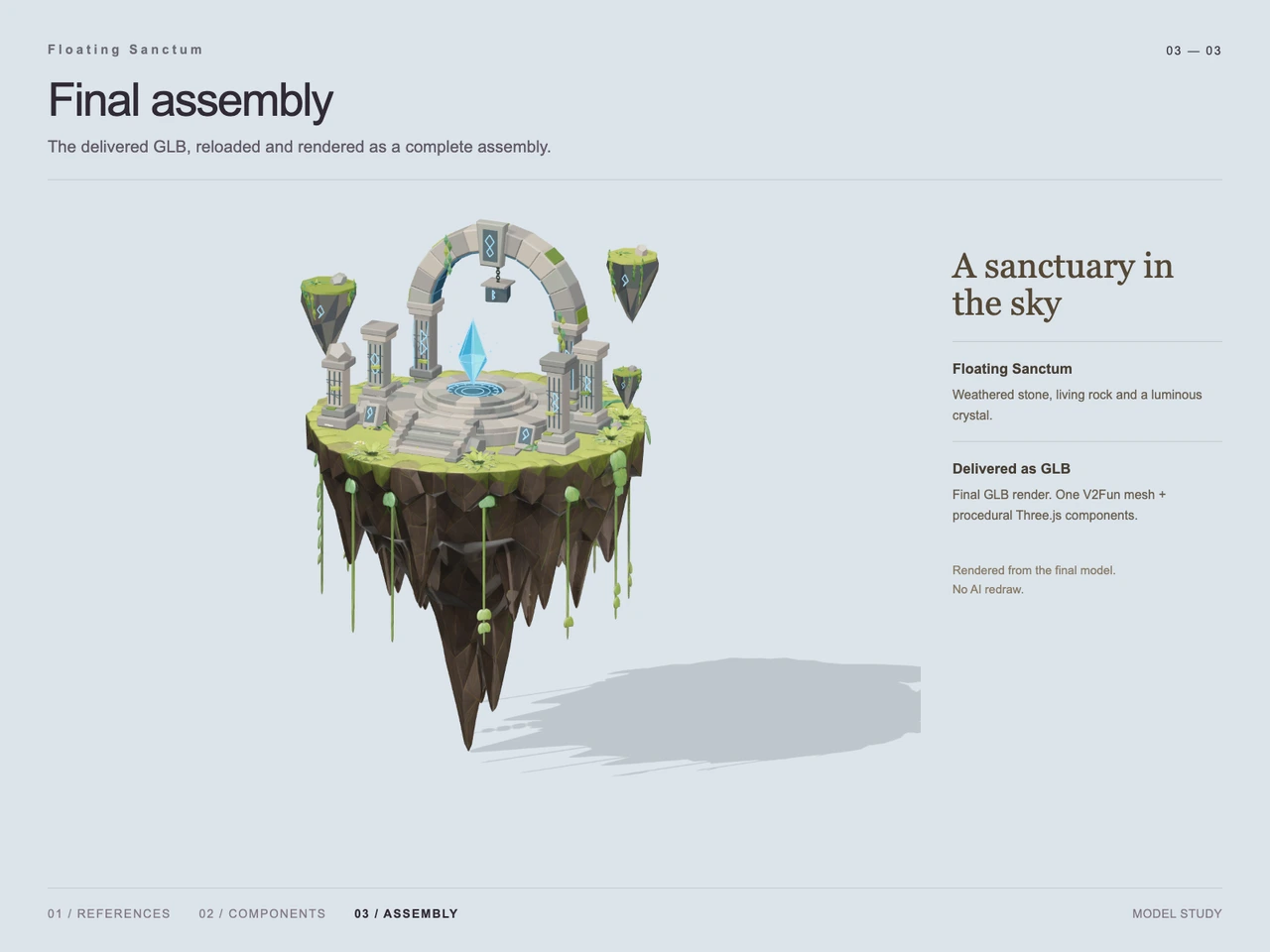
Interactive 3D preview · Build a Floating Fantasy Sanctum with GPT-6 Astra and V2FunDrag to rotate · Scroll to zoom
Take a Closer Look
-
 01 / Input
Input · Build a Floating Fantasy Sanctum with GPT-6 Astra and V2Fun
-
 02 / Process
Process · Build a Floating Fantasy Sanctum with GPT-6 Astra and V2Fun
-
03 / Final
Final · Build a Floating Fantasy Sanctum with GPT-6 Astra and V2Fun
Overview
This case translates a detailed fantasy-environment reference into a hybrid 3D scene. The target composition is a tapered floating rock island topped with grass and ruins, centered on a glowing crystal altar and surrounded by three smaller islands.
GPT-6 Astra interprets the scene hierarchy, separates the irregular terrain from the more regular architectural and decorative parts, and coordinates final placement. V2Fun supplies the generated living-rock island, while Three.js procedural construction covers the ruined arch, altar, stairway, crystal, runes, satellite islands, plants, and rubble. This division follows the broader GPT-6 Astra and V2Fun model-collaboration workflow.
Tools Used
- GPT-6 Astra: reference analysis, component planning, spatial relationships, and assembly.
- V2Fun: generation of the main irregular rock-island mesh from visual reference material.
- Three.js / procedural code: construction of the architectural forms, magical details, secondary islands, vegetation, and rubble shown in the component study.
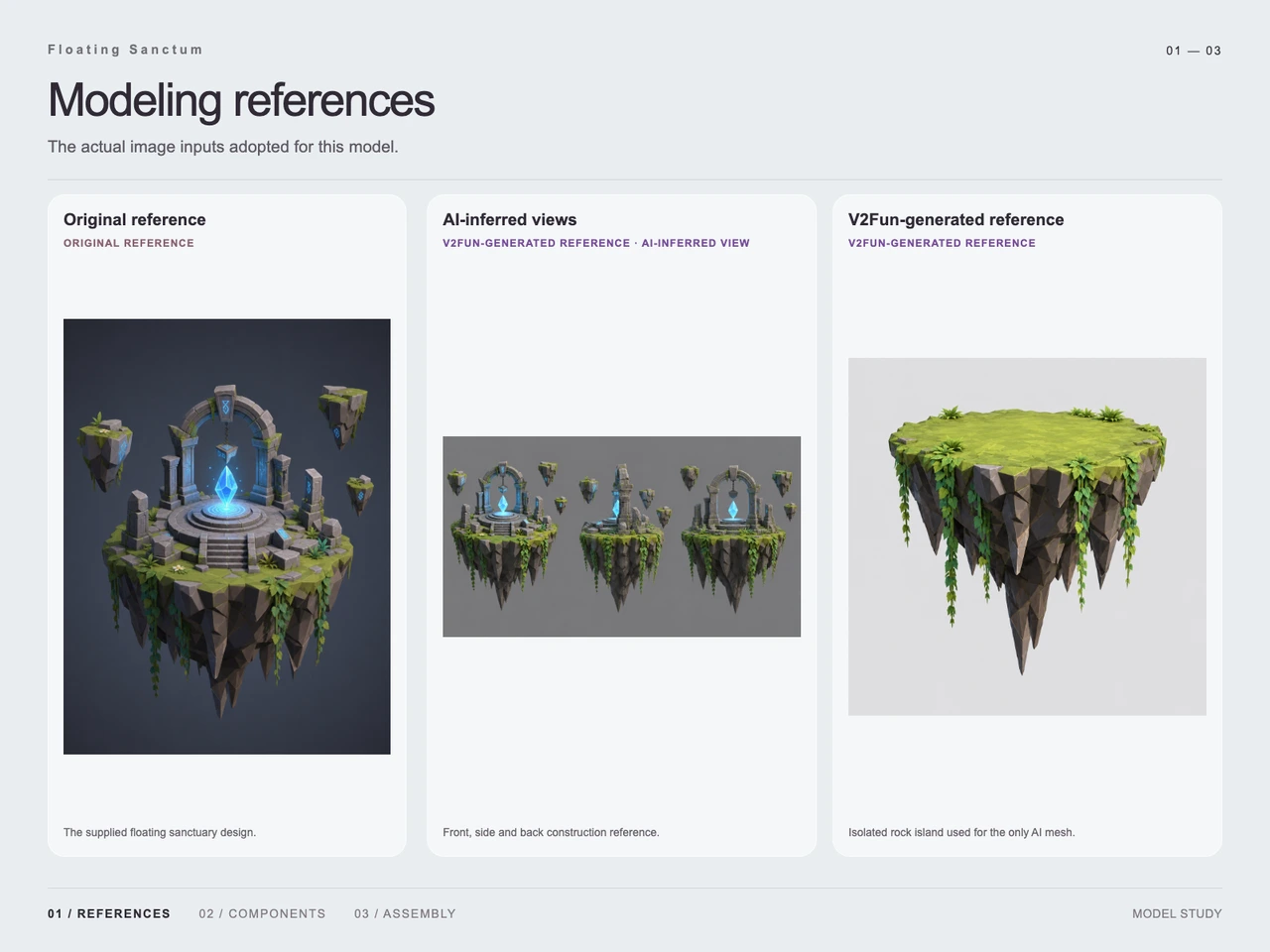
- Visual references: the original composition plus AI-inferred front, side, and rear views used as construction guidance. For more context on choosing reference coverage, see the single-image and multi-view input guide.
- GLB: the supplied final delivery format.
Step 1 — Analyze the Reference
The original image establishes a front three-quarter, slightly elevated view of the complete sanctuary. Its dominant layers are the dark faceted rock base, bright grassy top, circular altar, cyan crystal, segmented stone arch, hanging rune device, vegetation, and three satellite islands.
The scene also depends on material and color contrast: deep gray rock and weathered stone sit against fresh green growth and cyan-blue magical accents. The reference does not reveal every hidden surface, so inferred front, side, and rear studies are used as construction guidance rather than claimed as additional photographed views.
Step 2 — Decompose the Scene
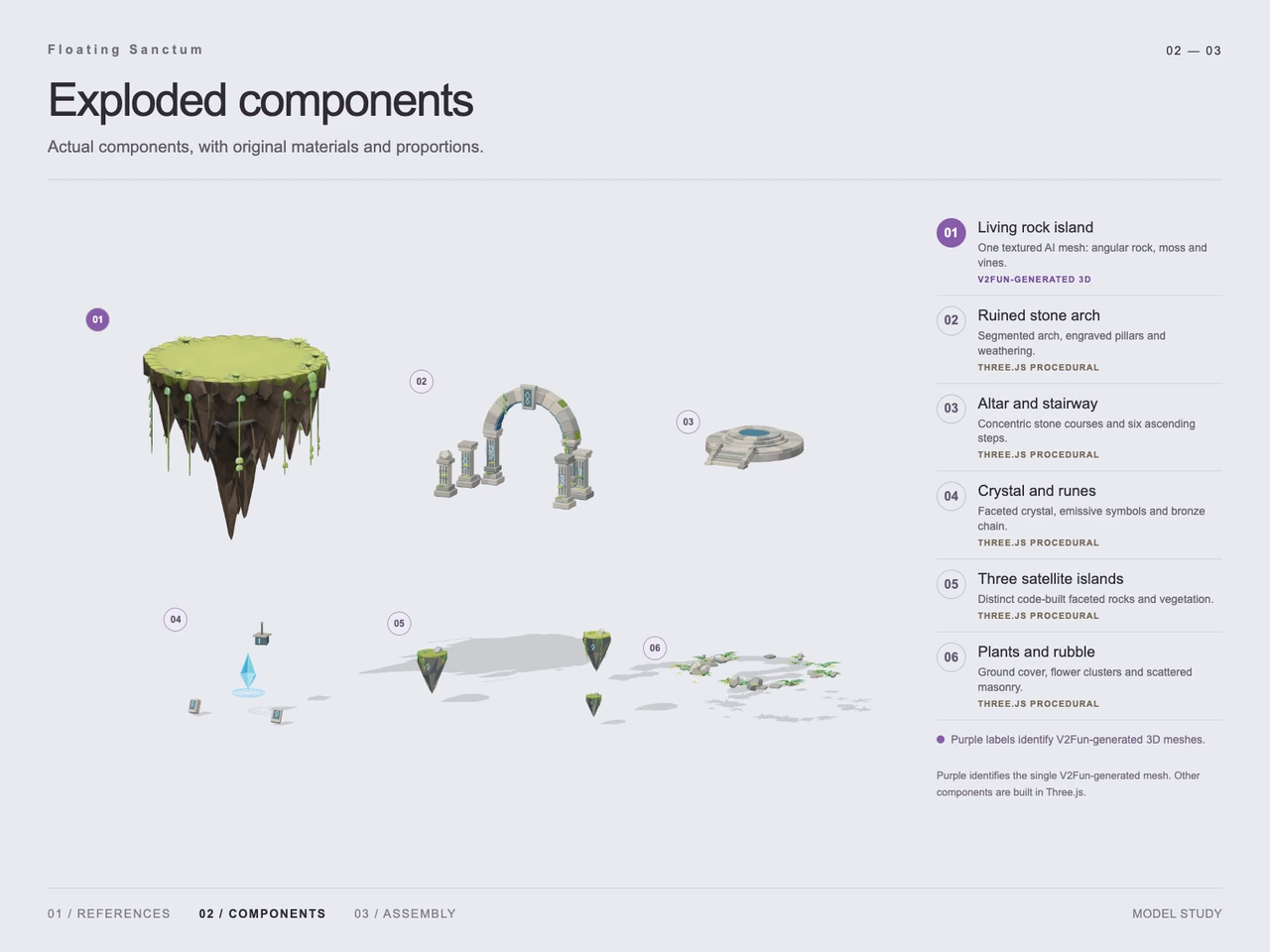
GPT-6 Astra separates the environment into six visible groups:
- Living rock island.
- Ruined stone arch.
- Altar and stairway.
- Crystal and rune elements.
- Three satellite islands.
- Plants and rubble.
This decomposition preserves the composition as independently placeable elements instead of asking one generation pass to resolve the entire scene. The input strategy is related to V2Fun's multi-view 3D modeling workflow, although the displayed auxiliary views in this case are AI-inferred references.
Step 3 — Generate the Main Island with V2Fun
The evidence identifies the main living-rock island as the single V2Fun-generated 3D mesh. Its isolated reference shows the broad grassy platform, angular inverted rock mass, irregular perimeter, and hanging vegetation that define the environment's primary silhouette.
No topology, UV, polygon-count, dimensional, or downstream-readiness claims are made from the rendered study alone.
Step 4 — Build the Remaining Components Procedurally
The component sheet labels the ruined arch, altar and stairs, crystal and runes, satellite islands, plants, and rubble as Three.js procedural elements. Regular stone courses and concentric altar rings suit procedural construction, while repeated runic accents, stones, vegetation clusters, and smaller islands can be arranged as separate scene objects.
The glowing crystal and cyan symbols provide the focal contrast, while moss, vines, flowers, and rubble soften the harder architectural forms.
Step 5 — Assemble and Calibrate the Scene
GPT-6 Astra brings the generated island and procedural components together, adjusting their relative scale, rotation, and placement. The circular altar sits near the center of the grassy surface, the arch rises behind it, the crystal floats over the rune circle, and the three small islands frame the main silhouette without obscuring it.
The final rendered assembly visibly retains the stepped altar, segmented arch, hanging rune device, side pillars, scattered stones, vegetation, cyan accents, and tapered rock base. These observations describe the delivered render, not measured geometric fidelity.
Workflow
Reference image → Analyze visual hierarchy → Infer supporting views → Decompose components → Generate the main rock island with V2Fun → Build regular and repeated elements with Three.js → Assemble and calibrate → Render → Export GLB
For format-specific handoff considerations beyond this case, consult the AI 3D export guide for FBX, GLB, OBJ, and USDZ.
Prompt
Create a fantasy ruin island floating in the sky. The main form is an inverted-cone rock island with sharp dark-gray faceted stones beneath a bright grassy surface. Add moss, ferns, small white flowers, rubble, and long vines hanging from the edge. At the center, place a tiered circular gray-stone altar reached by short front steps. Its concentric rune circle glows cyan-blue, with a long faceted blue crystal floating above it and a few luminous particles nearby.
Behind the altar, build a segmented semicircular stone arch. Suspend a blue rune plaque at its crown and hang a square inscribed stone-and-metal device from a short chain below it. Add side pillars, broken columns, and leaning rune stones with moss and glowing blue symbols. Surround the main island with three smaller inverted rock islands carrying grass, flowers, stones, and blue runes.
Use a refined stylized low-poly 3D game-scene aesthetic with clear facets, substantial stone blocks, soft ambient light, and strong contrast between green vegetation and cyan magical light. Frame the complete island, arch, and satellite islands from a slightly elevated front three-quarter view against a deep blue-gray gradient background in a vertical 3:4 composition. Include no people, extra text, or watermark.
Result
The delivered render presents a complete floating sanctuary assembled from one V2Fun-generated main-island mesh and the procedural components documented in the exploded study. The scene includes the grassy faceted island, central altar and stairs, luminous crystal, ruined arch, rune details, vegetation, rubble, and three surrounding islands.
Final output: floating-sanctum.glb
File type: model/gltf-binary
Supplied file size: 34,480,244 bytes (approximately 34.48 MB)
Generation time and total workflow time were not measured. The supplied evidence also does not establish topology quality, UV quality, engine readiness, printability, or commercial-use status.
Frequently Asked Questions
What was generated with V2Fun in the floating-sanctum case?
The component study identifies the main living-rock island as the single V2Fun-generated 3D mesh. The arch, altar, stairs, magical elements, satellite islands, plants, and rubble are labeled as procedural Three.js components.
How did GPT-6 Astra contribute to this scene?
GPT-6 Astra interpreted the reference hierarchy, decomposed the sanctuary into component groups, used supporting inferred views for construction guidance, and coordinated the scale and placement of the generated and procedural elements.
Why was the scene split into separate components?
The split lets the workflow use V2Fun for the irregular primary terrain while treating regular stone courses, concentric altar forms, repeated runes, vegetation clusters, and secondary islands as independently constructed and positioned elements.
Does the case use multiple reference views?
Yes, but with an important qualification: the original composition is accompanied by AI-inferred front, side, and rear views. They serve as construction references and are not presented as additional original photographs.
What does the final GLB contain?
The final render shows the assembled grassy floating island, tiered altar, stairs, cyan crystal and rune circle, segmented arch, hanging rune device, pillars, vegetation, rubble, and three satellite islands. The supplied filename is floating-sanctum.glb.
Is the floating sanctuary proven to be game-ready or optimized?
No. The images and metadata demonstrate a rendered assembly and a GLB delivery, but they do not prove topology quality, UV quality, polygon count, collision setup, runtime performance, or engine readiness.
Explore More
-
GPT-6 Astra x V2Fun - From Code Generation to Model Collaboration | V2Fun
See how GPT-6 Astra and V2Fun combine agent reasoning, code generation, and AI 3D foundation models to build complex, structured 3D assets.
View page → -
AI 3D Model Generator Input Guide: Single vs. Multi-View | V2Fun
Learn how to prepare photos, multi-view references, and sketches for an AI 3D Model Generator, then inspect geometry and textures before export.
View page → -
V2Fun - Multi-View to 3D Model AI
Generate accurate 3D models from multiple reference images with V2Fun's multi-view to 3D model AI. Create structured assets with better shape consistency and detail.
View page → -
AI 3D Model Generator Export Guide: FBX, GLB, OBJ, or USDZ? | V2Fun
Use an AI 3D Model Generator with the right export format. Compare FBX, GLB, OBJ, and USDZ for Blender, game engines, animation, web, and AR.
View page →