Desert Sail Cart: GPT-6 Astra and V2Fun 3D Workflow
Follow a desert traveler and three-wheeled sail cart from generated references to component breakdown and final GLB presentation, combining a V2Fun character with Three.js machinery.
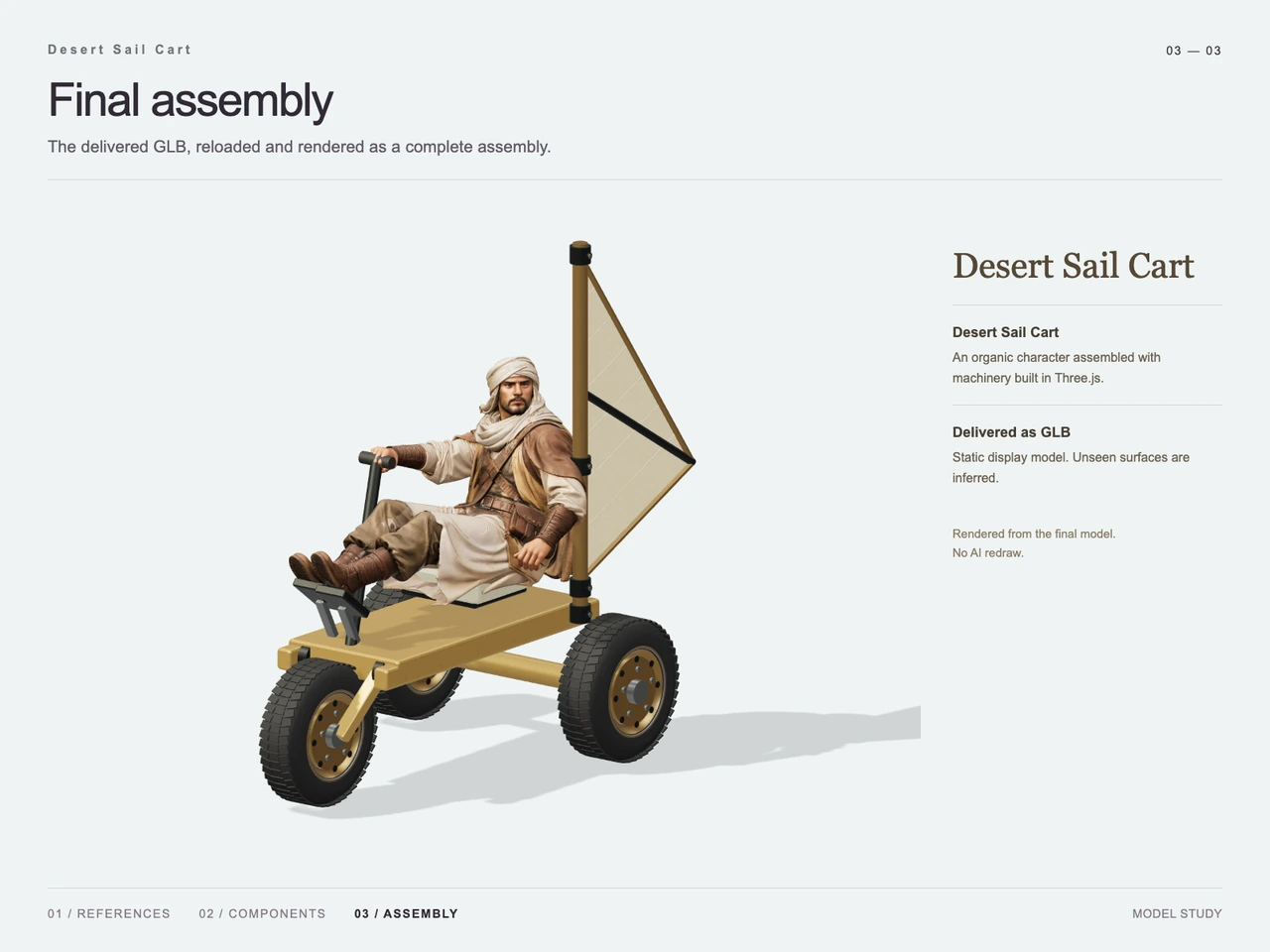
Interactive 3D preview · Desert Sail Cart: GPT-6 Astra and V2Fun 3D WorkflowDrag to rotate · Scroll to zoom
Take a Closer Look
-
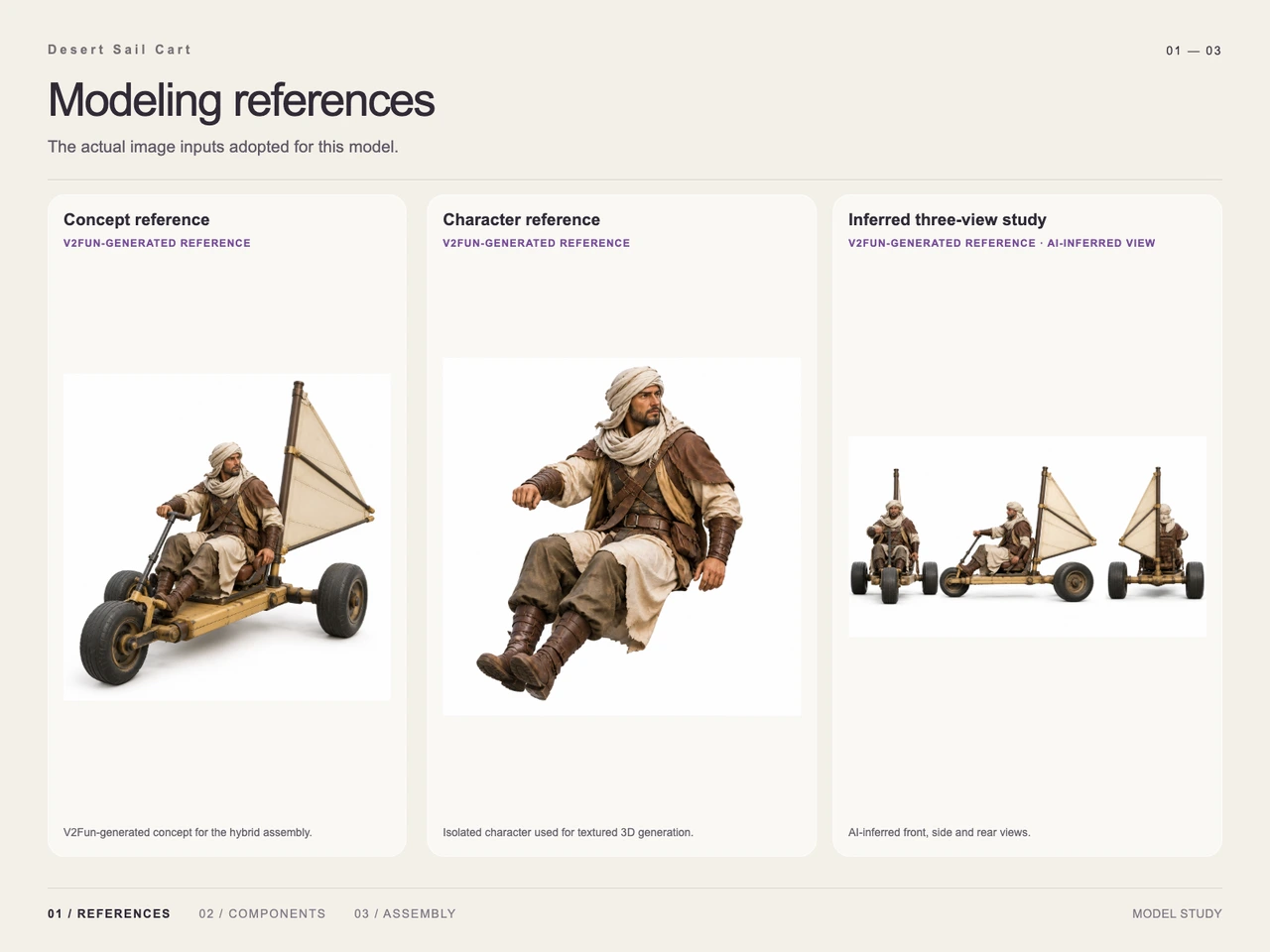 01 / Input
Input · Desert Sail Cart: GPT-6 Astra and V2Fun 3D Workflow
-
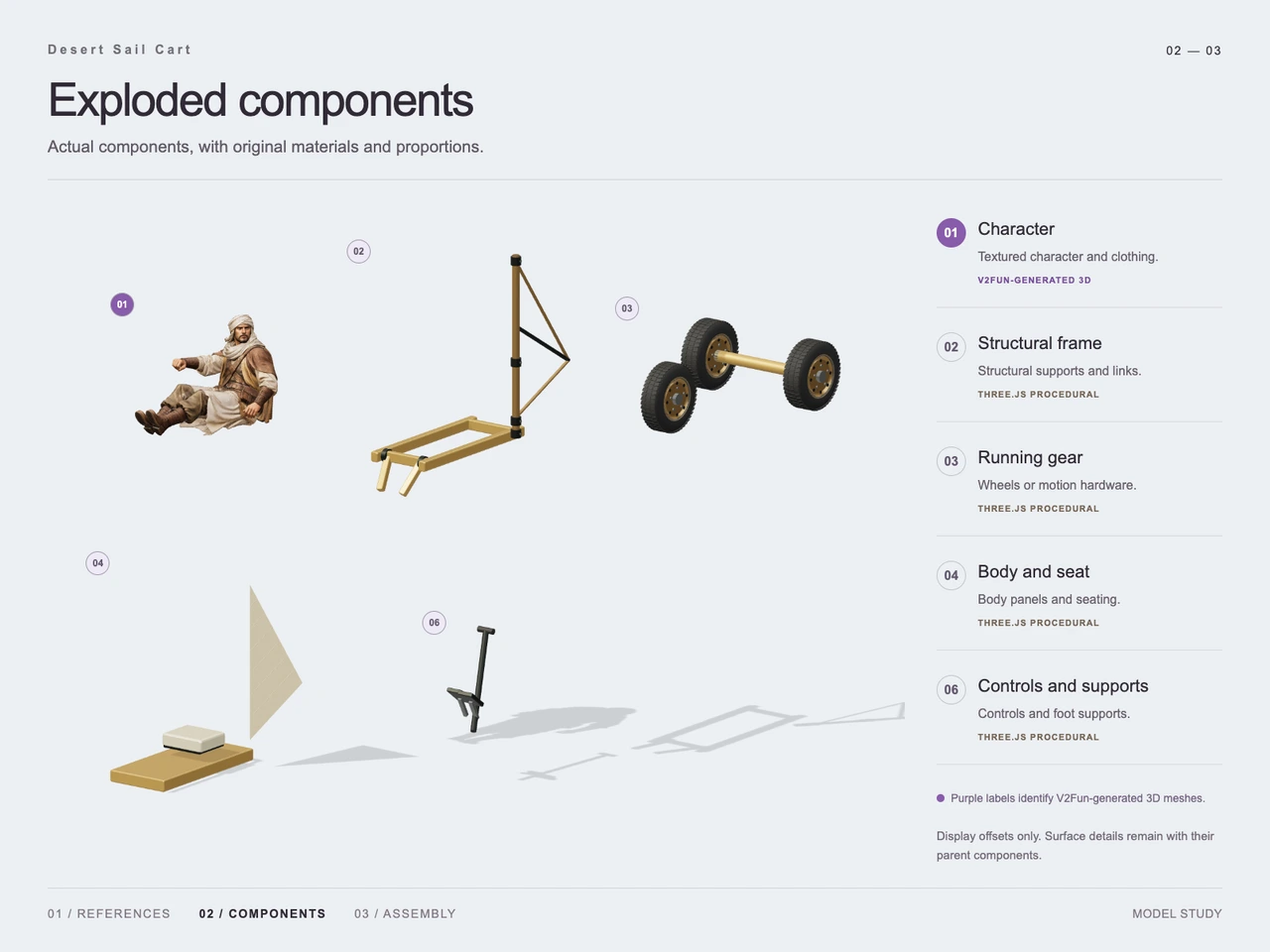 02 / Process
Process · Desert Sail Cart: GPT-6 Astra and V2Fun 3D Workflow
-
03 / Final
Final · Desert Sail Cart: GPT-6 Astra and V2Fun 3D Workflow
Overview
This case pairs a turbaned desert traveler with a low, three-wheeled sail cart. Layered robes, leather bracers, and a seated pose give the character its identity; a sand-yellow platform, broad tires, exposed axle, upright mast, and pale sail define the vehicle.
The supplied technical account assigns component planning and assembly coordination to GPT-6 Astra. The process image identifies the textured character as V2Fun-generated 3D and the mechanical groups as Three.js procedural work. This division illustrates the broader GPT-6 Astra and V2Fun collaboration workflow, with complex character surfaces generated separately from regular vehicle geometry.
Tools Used
- GPT-6 Astra: interpreting the subject hierarchy, planning components, and coordinating assembly adjustments, as described in the technical account.
- V2Fun: generated concept and character references, plus the textured seated character mesh identified in the process sheet.
- Three.js: procedural structural frame, running gear, body and seat, and controls and supports.
- GLB: the supplied final asset format.
Step 1 — Establish the Visual References
The input sheet presents a complete cart concept, an isolated seated traveler, and an inferred front, side, and rear study. The isolated reference exposes the character’s clothing and pose without the vehicle covering them. These references connect to the concept-preparation role of V2Fun’s AI image generator.
The three-view study is explicitly labeled AI-inferred. It offers a proposed interpretation of additional angles, rather than measured evidence of hidden surfaces.
Step 2 — Separate Character and Mechanical Groups
The exploded presentation shows five labeled groups: character, structural frame, running gear, body and seat, and controls and supports. The sail panel is also visibly separated beside the platform and seat elements.
This breakdown makes the main assembly relationships readable: the traveler sits above the platform, the wheels support the chassis, the mast rises beside the seat, and the steering control and foot support sit ahead of the rider. The exploded offsets are for presentation and do not represent operating positions.
Step 3 — Generate the Traveler and Build the Cart
V2Fun supplies the textured character, including the turban, face, layered clothing, boots, and leather accessories. The case demonstrates a component-level use of image-to-3D model generation.
Three.js supplies the regular machinery visible in the process sheet: rectangular frame members and platform, wheels and axle, mast and straight braces, seat elements, and control hardware. The finished presentation combines the detailed clothing surfaces with simpler mechanical forms.
Step 4 — Assemble and Present the Output
The technical account describes returning the generated component to the agent for assembly calibration. In the final image, the traveler sits over the platform with one hand at the steering grip and boots positioned over the front foot support. The mast and sail remain beside and behind the torso, leaving the face visible.
The final sheet describes its image as a render of the delivered GLB after reloading. It identifies the asset as a static display model and notes that unseen surfaces are inferred.
Workflow
Design prompt → Generated concept and isolated character references → Component planning → V2Fun character generation and Three.js mechanical construction → Assembly calibration → GLB export and reload presentation.
Prompt
English translation of the design brief:
An adult desert traveler wearing a turban, layered cloth robes, and leather bracers sits on a low three-wheeled sail cart, holding the steering lever with one hand and resting the other on the seat. The machine consists of a rectangular load-bearing platform, three wide tires, exposed axles, one vertical mast, and a triangular rigid sail. The sail uses flat segmented hard panels, connects to the mast through two straight rods, and sits beside and behind the traveler without covering the face. Use a sand-yellow vehicle body, dark brown leather, and ivory sail panels to suggest lightweight desert travel equipment.
Create one complete standalone asset containing one character and one machine, with realistic proportions and mild exaggeration in a collectible-model style. Aim for an expressive face and natural clothing folds. Build the machinery from clear cylinders, discs, rectangular panels, straight rods, and a few regular curved tubes. Keep major part boundaries distinct and connections plausible, preserving contact points with the seat, grip, and footrest.
Show a front three-quarter view from slightly above, with the entire subject centered and margins around it. Use a white background, soft studio lighting, contact shadows, sharp focus throughout, and refined PBR materials. Exclude text, numbers, logos, watermarks, complex scenery, and motion blur. Produce one finished reference image, not a collage or exploded view.
Result
The final presentation shows a seated desert traveler on a sand-colored tricycle cart with dark treaded tires, an exposed rear axle, and a cream sail supported by straight members. It retains the brief’s main silhouette and color relationships, while the chassis and controls visibly differ in detail from the initial concept.
Supplied output metadata: 77-v2-final.glb, 55,220,640 bytes, MIME type model/gltf-binary. For context on this deliverable format, see the AI 3D export format guide.
The evidence supports a static hybrid assembly and its rendered presentation. No case-specific timing or token measurements are supplied.
Frequently Asked Questions
Which parts of the desert sail cart were generated with V2Fun?
The process sheet identifies the textured seated traveler as V2Fun-generated 3D. The input sheet also labels the concept, isolated character reference, and inferred three-view study as V2Fun-generated references.
What did Three.js contribute to this case?
The process sheet credits Three.js procedural construction for the structural frame, running gear, body and seat, and controls and supports. These mechanical elements are combined with the generated character.
Were the front, side, and rear references captured from a real cart?
No. The supplied reference sheet explicitly labels them as an AI-inferred three-view study. They represent proposed views, not measured documentation of a physical vehicle.
How does the final assembly preserve the traveler’s relationship to the cart?
The final image shows the traveler seated above the platform, one hand at the steering grip, and boots over the front foot support. The sail sits beside and behind the rider without obscuring the face; exact contact geometry is not established by the image.
What is the final deliverable, and is it animated?
The supplied file is 77-v2-final.glb, sized at 55,220,640 bytes with MIME type model/gltf-binary. The final presentation identifies it as a static display model; animation is not demonstrated.
Explore More
-
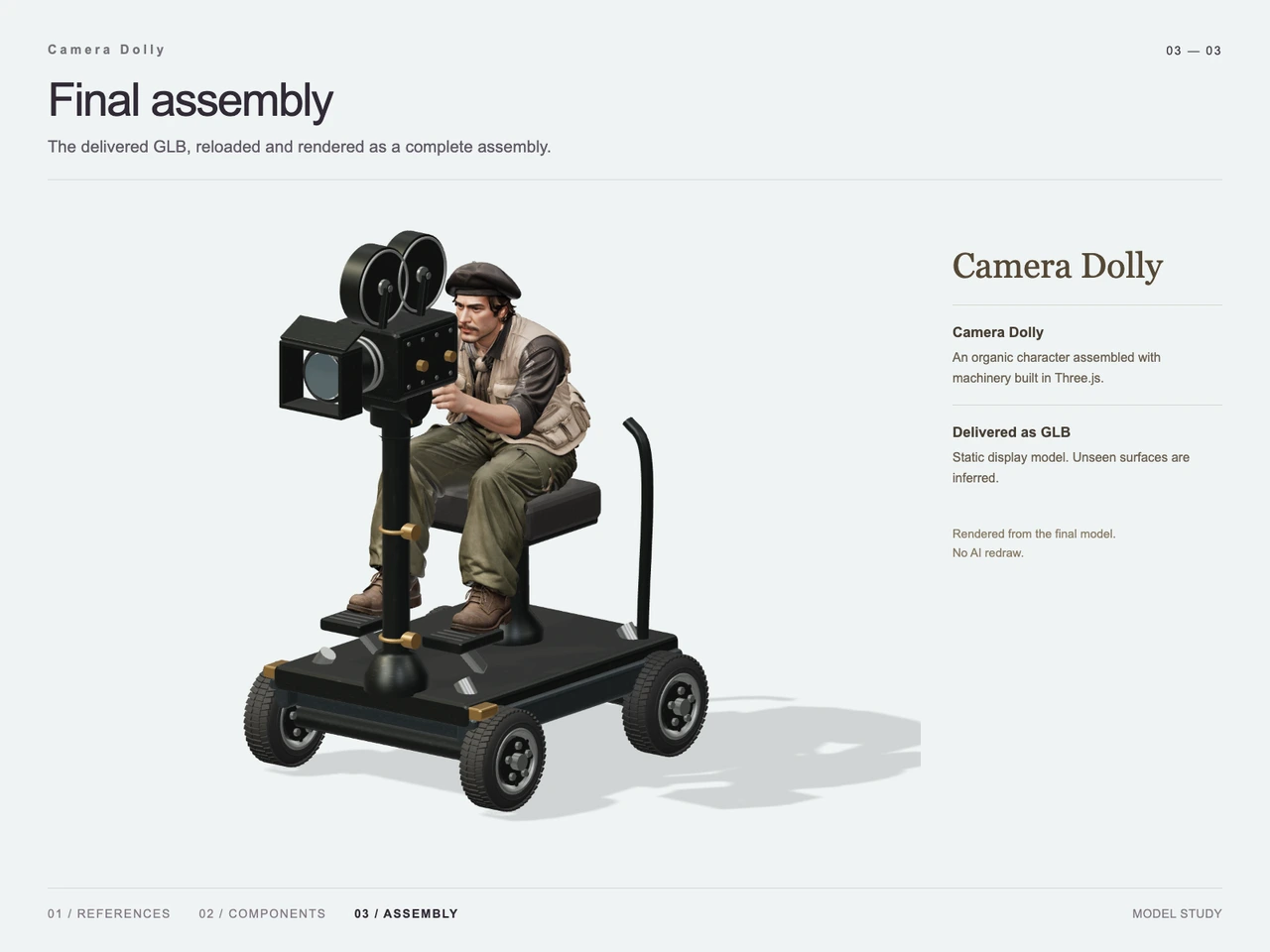
GPT-6 Astra x V2Fun - From Code Generation to Model Collaboration | V2Fun
See how GPT-6 Astra and V2Fun combine agent reasoning, code generation, and AI 3D foundation models to build complex, structured 3D assets.
View page → -
V2Fun - AI Image Generator for 3D Creation
Create concept images, character references, and visual assets with V2Fun's AI image generator. Turn ideas into 3D-ready images for modeling, animation, and game design.
View page → -
V2Fun - AI 3D Model Generator
Create 3D models from text prompts or images with V2Fun's AI 3D model generator. Generate characters, props, game assets, and 3D-printable models faster.
View page → -
AI 3D Model Generator Export Guide: FBX, GLB, OBJ, or USDZ? | V2Fun
Use an AI 3D Model Generator with the right export format. Compare FBX, GLB, OBJ, and USDZ for Blender, game engines, animation, web, and AR.
View page →