Cat Aviator 3D Workflow with GPT-6 Astra and V2Fun
Follow The Little Aviator from reference studies to an exploded component view and final assembly, combining a V2Fun-generated cat pilot with a vintage airplane built in Three.js.
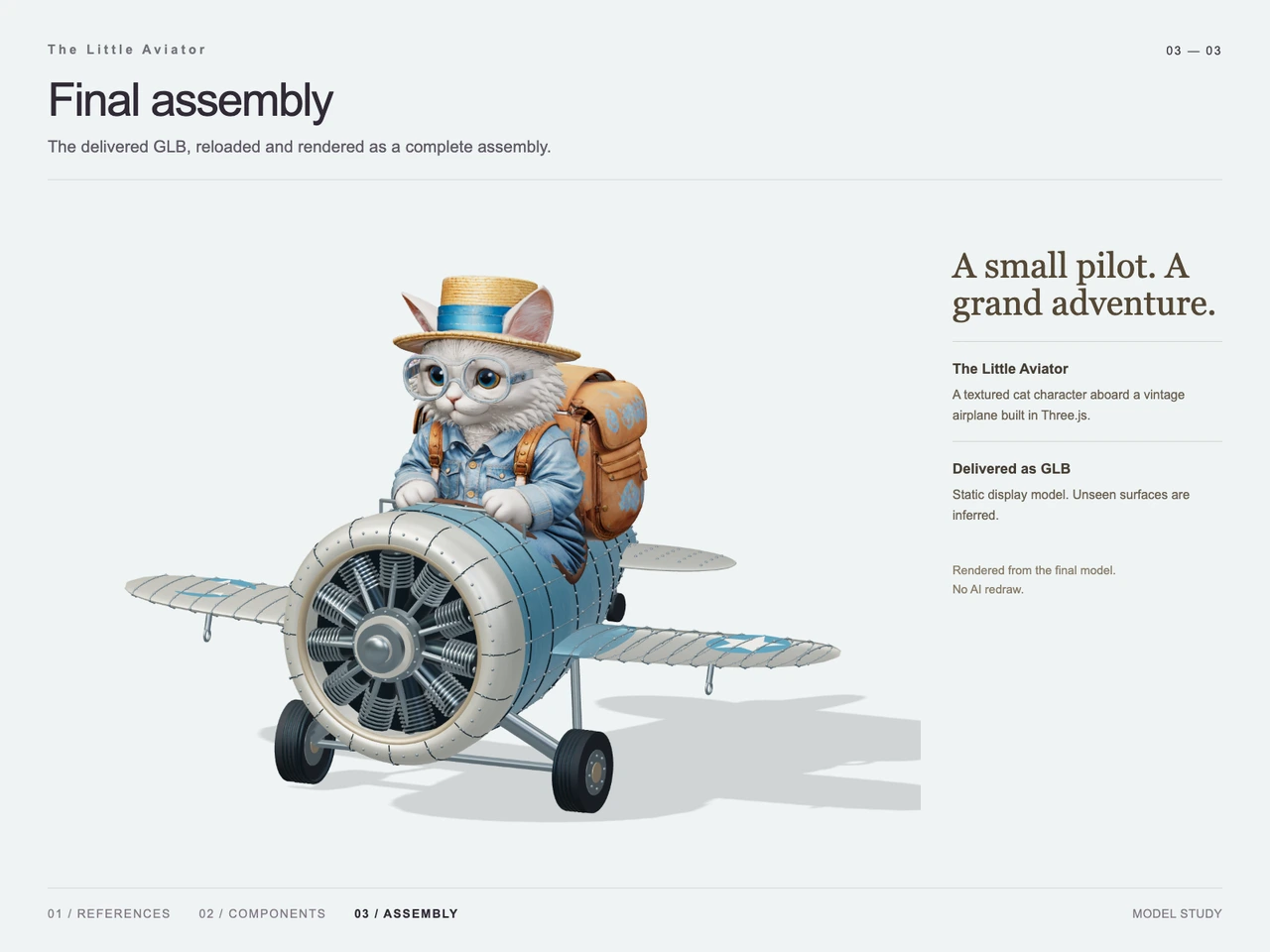
Interactive 3D preview · Cat Aviator 3D Workflow with GPT-6 Astra and V2FunDrag to rotate · Scroll to zoom
Take a Closer Look
-
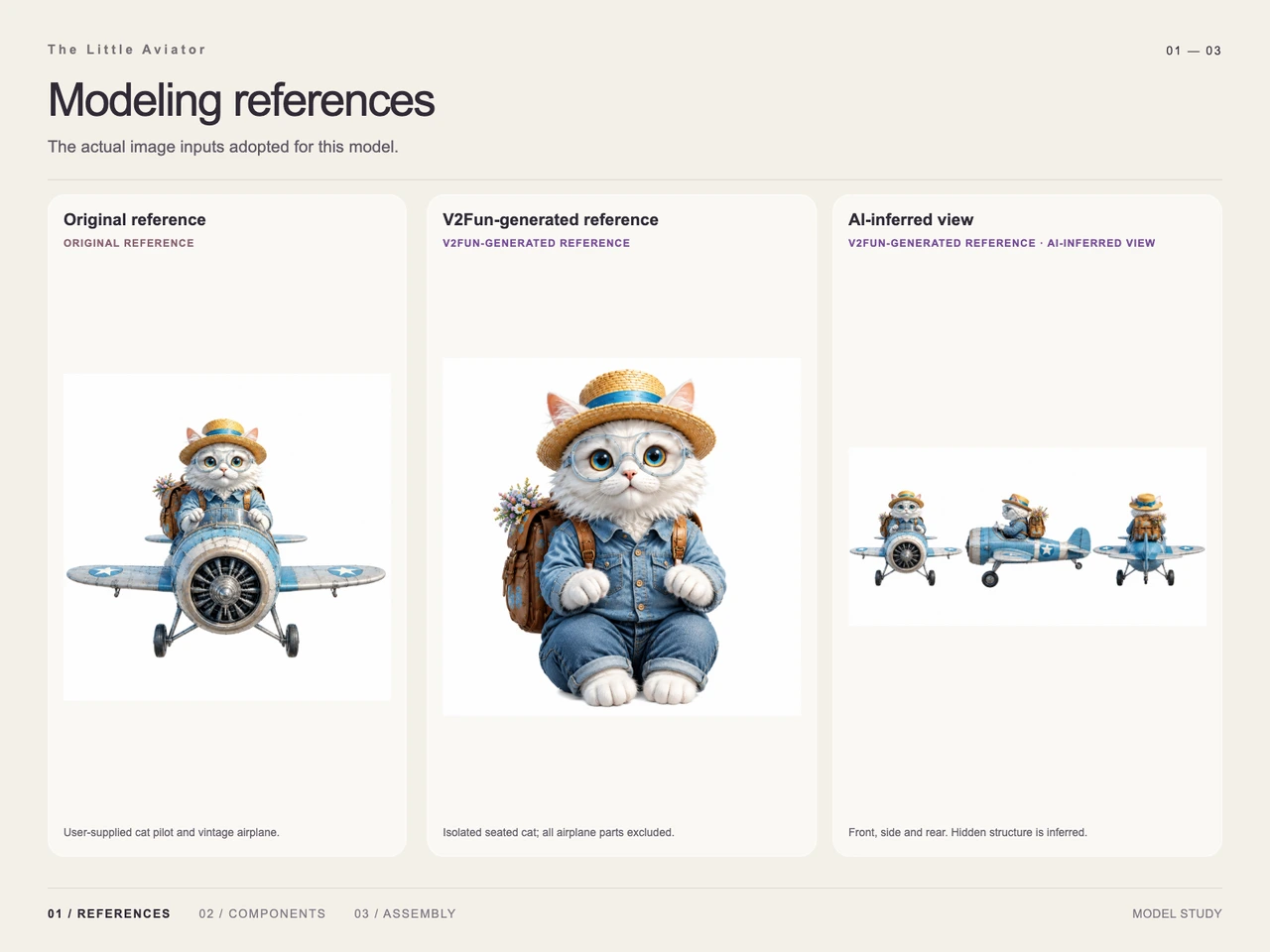 01 / Input
Input · Cat Aviator 3D Workflow with GPT-6 Astra and V2Fun
-
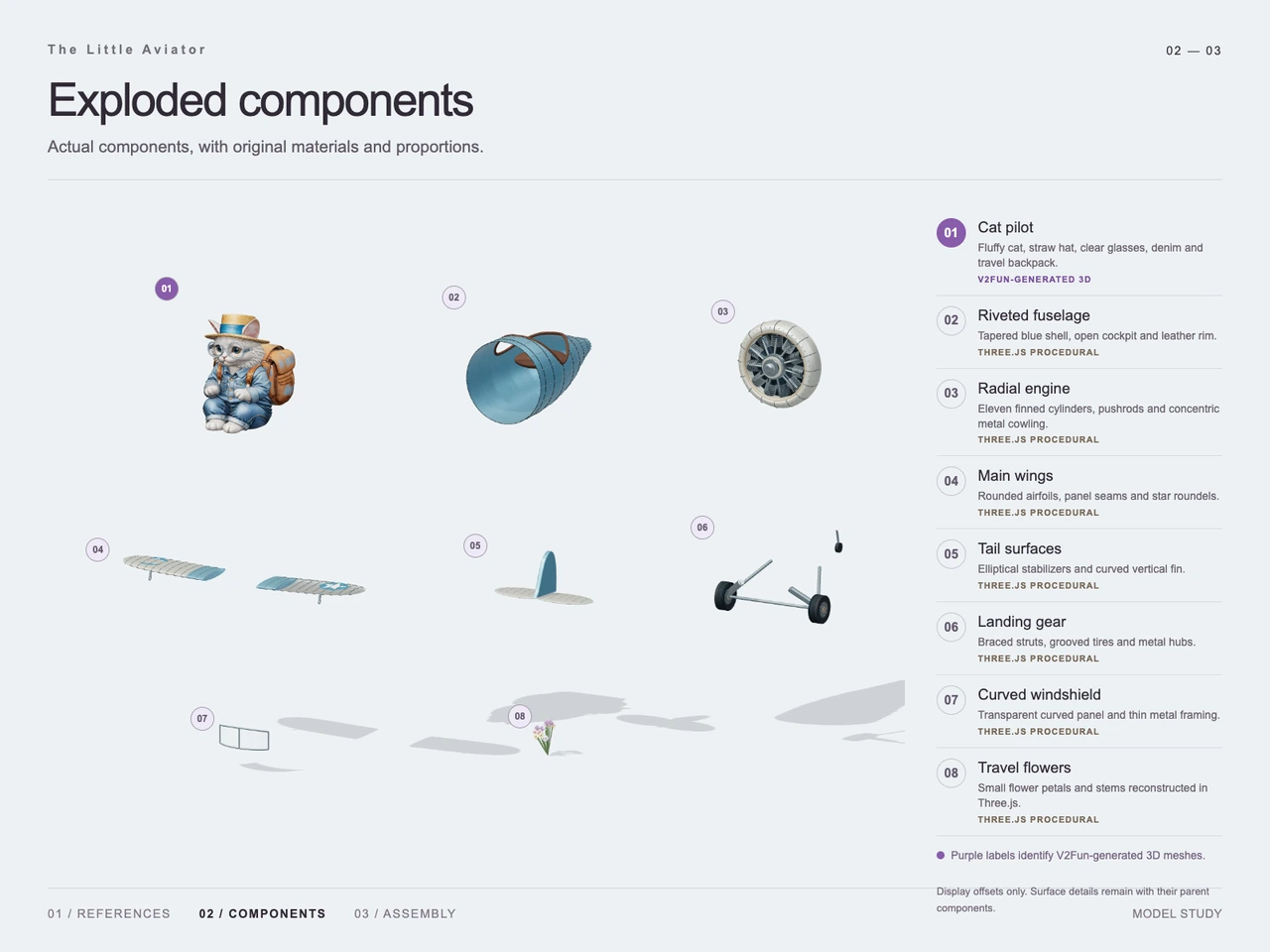 02 / Process
Process · Cat Aviator 3D Workflow with GPT-6 Astra and V2Fun
-
03 / Final
Final · Cat Aviator 3D Workflow with GPT-6 Astra and V2Fun
Overview
The Little Aviator pairs a white long-haired cat with a miniature vintage airplane. The design brings together a straw hat, oversized transparent glasses, denim clothing and a leather travel backpack above an exposed radial engine and riveted blue fuselage.
The case documents a hybrid construction method: V2Fun generates the cat character, while Three.js supplies the airplane and smaller procedural elements. The technical notes assign reference analysis, component planning and assembly calibration to GPT-6 Astra. This division follows the broader GPT-6 Astra and V2Fun collaboration workflow.
Tools Used
- GPT-6 Astra: visual hierarchy analysis, component decomposition and agent-side assembly, as described in the case notes.
- V2Fun: generated reference imagery and the cat pilot 3D component, identified in the presentation.
- Three.js: procedural airplane components, windshield and flowers, identified in the exploded view.
- GLB: the supplied final asset format.
Step 1 — Separate the Character Reference
The input presentation distinguishes three sources: the original cat-and-airplane image, a generated reference showing the seated cat without the airplane, and an AI-inferred front, side and rear study of the complete subject.
The isolated reference makes the cat's pose, clothing and backpack visible independently of the cockpit. The additional views suggest hidden structure, but they are generated interpretations rather than observations of an existing object. The single-image and multi-view input guide provides related guidance on reference coverage and occlusion.
Step 2 — Divide the Model into Eight Component Groups
The process presentation identifies eight groups:
- Cat pilot, including the hat, glasses, denim outfit and backpack.
- Riveted fuselage with an open cockpit and leather rim.
- Radial engine with finned cylinders, pushrods and a circular metal cowling.
- Main wings with panel seams and star roundels.
- Tail surfaces with horizontal stabilizers and a curved vertical fin.
- Landing gear with braced struts, grooved tires and metal hubs.
- Curved windshield with thin framing.
- Travel flowers with small petals and stems.
These are presentation groups, not a verified count of meshes inside the GLB. The exploded positions are display offsets used to explain the assembly.
Step 3 — Generate the Cat and Build the Airplane
The cat pilot is the only group marked as V2Fun-generated 3D. Its irregular silhouette and layered accessories carry the character identity. This is the case's direct connection to V2Fun image-to-3D model generation.
The other seven groups are labeled as Three.js procedural work. The airplane uses repeated rivets, wing seams, engine fins and landing-gear struts to establish its mechanical appearance. The small flower arrangement is also shown as a procedural component rather than a separate AI-generated asset.
Step 4 — Assemble and Present the Model
The final view places the cat in the cockpit behind the windshield, with the backpack rising above the rear fuselage. Both main wings remain visible, and the circular cowling frames the exposed engine without a long propeller blade crossing it.
The presentation identifies this image as a render of the delivered GLB after reloading. It shows the assembly from an oblique front angle, revealing cockpit depth and the backpack more clearly than the strictly frontal composition requested in the prompt. Unseen surfaces are explicitly described as inferred.
Workflow
Original reference → isolated cat reference and inferred views → component decomposition → V2Fun character generation and Three.js construction → assembly → GLB export and documented reload render.
Prompt
English translation of the design brief:
An anthropomorphic white long-haired cat pilot sits in the open cockpit of a miniature vintage airplane, looking directly at the camera. Give it a round face, large eyes, a pink nose and fluffy whiskers. It wears a woven straw hat with a blue ribbon, oversized pale-blue transparent round glasses, a light-blue denim shirt and a brown leather travel backpack with a small bunch of colorful wildflowers in a side pocket. Both white front paws rest behind a transparent curved windshield.
Center the airplane nose. A circular silver cowling surrounds a detailed radial engine and central round hub, with no long propeller blades obscuring the engine. Use blue-and-white metal bodywork with rivets, seams, small paint chips and wear. Extend both main wings horizontally, each with a white five-pointed star on a blue circle. Show smaller tail surfaces behind and two narrow tires connected by silver diagonal landing-gear struts below.
Combine a cute fairy-tale character with realistic mechanical detail and clearly differentiated fur, woven straw, leather and metal. Use a strictly frontal, nearly symmetrical composition with the complete airplane and both wings in frame, a white studio background, soft shadows, bright clean lighting, a square image and no additional text or watermark.
Result
The final presentation shows a static display assembly retaining the cat's prominent hat, glasses, denim clothing and backpack alongside the blue airplane, exposed engine, wings and landing gear. The flowers appear in the component study but are not clearly visible in the final angle.
Supplied asset metadata: cat-aviator.glb, 47,642,564 bytes, approximately 47.64 MB in decimal units, with MIME type model/gltf-binary. For context on this delivery format, see the AI 3D export format guide.
The case supports a visual account of reference preparation, hybrid construction and assembly. It provides no measured generation time or token savings.
Frequently Asked Questions
Which part of the cat aviator model was generated with V2Fun?
The exploded presentation marks the cat pilot, including its clothing and travel accessories, as V2Fun-generated 3D. The airplane, windshield and flowers are labeled as Three.js procedural components.
Why was the cat isolated from the airplane in the reference study?
The isolated seated-cat reference exposes the character's pose, outfit and backpack without the airplane covering its lower body. It provides a separate visual target for the character component.
Were the side and rear references observed views?
No. The reference presentation labels them as AI-inferred views. They suggest hidden structure but do not establish the original subject's unseen geometry.
Does the final render match the requested frontal composition?
The final render uses an oblique front angle rather than the strictly frontal composition in the prompt. It keeps both wings visible and reveals more of the cockpit and backpack.
What file was delivered for The Little Aviator?
The supplied metadata identifies cat-aviator.glb, a model/gltf-binary file of 47,642,564 bytes, approximately 47.64 MB. The final presentation describes it as a static display model and shows a documented reload render.
Explore More
-
GPT-6 Astra x V2Fun - From Code Generation to Model Collaboration | V2Fun
See how GPT-6 Astra and V2Fun combine agent reasoning, code generation, and AI 3D foundation models to build complex, structured 3D assets.
View page → -
AI 3D Model Generator Input Guide: Single vs. Multi-View | V2Fun
Learn how to prepare photos, multi-view references, and sketches for an AI 3D Model Generator, then inspect geometry and textures before export.
View page → -
V2Fun - AI 3D Model Generator
Create 3D models from text prompts or images with V2Fun's AI 3D model generator. Generate characters, props, game assets, and 3D-printable models faster.
View page → -
AI 3D Model Generator Export Guide: FBX, GLB, OBJ, or USDZ? | V2Fun
Use an AI 3D Model Generator with the right export format. Compare FBX, GLB, OBJ, and USDZ for Blender, game engines, animation, web, and AR.
View page →