Build a Bathtub Racer with GPT-6 Astra and V2Fun
A smiling vintage driver meets a blue bathtub on four wheels. This case combines a V2Fun-generated character with a vehicle built in Three.js, assembled as a static GLB model.
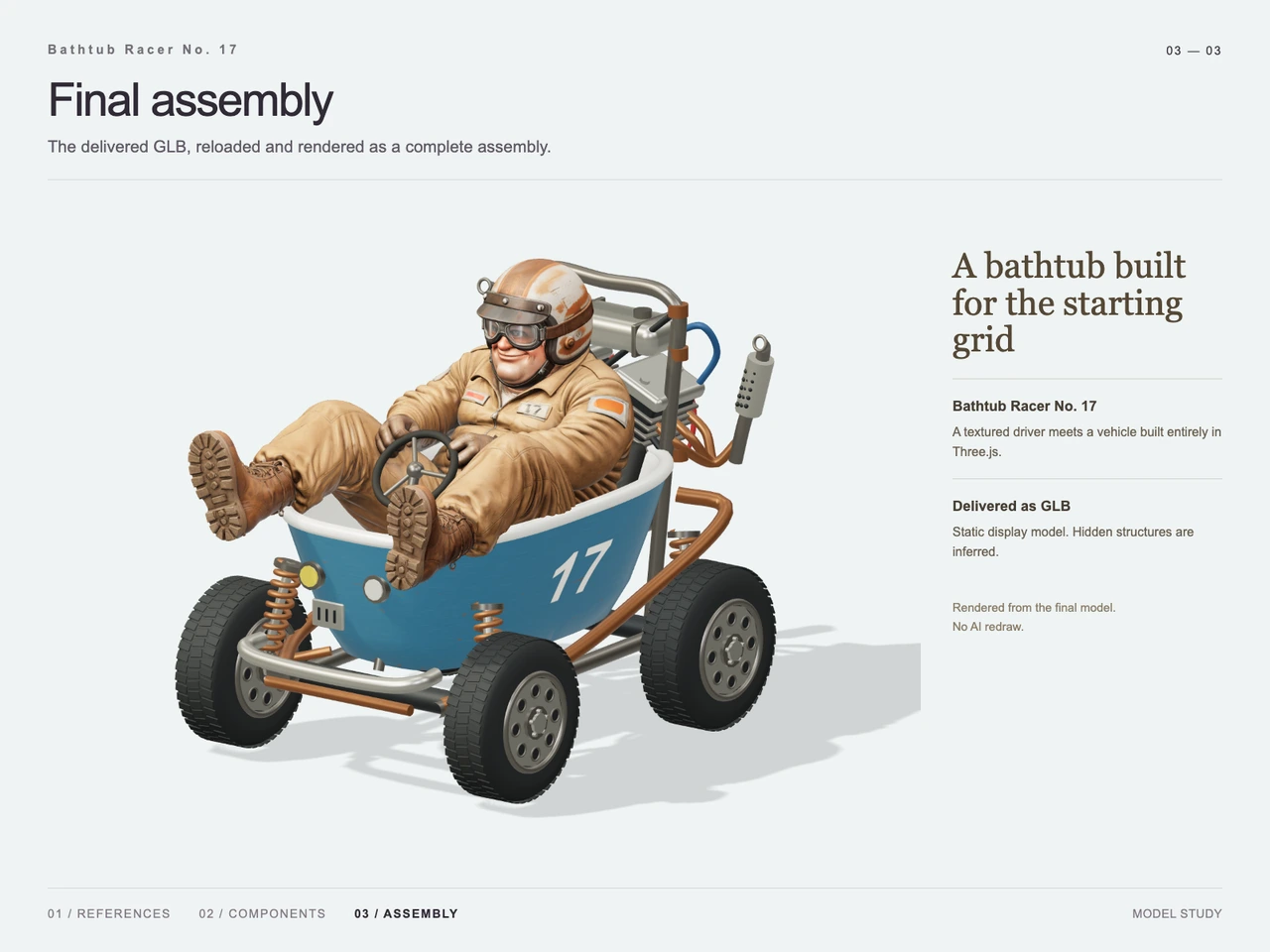
Interactive 3D preview · Build a Bathtub Racer with GPT-6 Astra and V2FunDrag to rotate · Scroll to zoom
Take a Closer Look
-
 01 / Input
Input · Build a Bathtub Racer with GPT-6 Astra and V2Fun
-
 02 / Process
Process · Build a Bathtub Racer with GPT-6 Astra and V2Fun
-
03 / Final
Final · Build a Bathtub Racer with GPT-6 Astra and V2Fun
Overview
Bathtub Racer No. 17 pairs a rounded, confident driver with an improvised racing machine: a blue enamel bathtub, exposed wheels and suspension, tubular frame, and an elevated rear engine. The design challenge is the relationship between them—the reclined torso, raised boots, steering wheel, and tub opening must read together.
The case uses a hybrid modeling approach. The technical notes assign visual analysis, decomposition, and assembly coordination to GPT-6 Astra. The component presentation identifies the seated driver as V2Fun-generated 3D and all four vehicle groups as Three.js procedural work. This division illustrates the broader GPT-6 Astra and V2Fun collaboration workflow.
Tools Used
- GPT-6 Astra: reference interpretation, component planning, and agent-side assembly coordination, as described in the case notes.
- V2Fun: generated character references and the textured seated-driver component.
- Three.js: procedural construction of the bathtub, chassis and steering, wheels and suspension, and rear engine.
- GLB: the supplied final asset format.
Step 1 — Establish the Modeling References
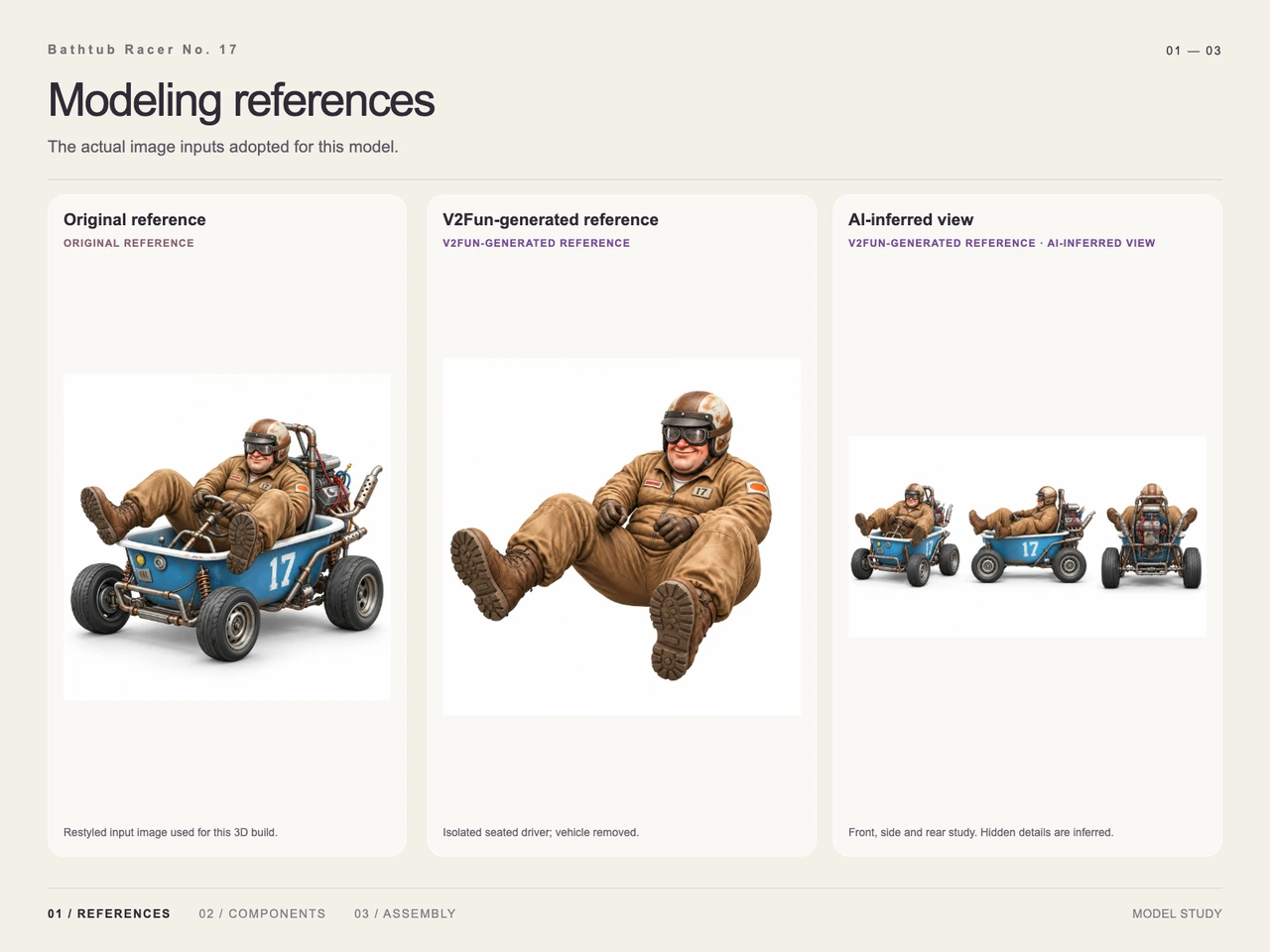
The input board presents a complete racer reference, an isolated driver image with the vehicle removed, and a front, side, and rear study. The complete reference establishes the vehicle silhouette and material palette. The isolated image makes the driver's reclining pose, gloves, helmet, clothing folds, and forward-facing boot soles easier to read.
The additional views are labeled AI-inferred. They provide design guidance for obscured areas, but do not independently verify the back or hidden mechanical structure. The single-image and multi-view input guide provides related guidance on preparing references and handling missing visual information.
Step 2 — Divide the Asset into Five Groups
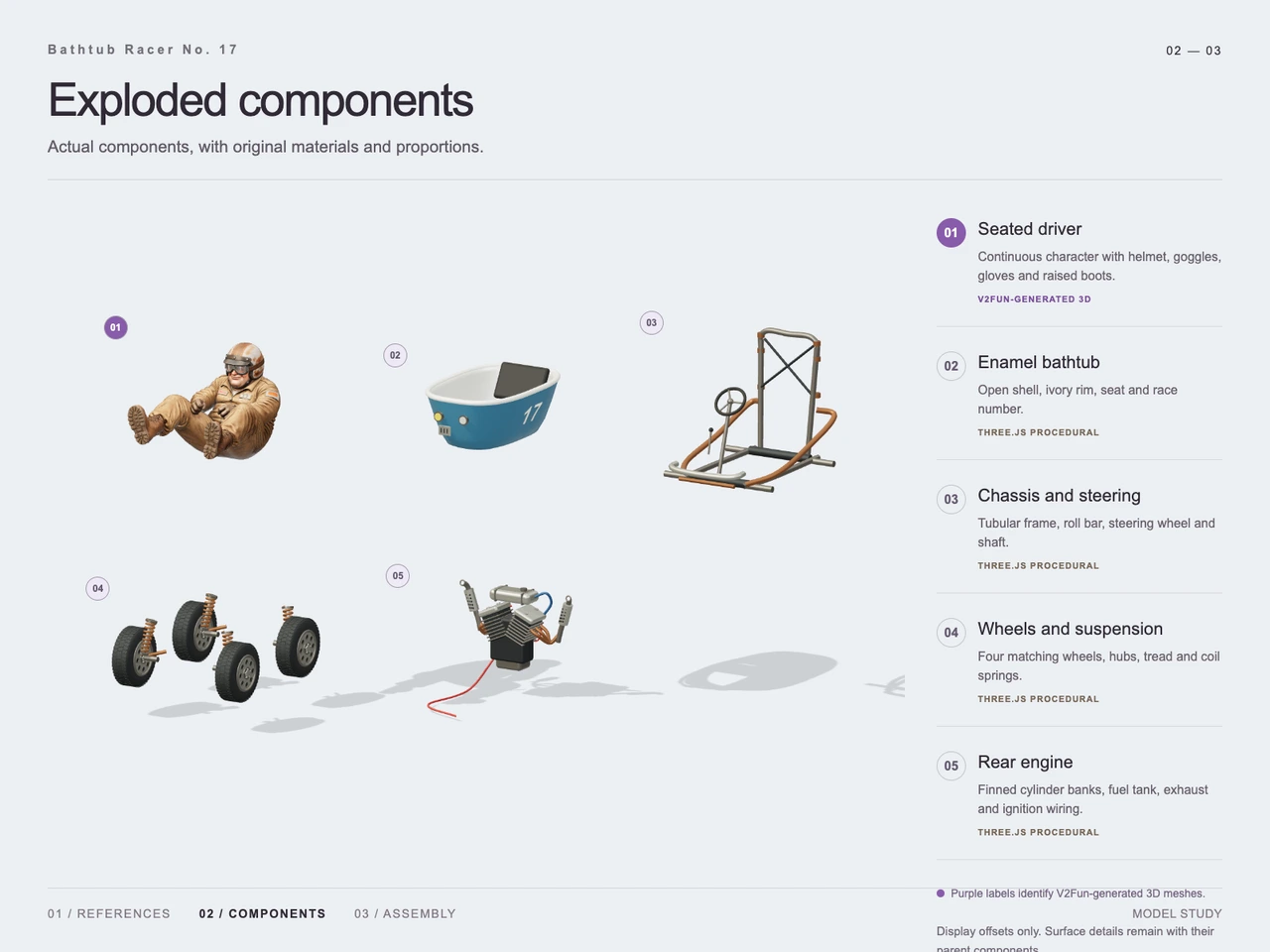
The exploded presentation documents five component groups:
- Seated driver: a continuous character with helmet, goggles, gloves, and raised boots.
- Enamel bathtub: an open blue shell with an ivory rim, seat, and race number.
- Chassis and steering: tubular frame, roll bar, steering wheel, and shaft.
- Wheels and suspension: four matching wheels with hubs, tread, and coil springs.
- Rear engine: finned cylinder banks, fuel tank, exhaust, and ignition wiring.
The spacing in this presentation is for displaying the parts. It does not establish detachable joints or a physical assembly system.
Step 3 — Generate the Driver and Build the Vehicle
V2Fun handles the driver as one character component. The process and final images show the rounded face, tan racing suit, striped helmet, goggles, and detailed boot soles. This is the case's documented use of image-to-3D model generation.
Three.js supplies the vehicle geometry, including the curved bathtub body and mechanical groups. The visible construction uses repeated wheel tread and springs, tubular supports, engine fins, and exhaust shields. The evidence supports this tool split without establishing a separate AI texturing pass or particular PBR map settings.
Step 4 — Assemble and Present the Model
The final view brings the driver into the tub with both boots raised over its front edge and the steering wheel positioned between the hands. The wheels surround the exposed chassis, while the engine and roll frame rise behind the driver.
The final presentation identifies its image as a render of the delivered GLB after reloading. It shows the completed static assembly from a slightly elevated front three-quarter angle. Hidden structures remain inferred.
Workflow
Complete reference → isolated driver and inferred view studies → five component groups → V2Fun driver generation and Three.js vehicle construction → assembly → GLB export → reloaded model presentation.
Prompt
English translation of the design brief; these are requested attributes rather than independently verified technical properties:
Create a rounded adult male racing driver with a confident smile, wearing a cream-and-brown striped vintage helmet, transparent goggles, a tan racing jumpsuit, leather gloves, lace-up work boots, and a small No. 17 chest patch. Recline him inside a blue enamel bathtub converted into a four-wheel racer. Both hands hold a small metal steering wheel, with knees bent high and both boot soles facing forward.
Give the bathtub a white rolled rim, a large white 17 on its blue side, chipped paint, light rust, and scuffs. Include four black rubber tires with recessed silver-gray hubs, exposed tubular chassis, front axle, steering links, copper-orange coil suspension, curved guards, two differently colored round headlights, and a small license plate. Behind the driver, place a high exposed engine with cooling fins, red and blue lines, a tubular roll cage, and a rearward exhaust with a perforated heat shield.
Combine humorous realism with lightly cartooned proportions and a collectible-model appearance. Request clear clothing folds and boot tread, refined PBR metal, leather, and painted surfaces. Show the complete driver and vehicle from a slightly elevated front three-quarter view against a white studio background, with soft lighting and contact shadows. Use a square composition with one standalone asset, no extra scenery, and no watermark.
Result
The final render retains the central visual identity: the smiling helmeted driver, raised boots, blue tub with white rim and No. 17 marking, dark treaded tires, copper-colored suspension, and exposed rear machinery. It demonstrates a static character-and-vehicle assembly; exact reference matching and material-map quality were not measured.
Supplied output metadata: bathtub-racer.glb, 52,156,048 bytes, MIME type model/gltf-binary. The case provides no generation-time or token-use measurements. For subsequent format decisions, see the GLB and other 3D export formats guide.
Frequently Asked Questions
Which bathtub racer component was generated with V2Fun?
The exploded presentation identifies the seated driver as V2Fun-generated 3D, including the helmet, goggles, suit, gloves, and raised boots.
What did Three.js contribute to this model?
The bathtub, chassis and steering, wheels and suspension, and rear engine are labeled as Three.js procedural components. Together they form the vehicle around the generated driver.
Were the front, side, and rear studies verified views of an existing object?
No. The reference board labels them AI-inferred views. They guide the design, while hidden details remain inferred.
Is Bathtub Racer No. 17 an animated vehicle?
The final presentation describes a static display model. The supplied evidence does not document character rigging, wheel animation, working steering, or vehicle simulation.
What file was delivered for the bathtub racer?
The supplied metadata lists bathtub-racer.glb at 52,156,048 bytes with MIME type model/gltf-binary. The final presentation states that the delivered GLB was reloaded and rendered as a complete assembly.
Explore More
-
GPT-6 Astra x V2Fun - From Code Generation to Model Collaboration | V2Fun
See how GPT-6 Astra and V2Fun combine agent reasoning, code generation, and AI 3D foundation models to build complex, structured 3D assets.
View page → -
AI 3D Model Generator Input Guide: Single vs. Multi-View | V2Fun
Learn how to prepare photos, multi-view references, and sketches for an AI 3D Model Generator, then inspect geometry and textures before export.
View page → -
V2Fun - AI 3D Model Generator
Create 3D models from text prompts or images with V2Fun's AI 3D model generator. Generate characters, props, game assets, and 3D-printable models faster.
View page → -
AI 3D Model Generator Export Guide: FBX, GLB, OBJ, or USDZ? | V2Fun
Use an AI 3D Model Generator with the right export format. Compare FBX, GLB, OBJ, and USDZ for Blender, game engines, animation, web, and AR.
View page →