Build an Astronaut Lunar Rover with GPT-6 Astra and V2Fun
See how a seated astronaut and open lunar rover were interpreted as separate organic and mechanical components, generated through a hybrid 3D workflow, calibrated by GPT-6 Astra, and delivered as one GLB asset.
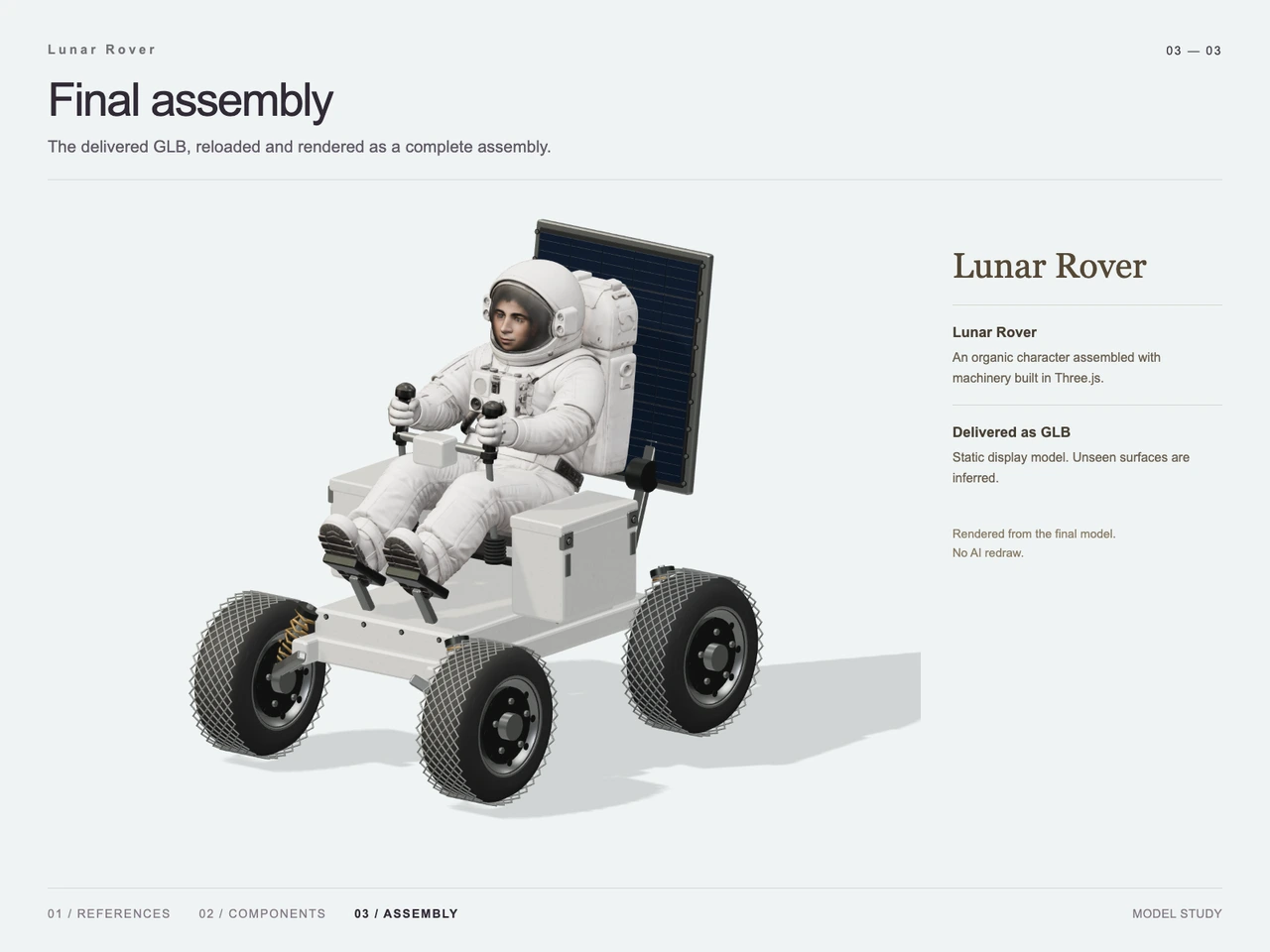
Interactive 3D preview · Build an Astronaut Lunar Rover with GPT-6 Astra and V2FunDrag to rotate · Scroll to zoom
Take a Closer Look
-
 01 / Input
Input · Build an Astronaut Lunar Rover with GPT-6 Astra and V2Fun
-
 02 / Process
Process · Build an Astronaut Lunar Rover with GPT-6 Astra and V2Fun
-
03 / Final
Final · Build an Astronaut Lunar Rover with GPT-6 Astra and V2Fun
Overview
This case explores a hybrid GPT-6 Astra × V2Fun workflow for building a single asset composed of an adult astronaut and an open lunar rover. The reference brief combines organic forms—such as the visible face, padded suit, gloves, and fabric folds—with regular mechanical forms including a rectangular chassis, four mesh-pattern wheels, suspension links, equipment boxes, controls, foot supports, and an upright solar panel.
The evidence shows three stages: concept and character references, an exploded component study, and a rendered final assembly. For broader context on this division of labor, see the GPT-6 Astra × V2Fun model-collaboration workflow.
Tools Used
- GPT-6 Astra: subject hierarchy analysis, component planning, spatial reasoning, and assembly calibration.
- V2Fun: generation of the astronaut character and complex forms or surface details.
- Three.js / procedural construction: regular mechanical components identified in the exploded study, including the structural frame, running gear, body and seat, equipment, controls, and supports.
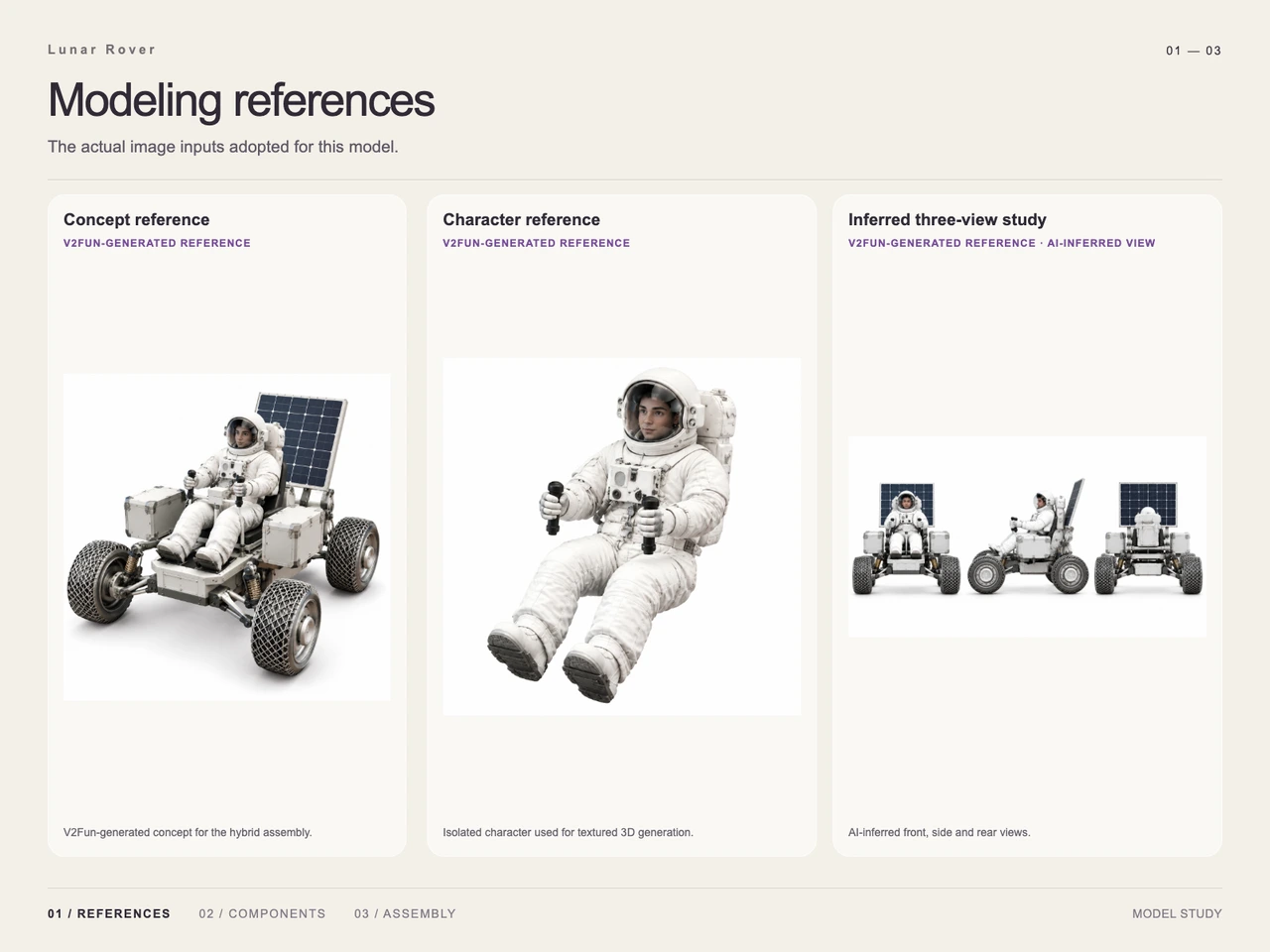
- Visual references: a complete concept image, an isolated character reference, and an AI-inferred front/side/rear study.
- GLB: the supplied final asset format.
Step 1 — Define the Complete Asset
The prompt establishes one centered astronaut–vehicle asset from a slightly elevated front three-quarter view. It specifies the astronaut’s seated pose and contact with the joysticks, seat, and footrests, while also defining the rover’s broad wheel stance, exposed structure, side equipment boxes, and rear solar panel.
Clear framing, limited occlusion, soft lighting, and a simple background make structural relationships easier to read. The single-image and multi-view input guide explains why complete silhouettes and views that reveal additional information are useful when preparing references.
Step 2 — Build Reference Evidence
The modeling sheet separates the complete rover concept from an isolated astronaut reference. It also includes an inferred three-view study showing the front, side, and rear arrangement of the assembled subject. These inferred views supply guidance for hidden structure, but they are interpretations rather than independently photographed evidence.
For projects where several verified angles are available, multi-view 3D modeling provides a directly relevant input route.
Step 3 — Decompose the Subject
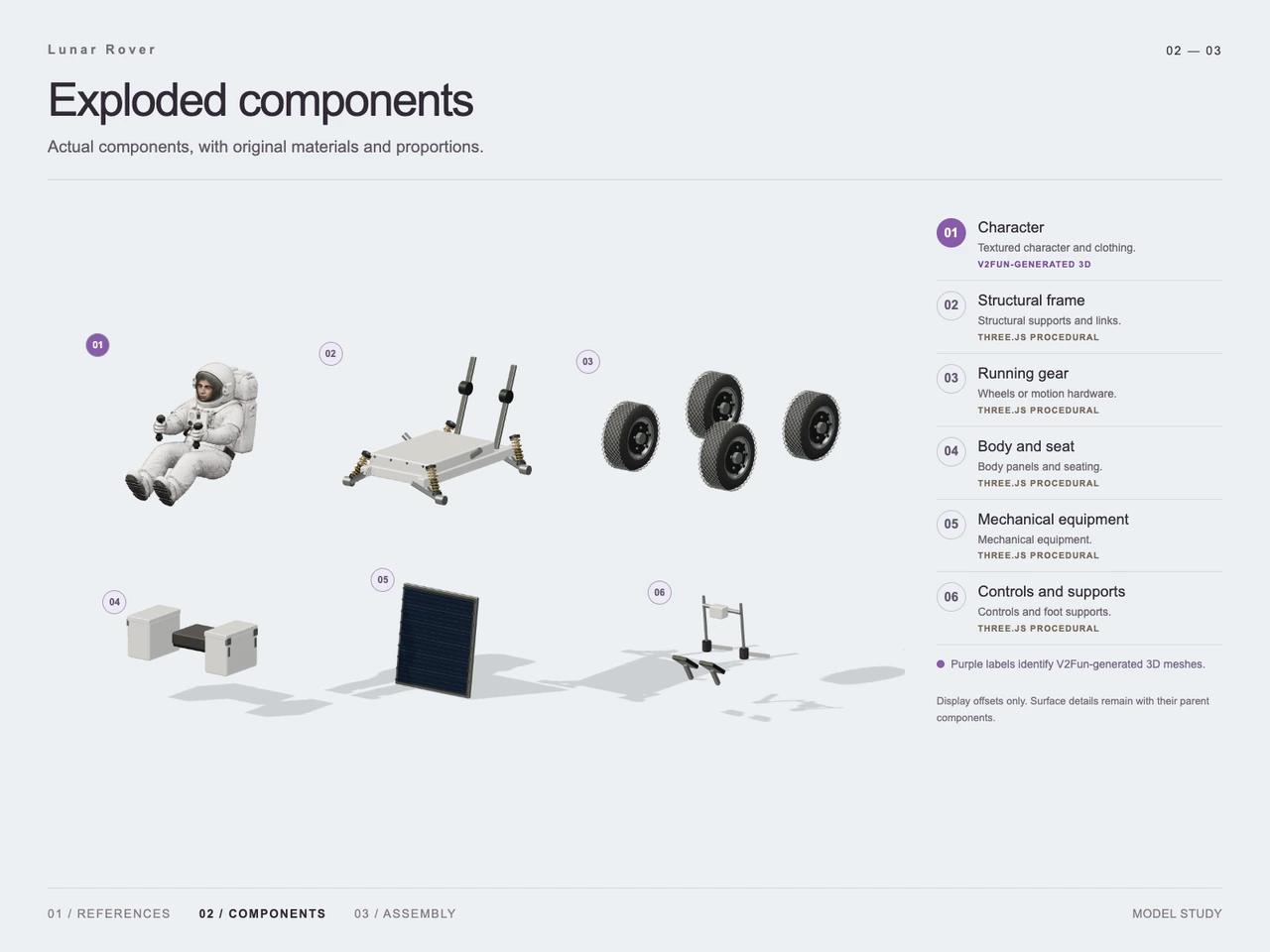
The exploded study organizes the asset into six functional groups: character, structural frame, running gear, body and seat, mechanical equipment, and controls and supports. This decomposition gives the agent explicit relationships to manage, including the astronaut’s scale relative to the seat, the placement of four wheels around the chassis, the rear panel position, and the alignment of hands and feet with the controls.
The sheet identifies the character as V2Fun-generated 3D and labels the remaining displayed groups as Three.js procedural components. These labels describe the demonstrated breakdown without proving hidden mesh construction details.
Step 4 — Generate and Construct Components
V2Fun handles the astronaut, where the face, helmet, padded clothing, gloves, boots, and soft folds require more irregular surface description. Regular rover elements can be constructed procedurally from plates, boxes, rods, cylinders, discs, and repeated wheel structures. This division lets the agent focus on hierarchy and placement instead of describing every complex surface through low-level geometry code.
Step 5 — Calibrate the Assembly
GPT-6 Astra brings the component groups back together and calibrates their relative scale, rotation, position, and contact points. The final render shows the astronaut seated between two equipment boxes, both hands aligned to upright controls, boots resting above paired foot supports, four wheels positioned around the chassis, and a dark-blue solar panel rising behind the seat.
The completed image also preserves the intended contrast between soft white suit forms and harder mechanical geometry. It demonstrates a coherent visual assembly, but it does not establish topology quality, physical dimensions, rigging, printability, or runtime performance.
Workflow
Prompt → Concept reference → Character isolation → Inferred three-view study → Component decomposition → V2Fun generation and procedural construction → Agent-side calibration → GLB assembly
Prompt
An adult astronaut in a thick white spacesuit, with a visible face inside a transparent helmet, sits on an open lunar rover and holds two control sticks. The vehicle has a rectangular chassis, four wide metal-mesh-style wheels, visible independent suspension links, two rectangular side equipment boxes, and an upright rear solar panel with orderly dark-blue cells. Contrast the suit’s soft folds with clear mechanical geometry. Preserve the contact points between the astronaut, seat, controls, and footrests. Present the complete standalone asset from a slightly elevated front three-quarter view, centered with margin on a white background under soft studio lighting and contact shadows. Keep every component in focus, use refined PBR-style materials, and exclude text, numbers, logos, watermarks, complex scenery, and motion blur. Produce one finished reference image rather than a collage or exploded view.
Result
The delivered file is 84-v2-final.glb, a 47,776,684-byte (approximately 45.56 MB) binary glTF asset. The supplied render presents the astronaut and rover as one complete static assembly with the major character–vehicle relationships visible.
GLB is appropriate for packaging a compact glTF scene, although downstream users should still inspect the actual imported asset and required data. See the FBX, GLB, OBJ, and USDZ export guide for format-selection and handoff considerations.
Frequently Asked Questions
What was the main challenge in this astronaut lunar-rover case?
The asset combines an organic seated character with regular mechanical structures. The workflow therefore had to preserve both the astronaut’s facial and clothing detail and the spatial contacts among the hands, joysticks, seat, boots, foot supports, chassis, wheels, and solar panel.
Which component was generated with V2Fun?
The exploded study explicitly labels the astronaut character as V2Fun-generated 3D. The structural frame, running gear, body and seat, mechanical equipment, and controls and supports are labeled as Three.js procedural components.
How did GPT-6 Astra contribute to the workflow?
The technical copy attributes subject hierarchy analysis and component planning to GPT-6 Astra, followed by agent-side calibration of component scale, rotation, position, and assembly relationships.
Were multiple reference views used?
The evidence includes a complete concept reference, an isolated character reference, and an AI-inferred front/side/rear study. Because the three-view study is inferred, it should be treated as modeling guidance rather than verified photography of every side.
What was delivered?
The supplied output is 84-v2-final.glb, a model/gltf-binary file containing 47,776,684 bytes, or approximately 45.56 MB.
Is the lunar-rover model proven ready for animation, games, or 3D printing?
No. The images demonstrate a coherent static visual assembly, but the row does not prove rigging, topology or UV quality, polygon count, physical scale, engine performance, or printability. Those properties require downstream inspection and validation.
Explore More
-
GPT-6 Astra x V2Fun - From Code Generation to Model Collaboration | V2Fun
See how GPT-6 Astra and V2Fun combine agent reasoning, code generation, and AI 3D foundation models to build complex, structured 3D assets.
View page → -
AI 3D Model Generator Input Guide: Single vs. Multi-View | V2Fun
Learn how to prepare photos, multi-view references, and sketches for an AI 3D Model Generator, then inspect geometry and textures before export.
View page → -
V2Fun - Multi-View to 3D Model AI
Generate accurate 3D models from multiple reference images with V2Fun's multi-view to 3D model AI. Create structured assets with better shape consistency and detail.
View page → -
AI 3D Model Generator Export Guide: FBX, GLB, OBJ, or USDZ? | V2Fun
Use an AI 3D Model Generator with the right export format. Compare FBX, GLB, OBJ, and USDZ for Blender, game engines, animation, web, and AR.
View page →